

Station Wagon Living
By Todd Duhnke
Many of us of a certain age clearly remember being hauled around by our parents in the back of a station wagon. It was mom’s vehicle of choice to take us to school, shopping, the doctor, et al. It was dad’s vehicle of choice to take us on vacation with all the gear. In our case it was initially with our ’55 Country Squire and later a new ’64 Mercury Colony Park wagon.
The “way, way back” aft facing third row was the cherished spot. Unless you were prone to car sickness, which occasionally my younger brother suffered from. It was just enough isolation from the parents up front, and the view out the back couldn’t be beat. (“I wonder what all those signs say?”—Brian Regan)
As families grew, station wagons became hugely popular from the early 1950’s all the way through the 1970s. In fact, in 1950, station wagons captured only a 4% share-of-market of all passenger cars. By 1956 station wagons enjoyed 11% and kept growing. And Ford typically outsold them all. They claimed to be, “The Wagonmasters” in much of their advertising.
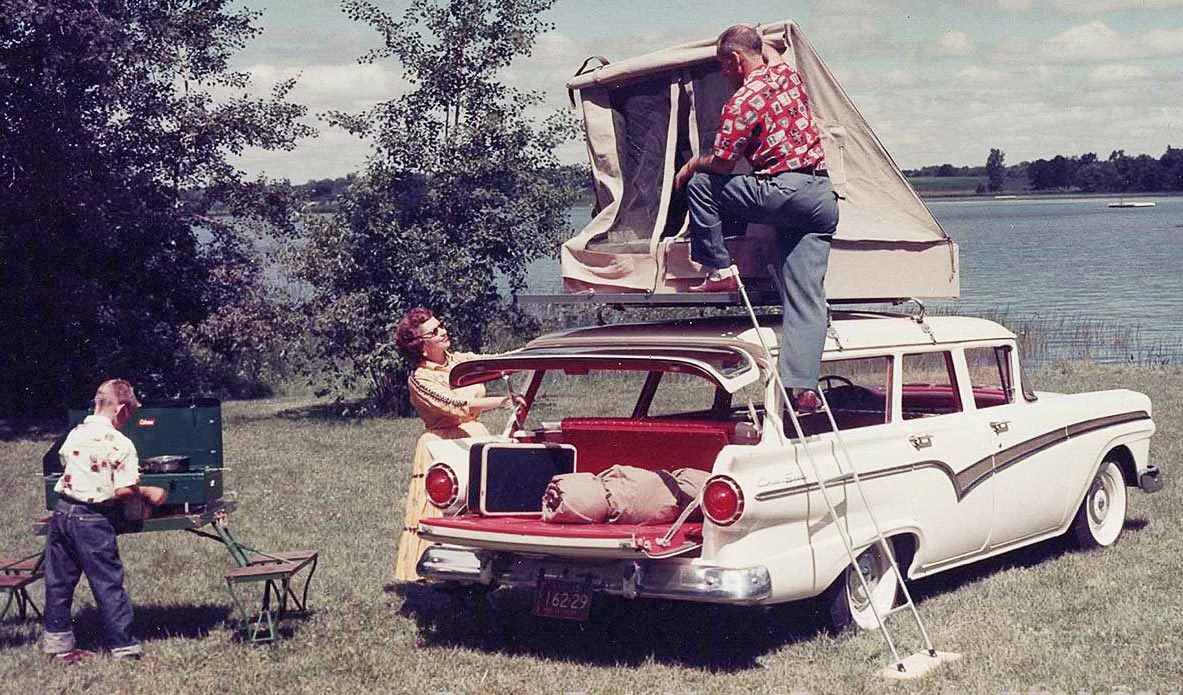
In the 1950s Ford used the station wagon to promote outdoor living, which included activities such as camping, fishing, horseback riding, canoing, gardening and hunting. They called the program, “Station Wagon Living.” Ford’s photographers went to great lengths to photograph new Ford wagons being used in these endeavors. They wanted to show that a new Ford wagon was more than just a shopping and dropping off the kids’ kind of vehicle. Perhaps the genesis of this program goes way back to Henry Ford’s time. It’s well known that Henry Ford, Harvey Firestone, and Thomas Edison frequently enjoyed getting outdoors and going camping. They called themselves “The Vagabonds.”
Photos courtesy of Ford Motor Company.
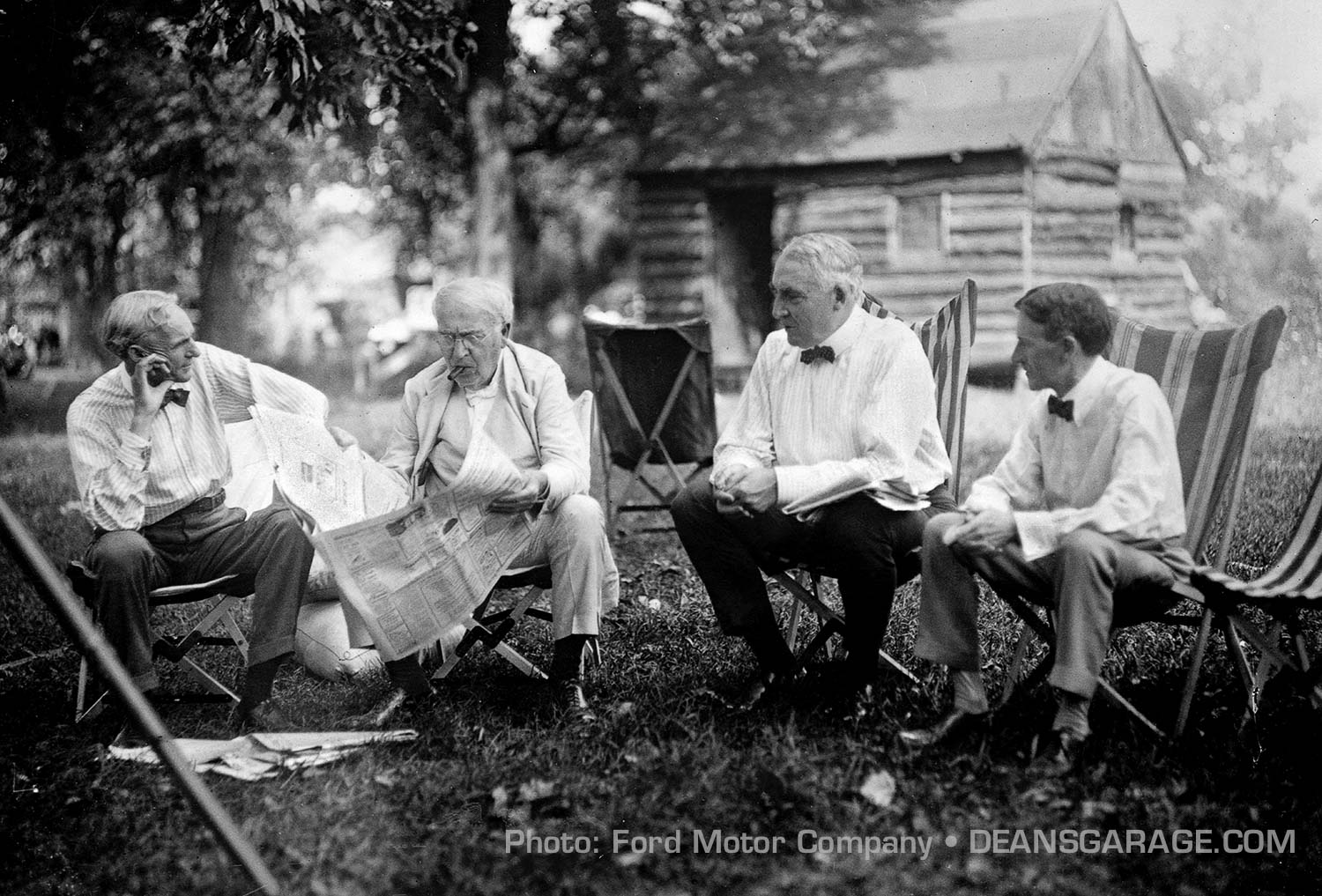
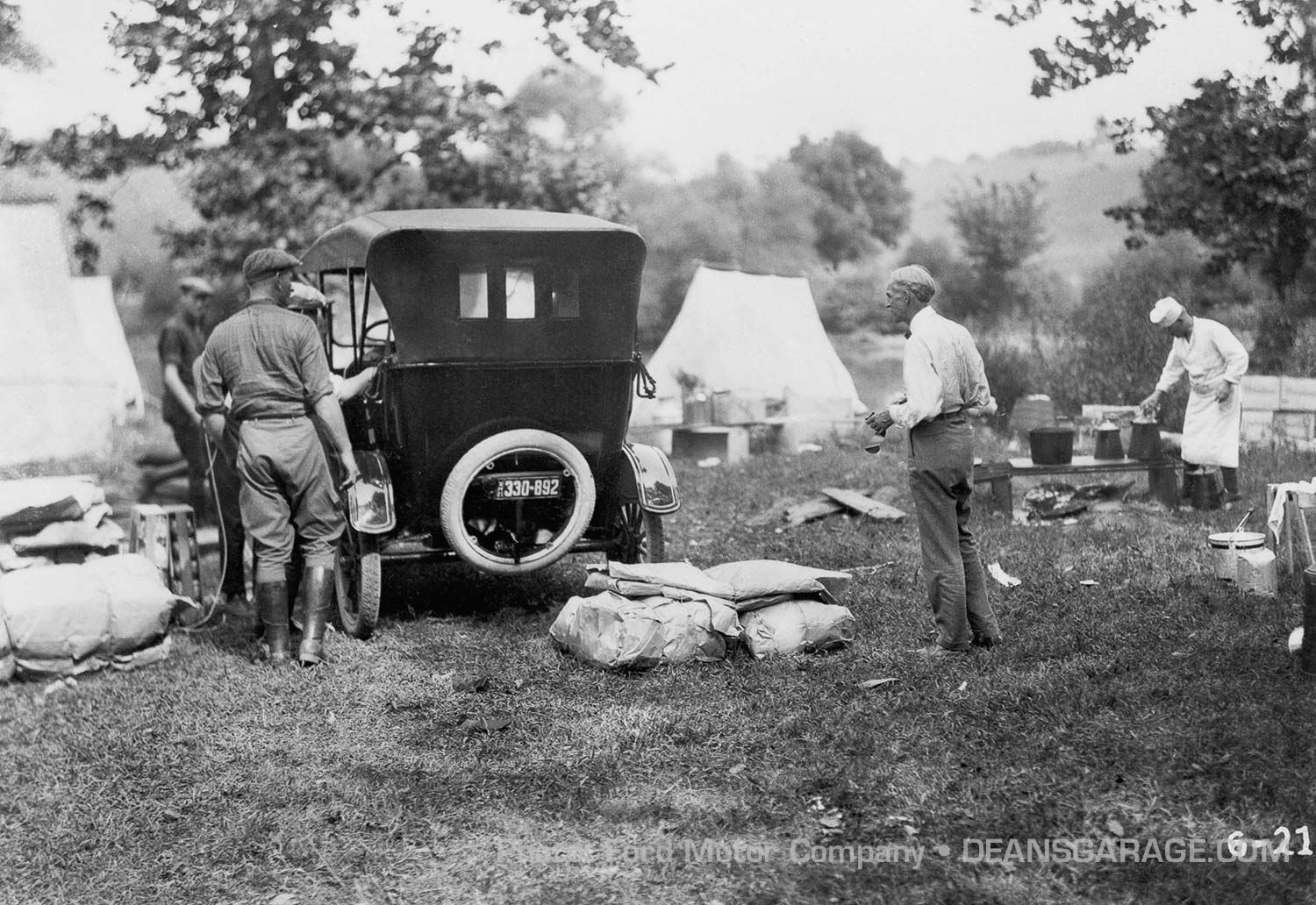
“The Vagabonds” in June,1921.
It also could have been spurred along in 1951 when two editors of the Ford Times magazine had dinner with R. Buckminster Fuller of geodesic dome fame. Fuller mentioned that he was having students at Massachusetts Institute of Technology create new lightweight and foldable designs in camping gear.
Ford took this to the next step and hired an engineering firm to develop camping items that could fit within or on top of a station wagon. Soon companies who manufactured tents, lights, stoves, and folding furniture submitted samples to the engineering firm for analysis.
Ford Times reported these developments in the magazine and soon many letters and pictures rolled in from customers who had modified their Country Squires, Ranch Wagons, and Country Sedans for just this kind of camping experience. Or as Ford Times called them, “rolling recreation centers.”
In 1957 Ford even produced a 256-page book, Ford Treasury of Station Wagon Living which was published by Simon and Schuster. Ford stated that it is, “A guide to outdoor recreation with a directory of over 1,300 campgrounds and field test reports on over 140 items of camp gear.”
This thorough guide to camping included sections on where to go, packing and loading, tent and wagon sleeping, what to buy, boats for your wagon, taking the children along, cooking gear, what gadgets to bring, beach equipment, and lastly a section devoted to hunters and fishermen. There was also a guide to over 1300 campgrounds within 35 states, with maps included. It was quite a thorough guide with many pictures, especially of ’56 and ’57 Ford wagons.
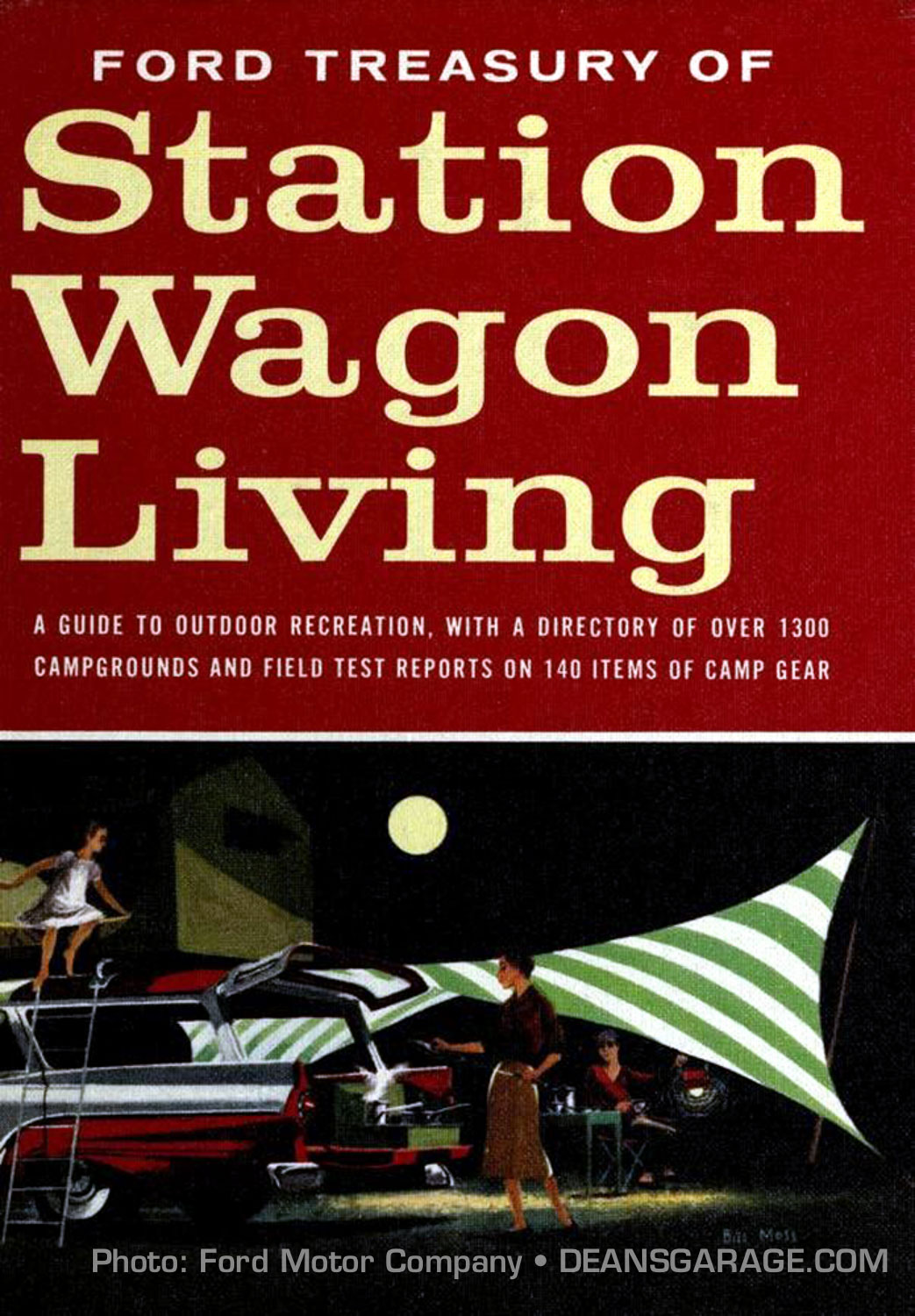
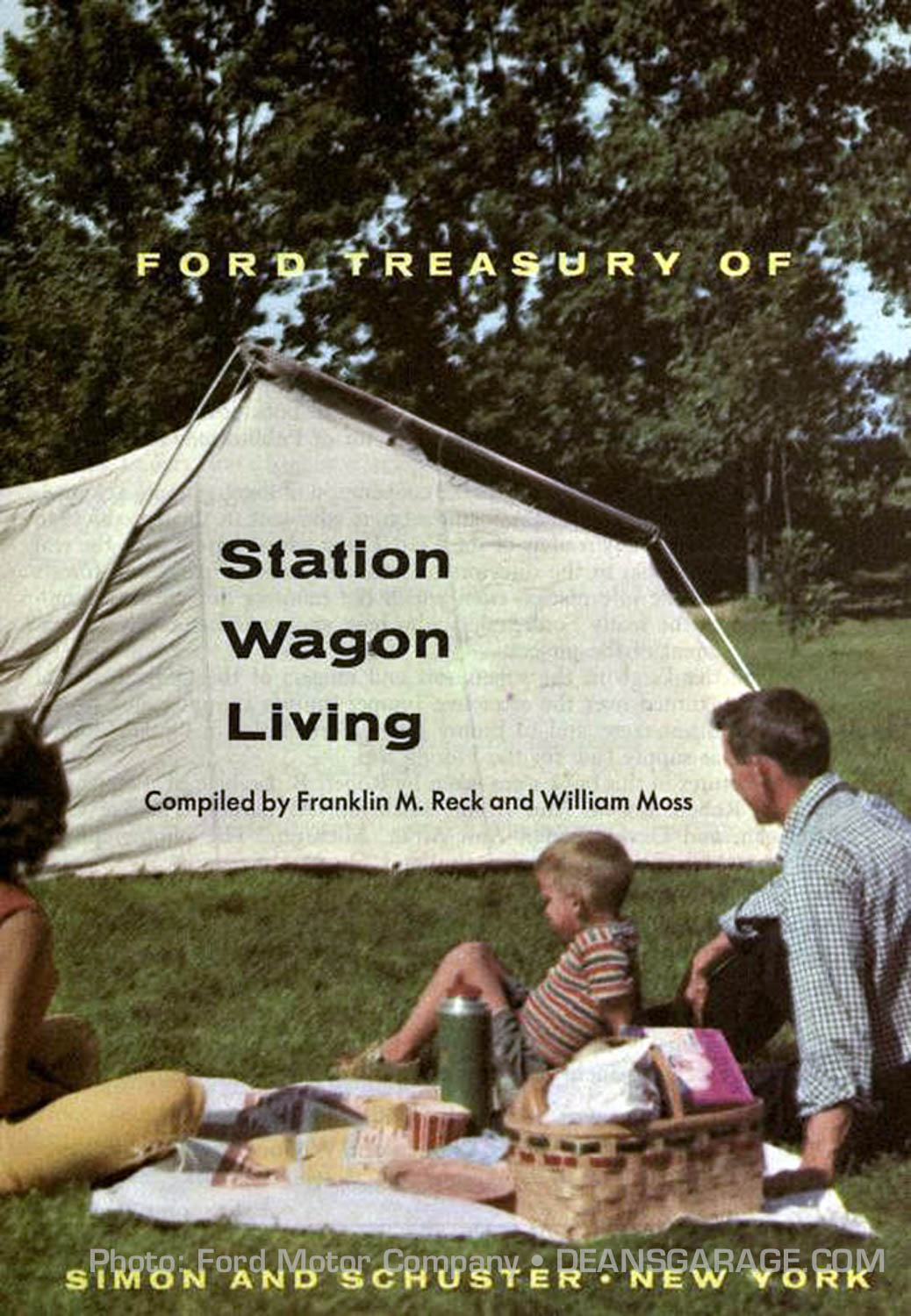
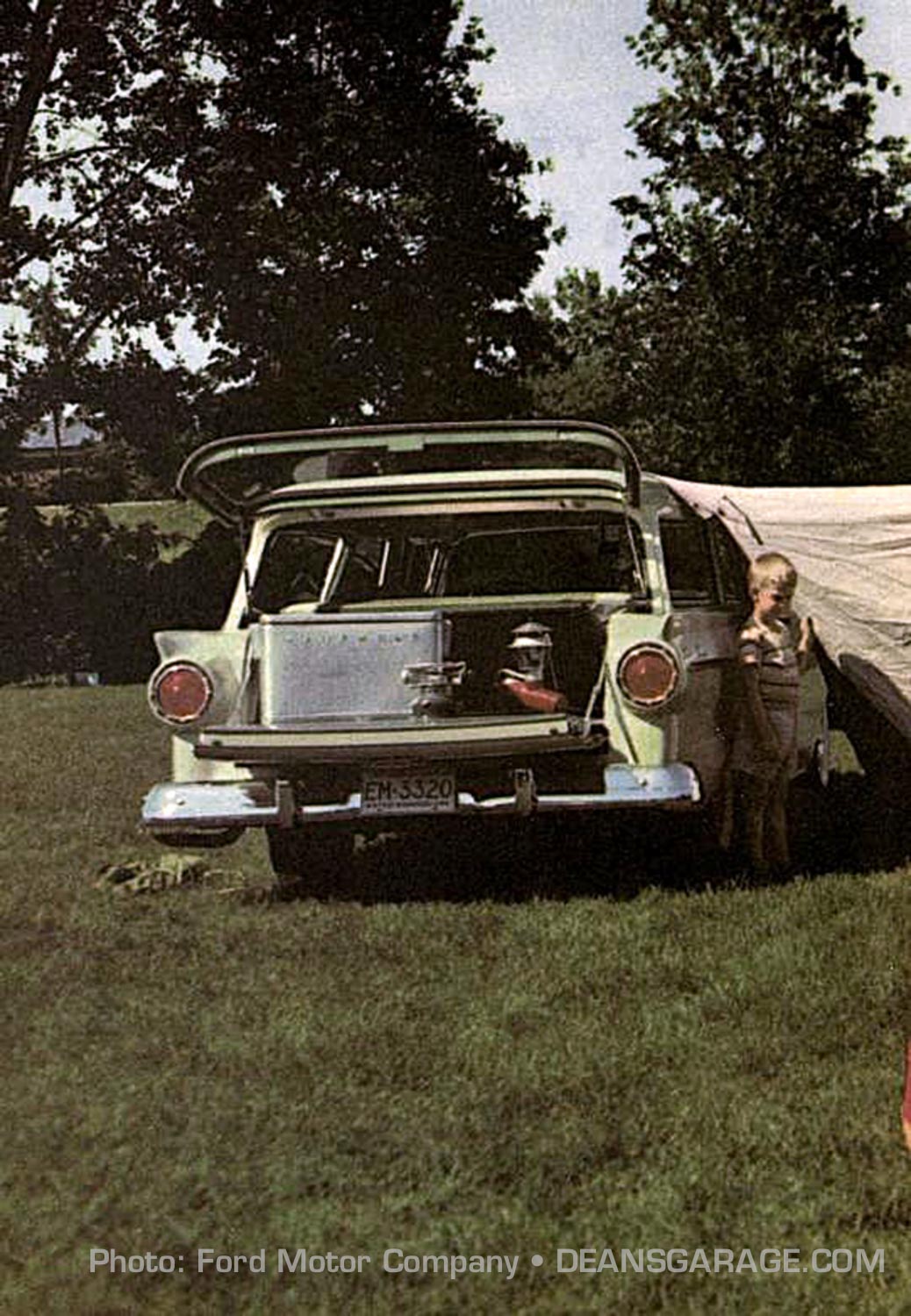
Cover, header page, and inside cover of Ford Treasury of Station Wagon Living.
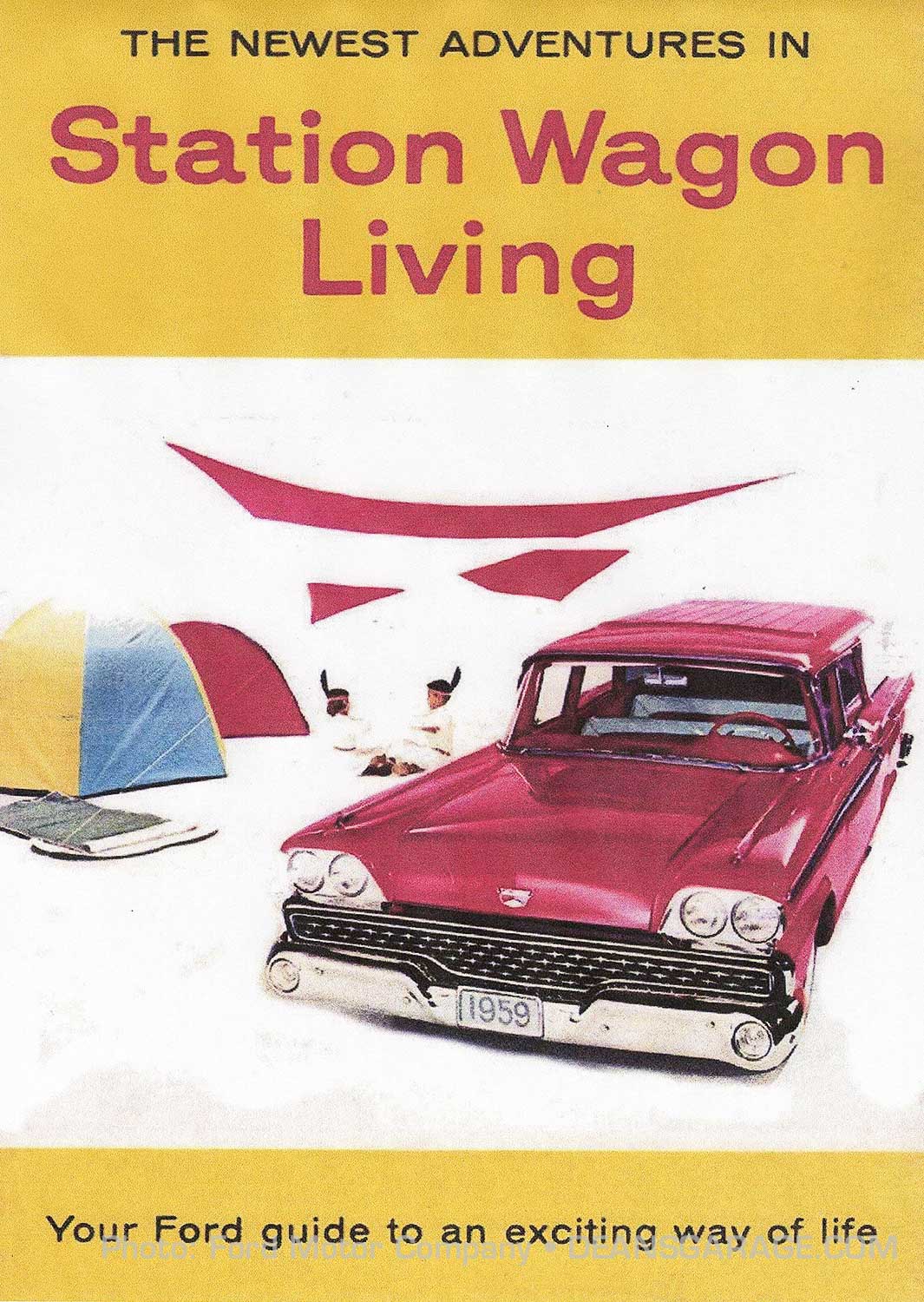
Ford refreshed Station Wagon Living in 1958 and again in 1959 with new titles, but much of the same content. Of course, it had all new pictures of ‘58 and ‘59 Fords! Early examples of content marketing.
From 1957 through 1960 Ford placed in affluent shopping centers their traveling American Road Show highlighted Station Wagon Living, Design for Suburban Living, and Design for Country Living. In 1960 alone the show visited 71 shopping centers in 59 cities coast to coast in just under five months. Over the course of these four years total adult attendance was estimated at 4,500,000 adults, 97% of which owned at least one car.
The program, which likely led to the sale of many Ford wagons over the course of the 1950s, seemed to fade away in the early sixties. Perhaps because of the addition of many manufactures of small, lightweight, pop-up campers. It became easier to sleep in one of those instead of in the back or on top of a wagon. The RV business exploded in the early sixties and now any style of car could pull a camper.
I have in my archives many pictures taken by Ford depicting Station Wagon Living. These 8x10s were printed off the original negative. In chronological order let’s review this rather nostalgic look back.
Looking back at these pictures it’s perhaps easy to see why station wagons of all makes have become very popular over the last decade or so in collector car circles. The flood of memories they bring, and nostalgia is inescapable
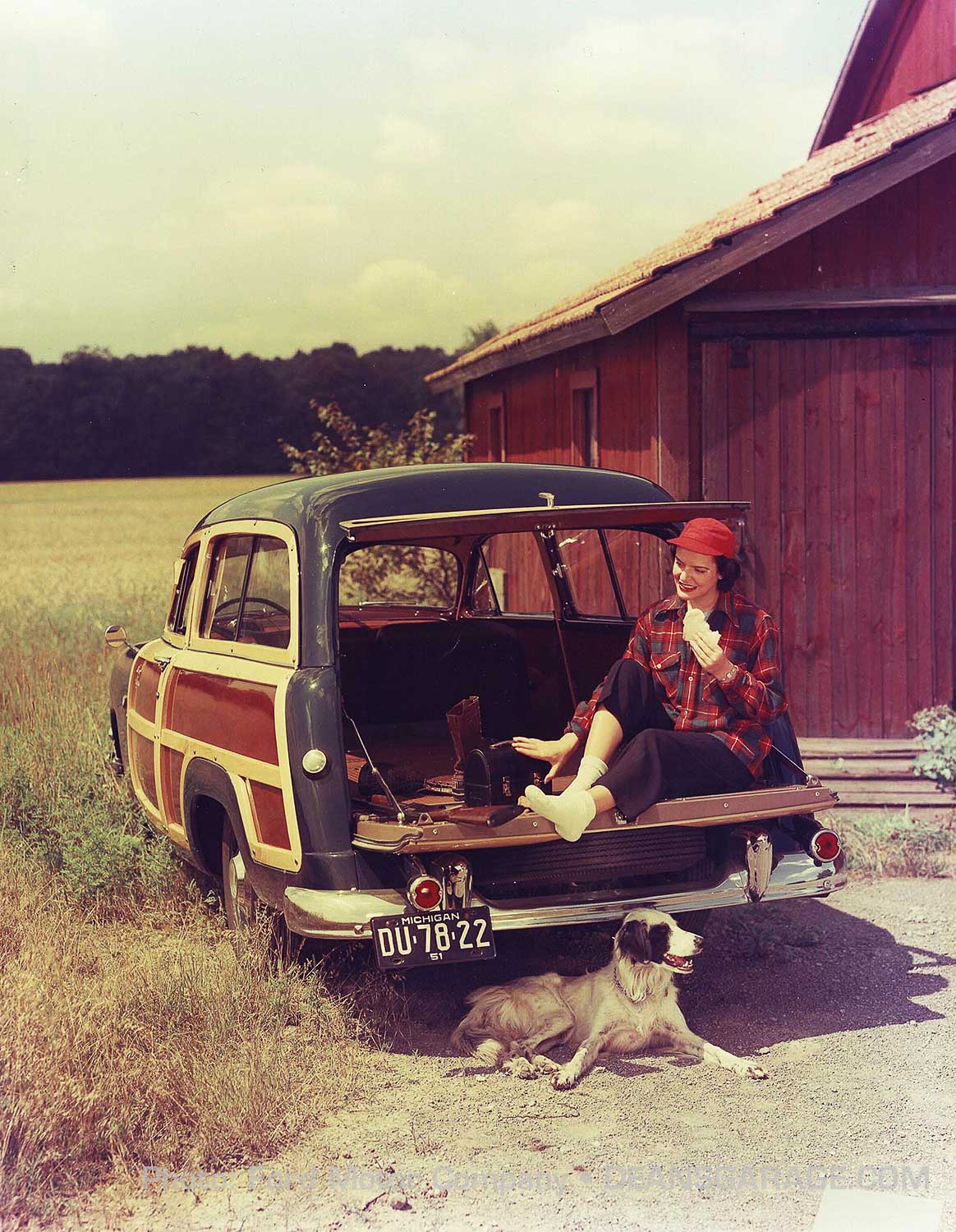
This lass is enjoying a lunch break from hunting in the back of her ’51 Country Squire.
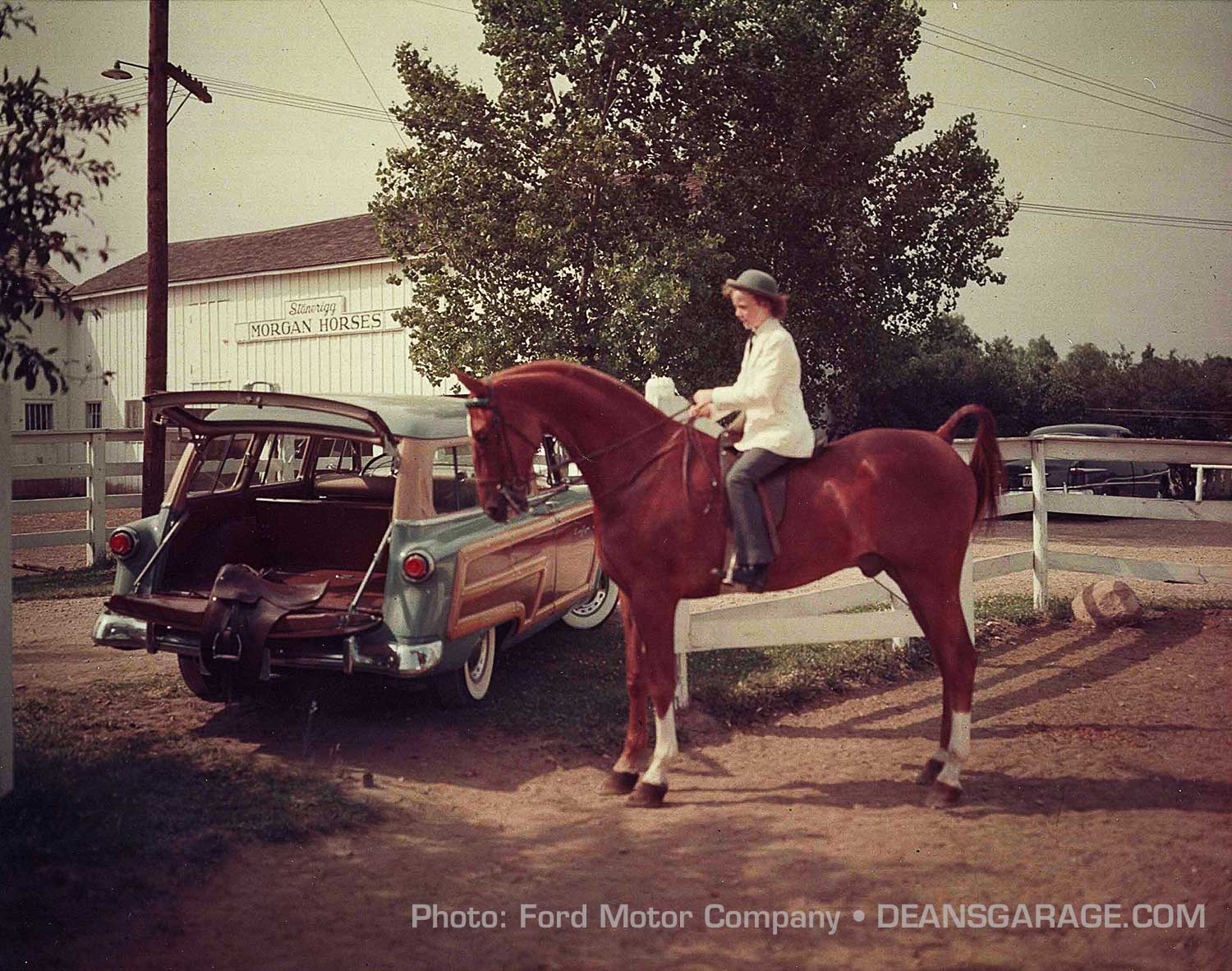
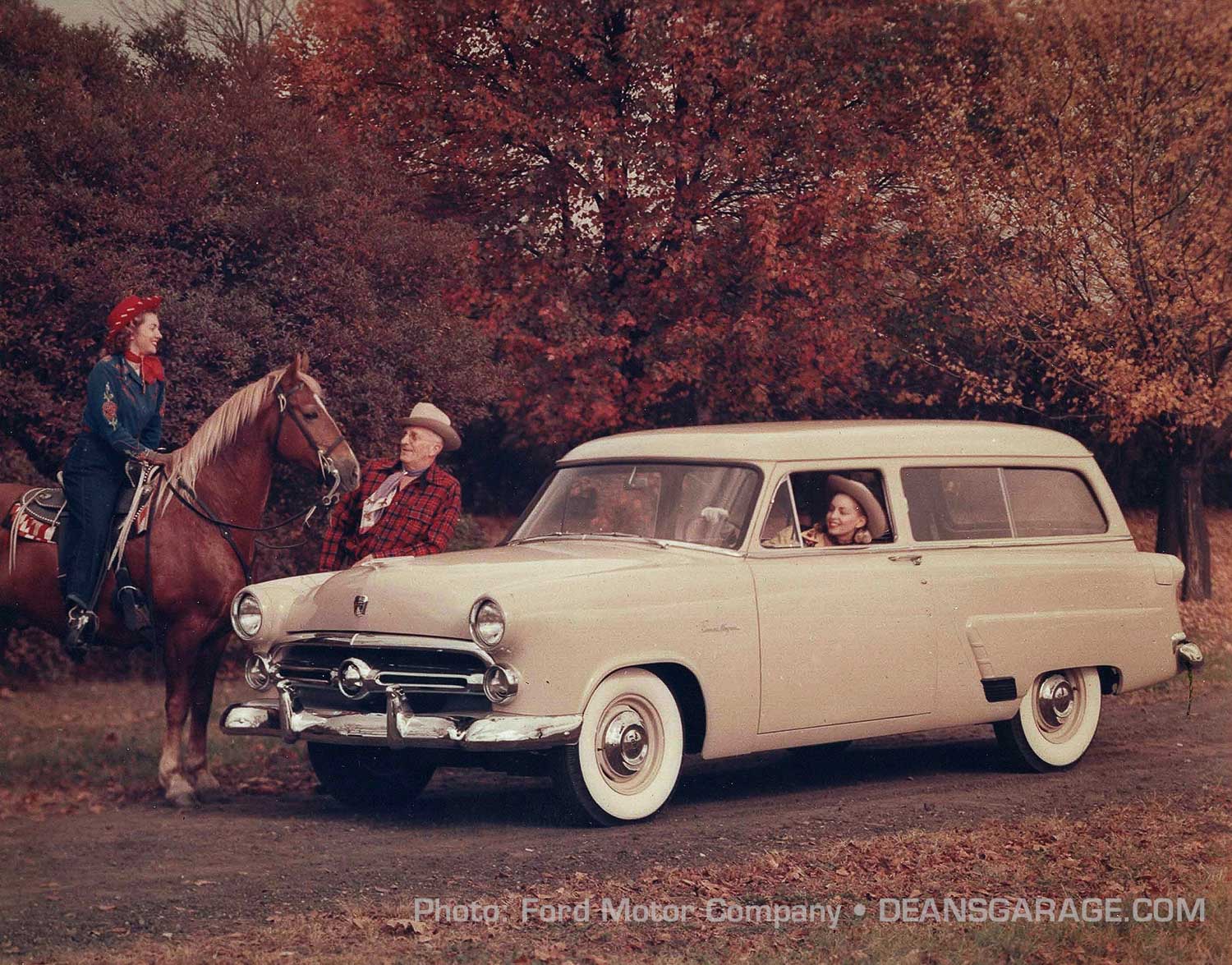
1952 Country Squire and Ranch Wagons. The first photo included a beautiful Morgan Horse!
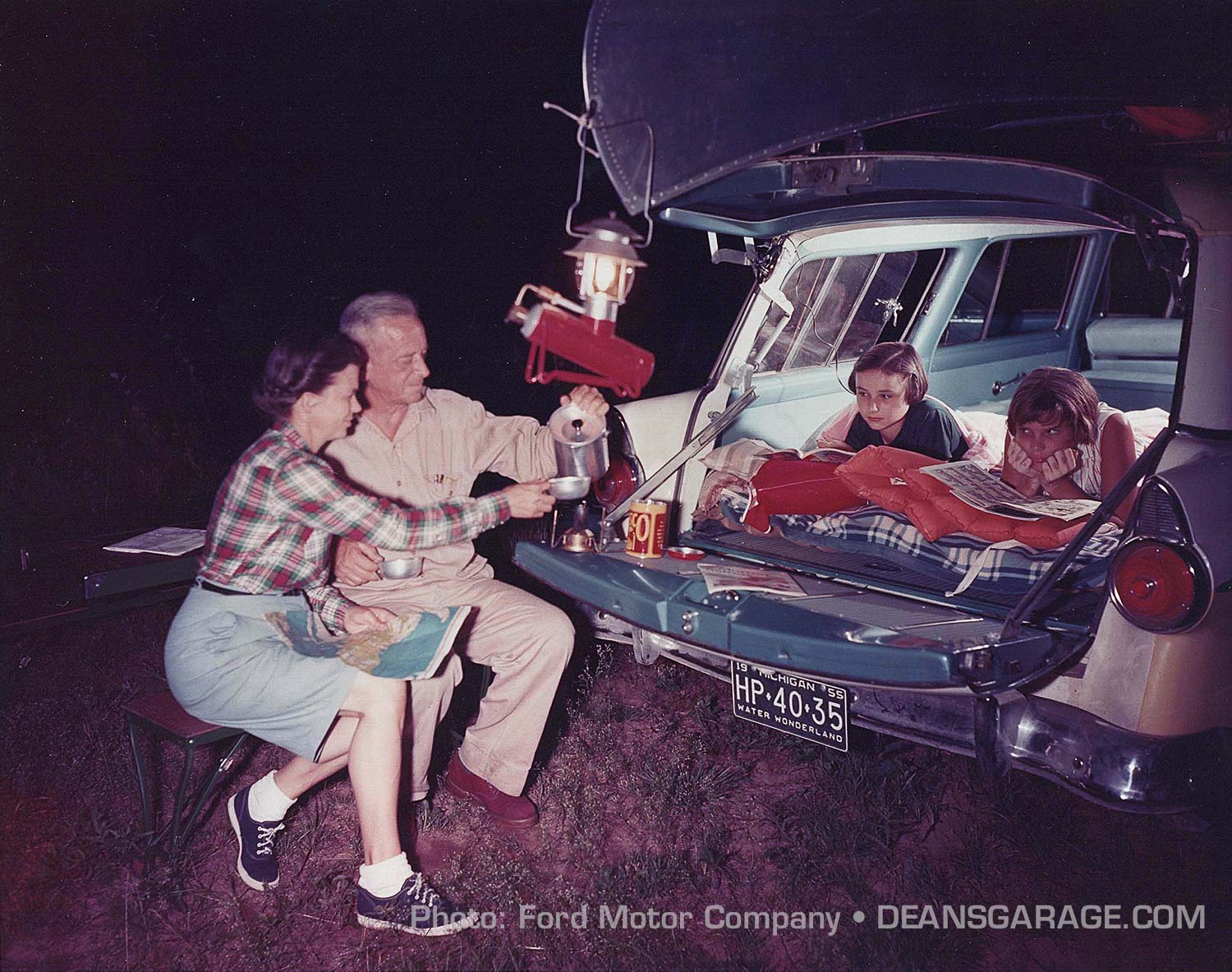
1955 Country Sedan. Note the canoe on top. Looks like the oldest daughter may not be digging camping.
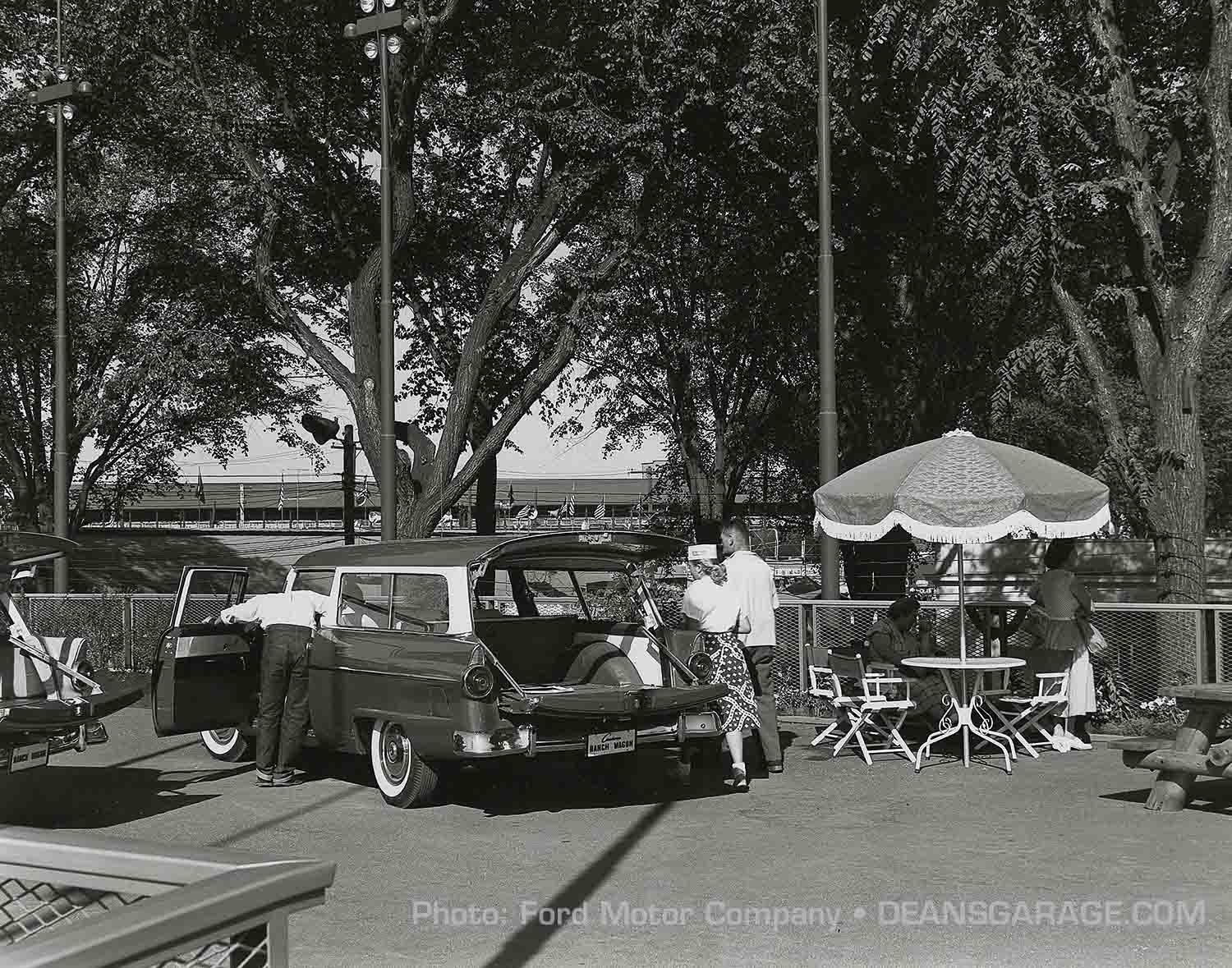
1955 Ranch Wagon at the Michigan State Fair where they displayed camping and folding furniture.
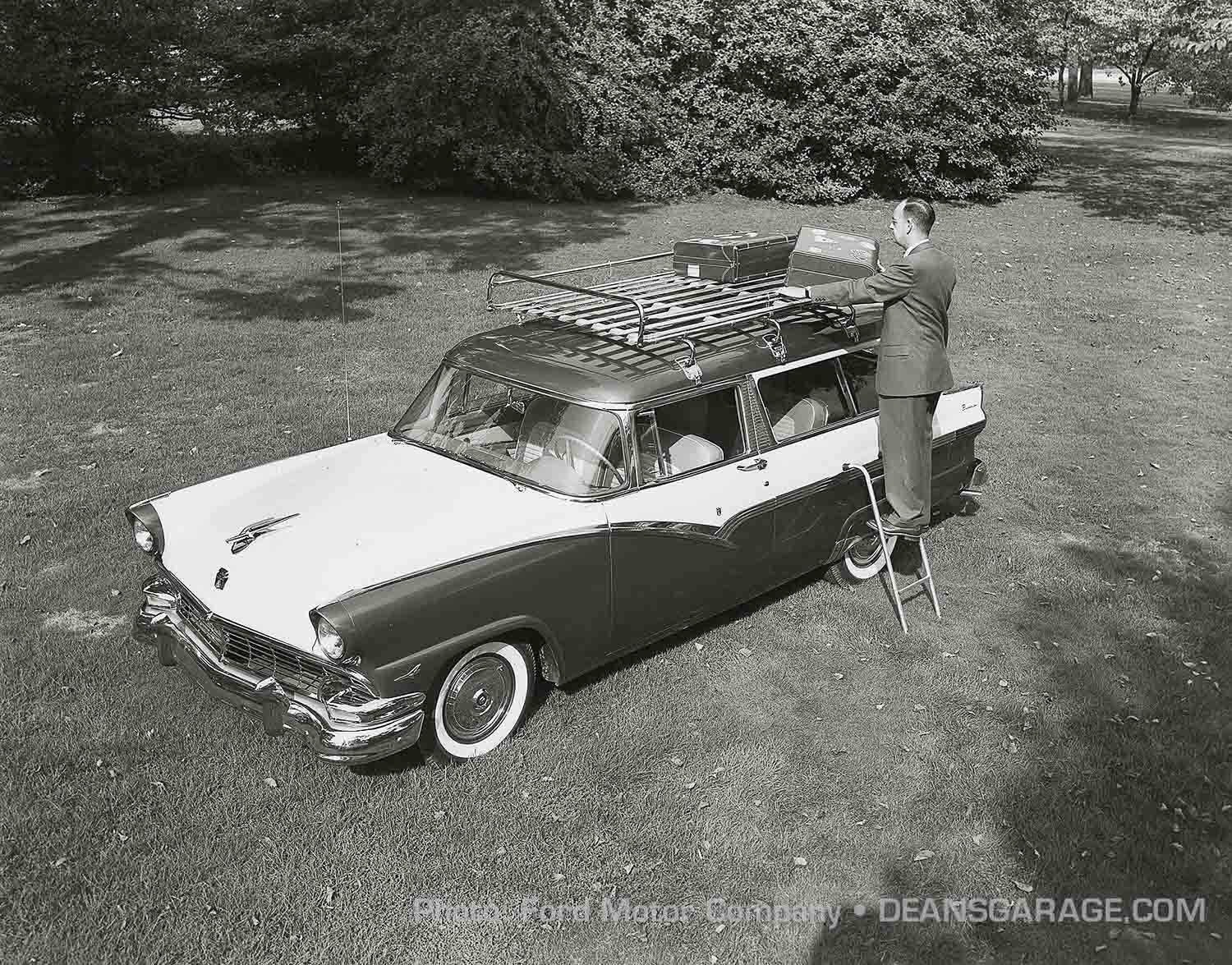
1956 Parklane with a huge roof rack ready for a long vacation. The Parklane was basically a two door Ranch Wagon dressed up in Fairlane trim with “B” pillar chrome to mimic and compete with the unique Chevrolet Nomad. Few were fooled.
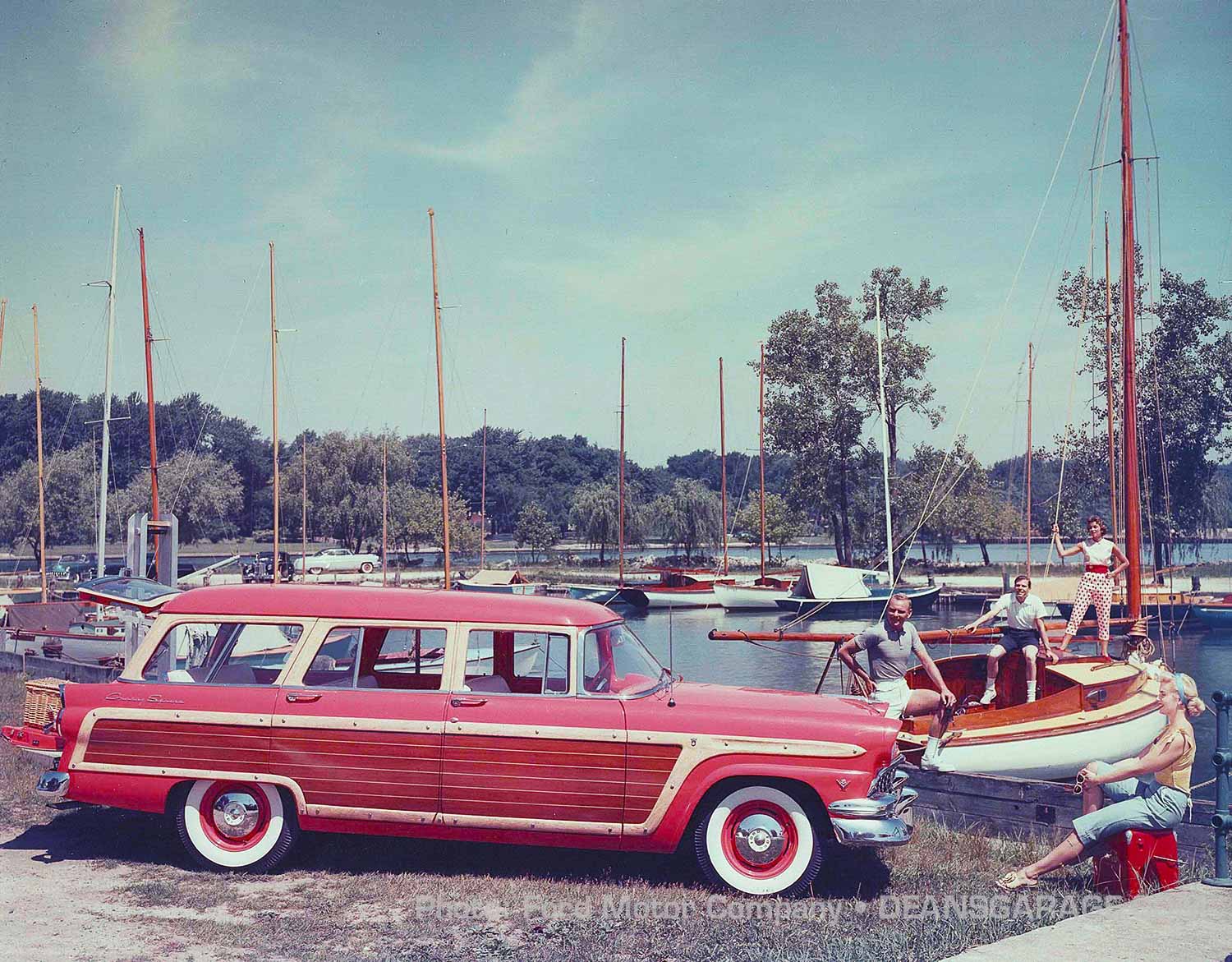
The owners of this 1956 Country Squire are ready for a picnic on a sailboat.
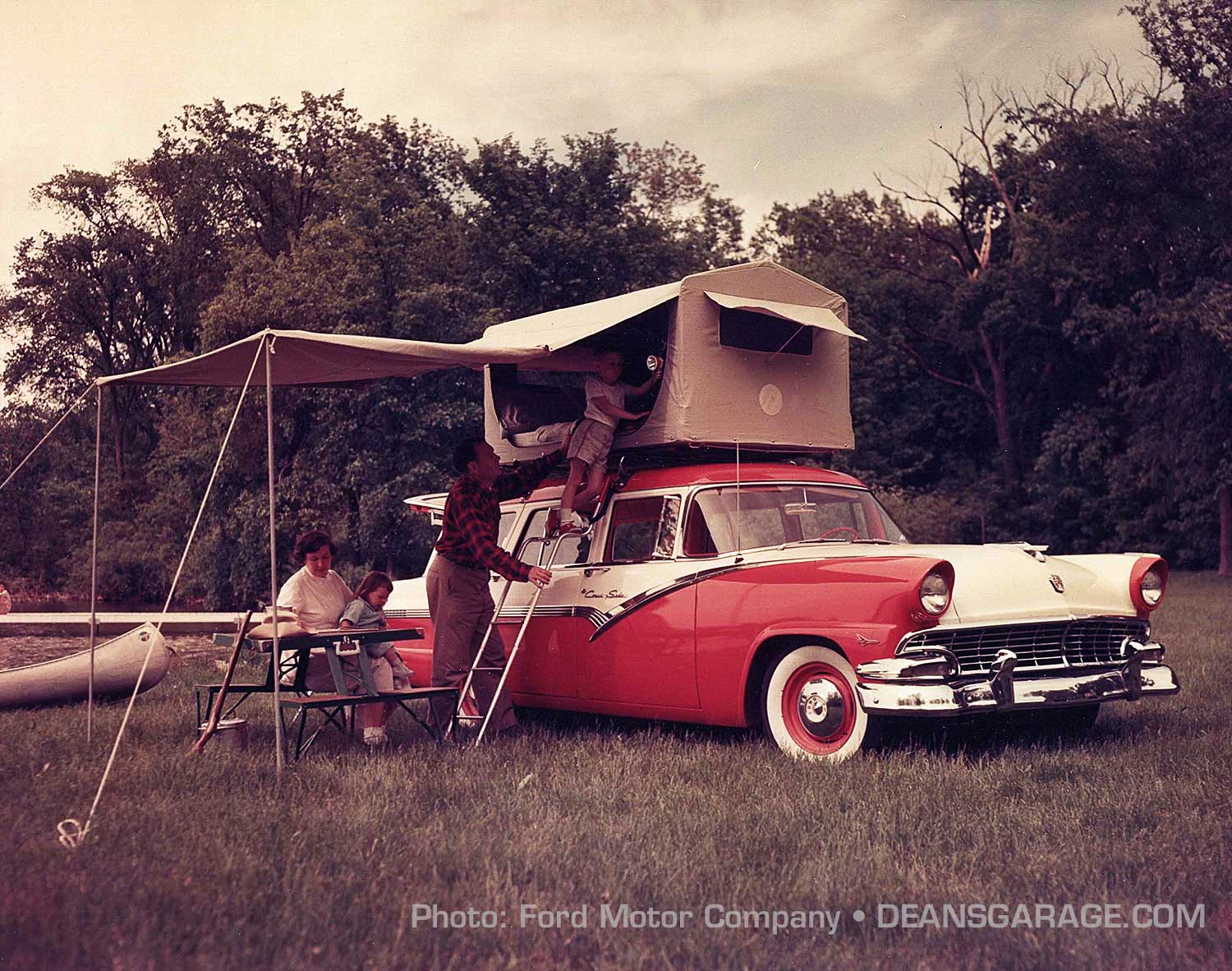
1956 Country Sedan with “upper deck” sleeping accommodations. Hopefully no one had to go to the bathroom in the middle of the night! Note the Grumman canoe.
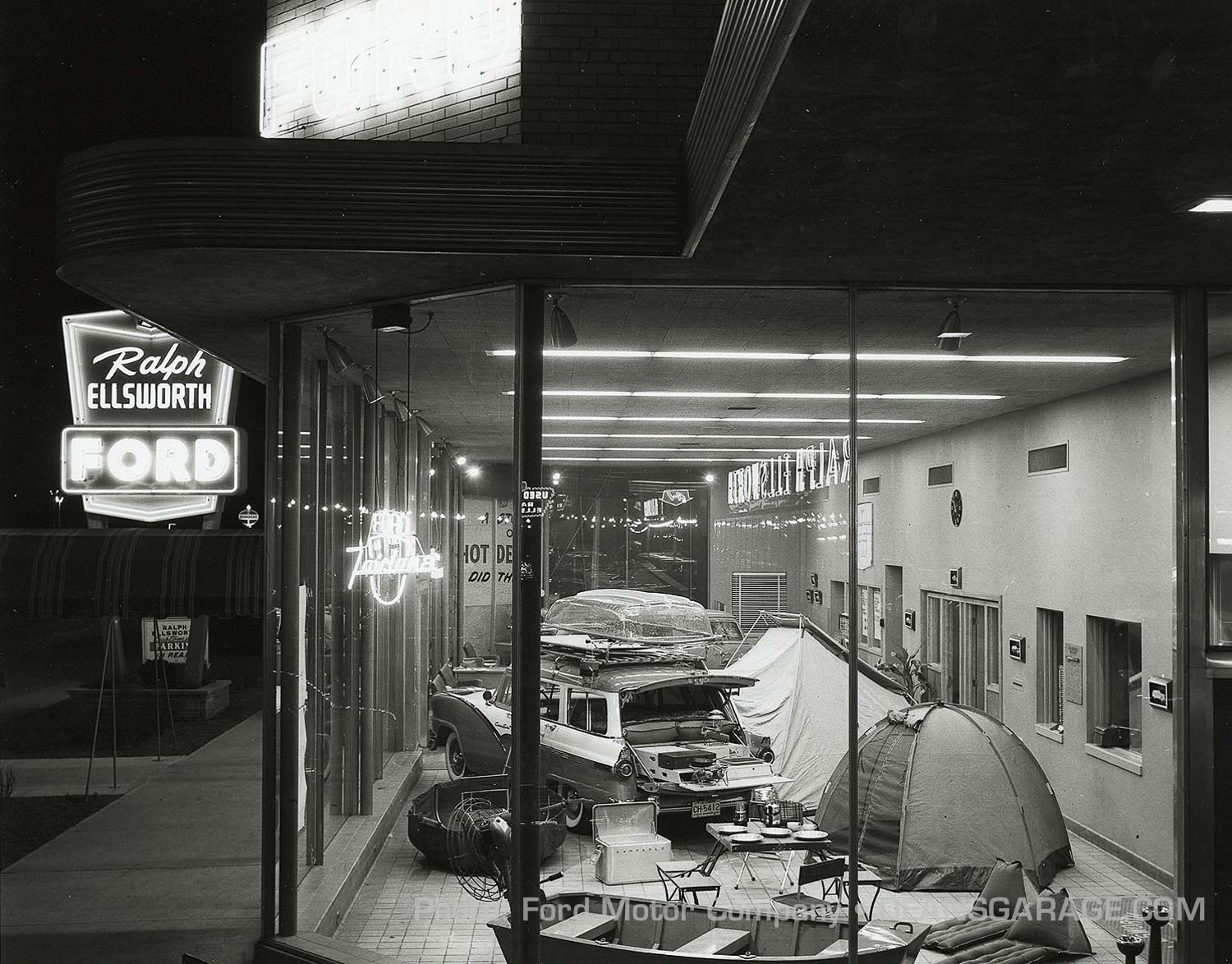
The Ralph Ellsworth Ford showroom in Garden City, Michigan, April 10, 1956. The dealer is “all in” with Station Wagon Living.
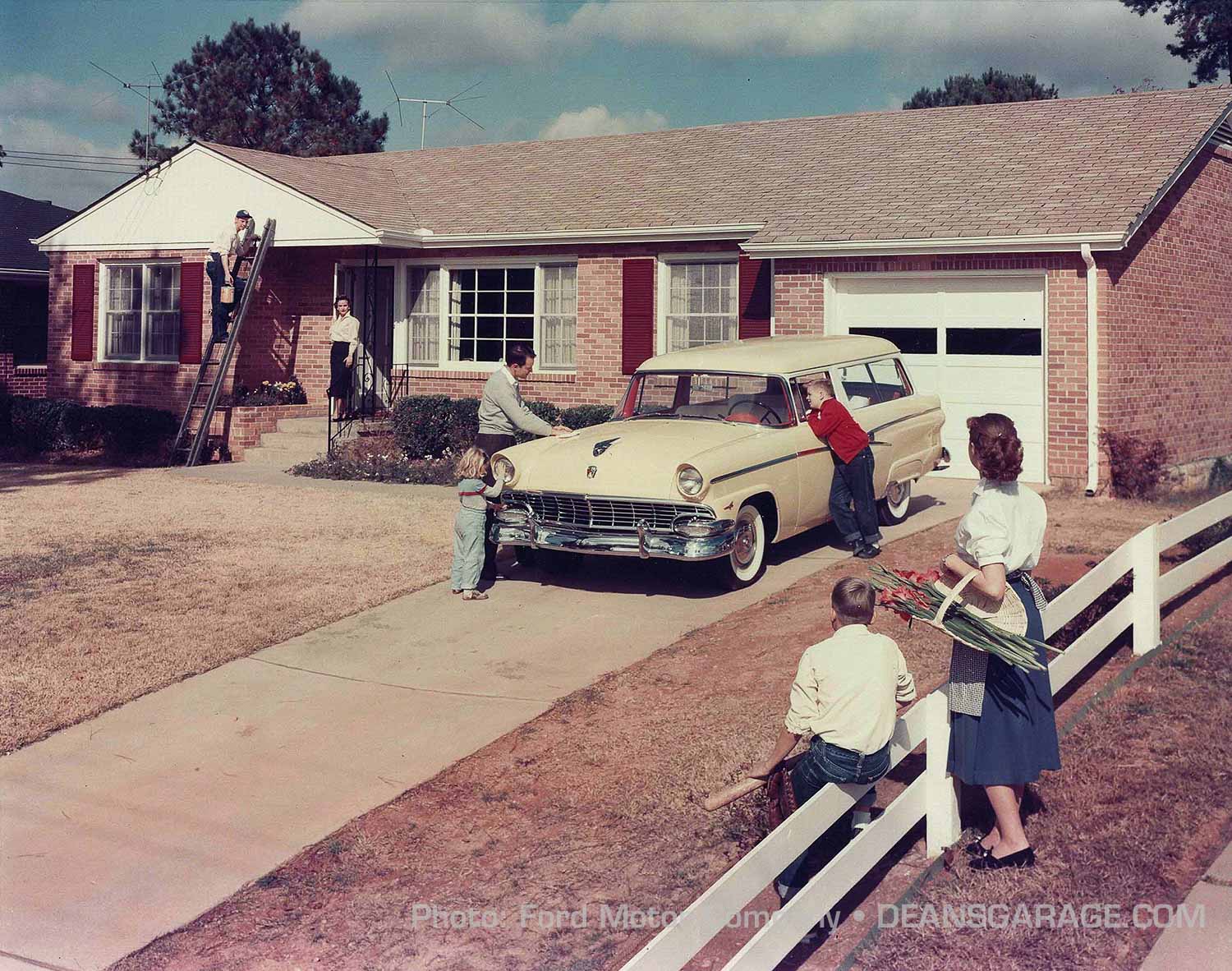
Everybody’s admiring the new ’56 Ranch Wagon.
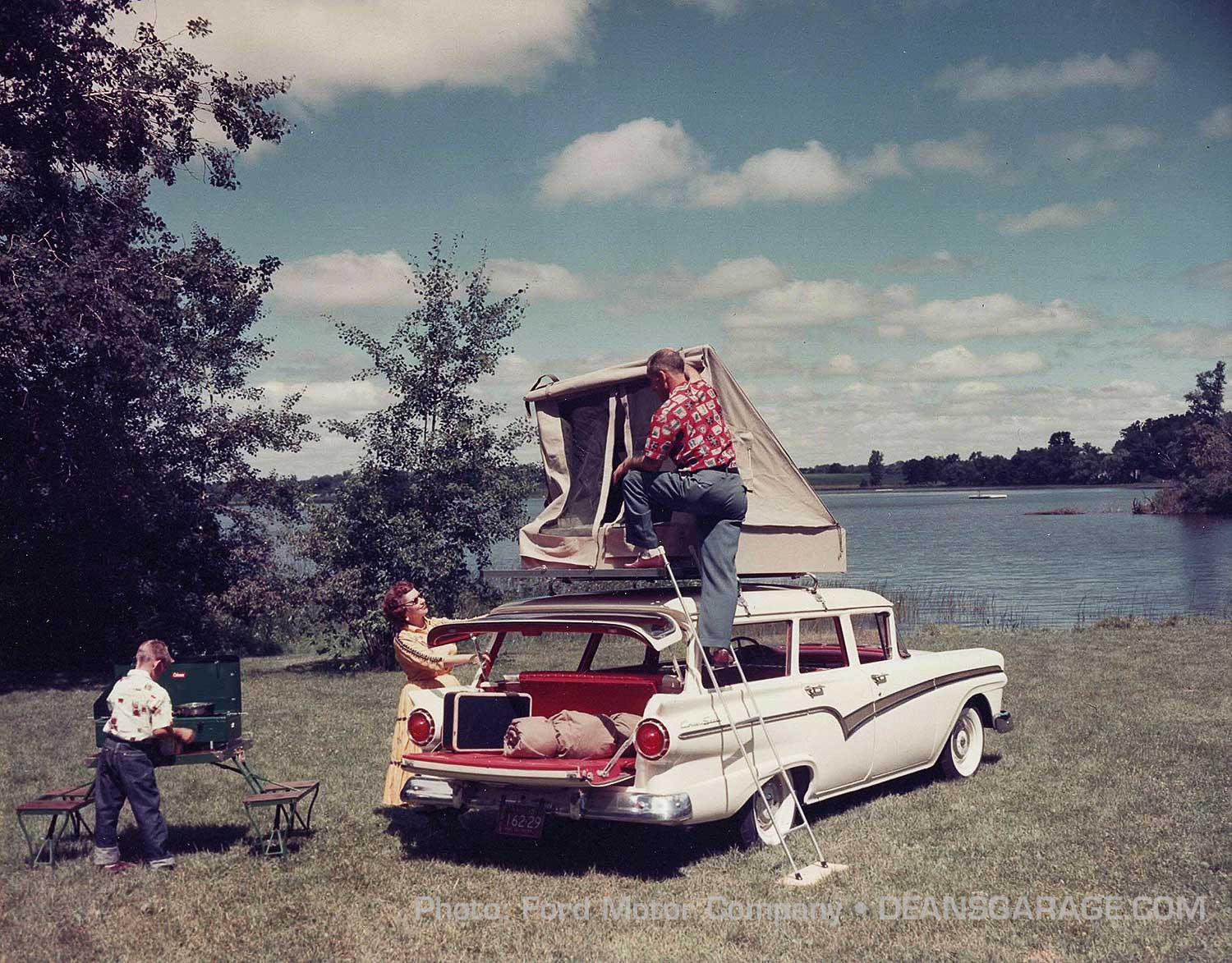
1957 Country Sedan with more “upper deck” sleeping accommodations. Why did boys always roll up the bottom of their jeans in the fifties? Did jeans only come in one length per waist size? Note the Coleman stove made here in Wichita. One can easily see why a pop-up or camper trailer became more popular.
(Why were the jeans rolled up? Because legs grew faster than waists. Moms would buy pants that were too long to allow room for growth.—Gary)
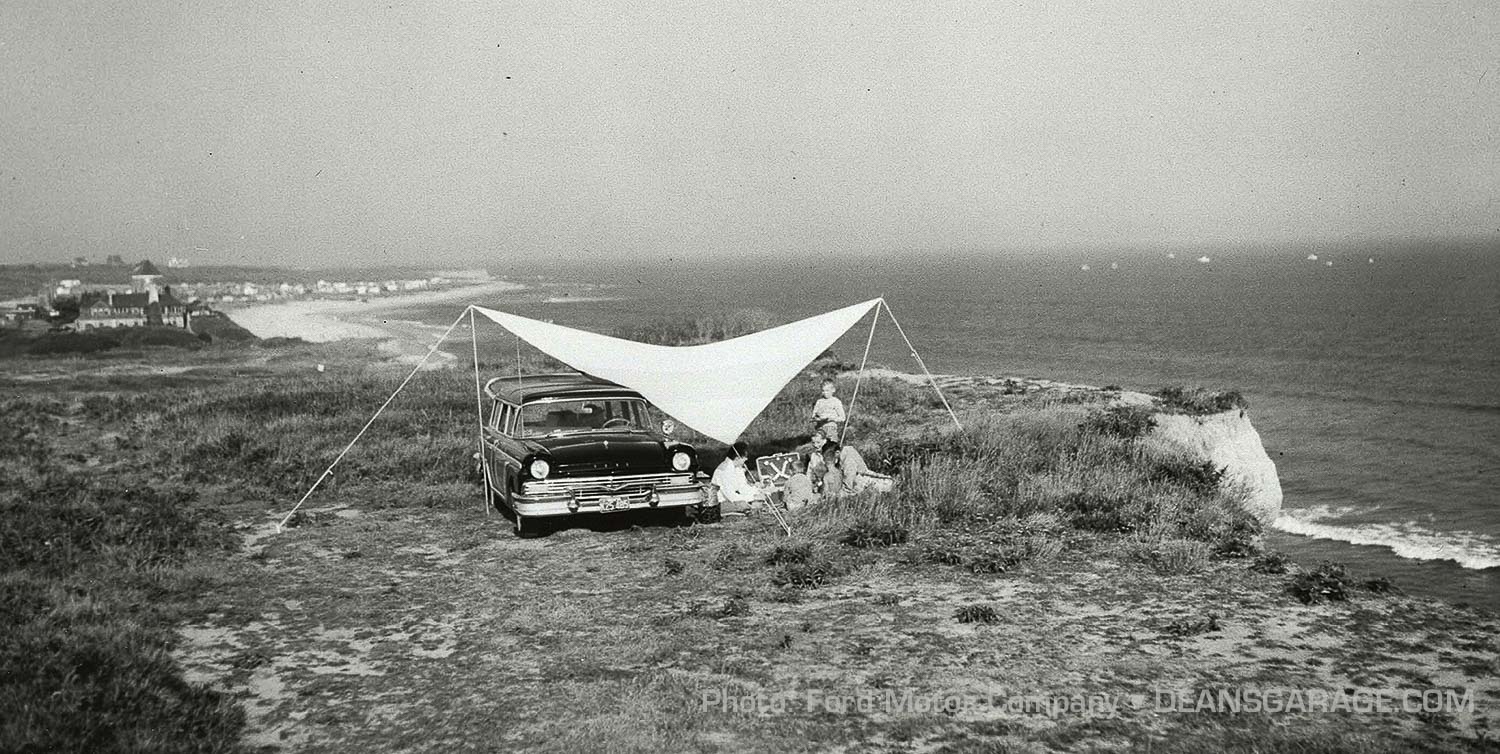
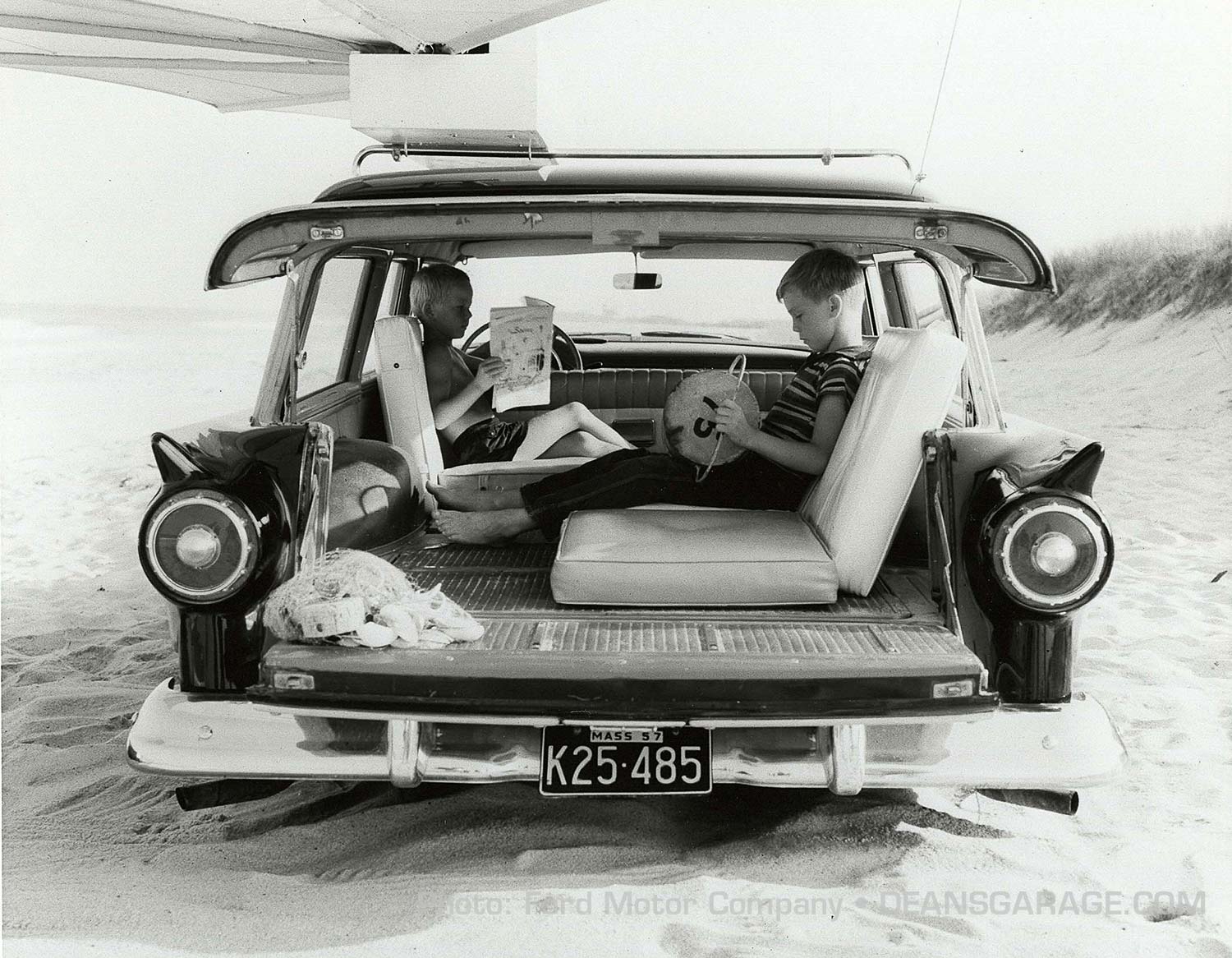
Camping on Cape Cod, August 25, 1957 with their ’57 Country Squire. Cape Cod barely looks inhabited in the top shot. Probably not like that today!
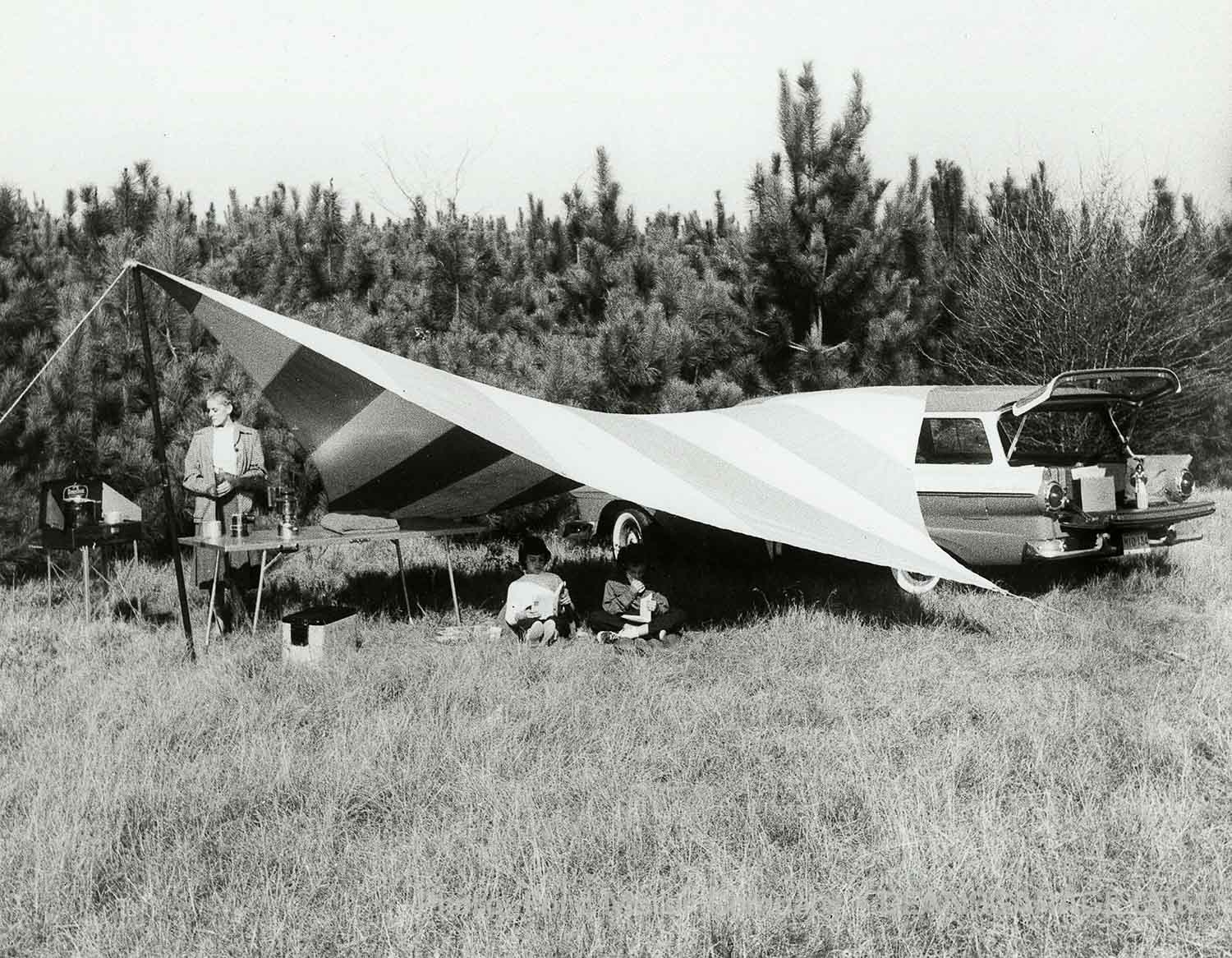
Quite the expansive and interesting awning attached to this ’57 Ranch Wagon. The girls look contented…for now.
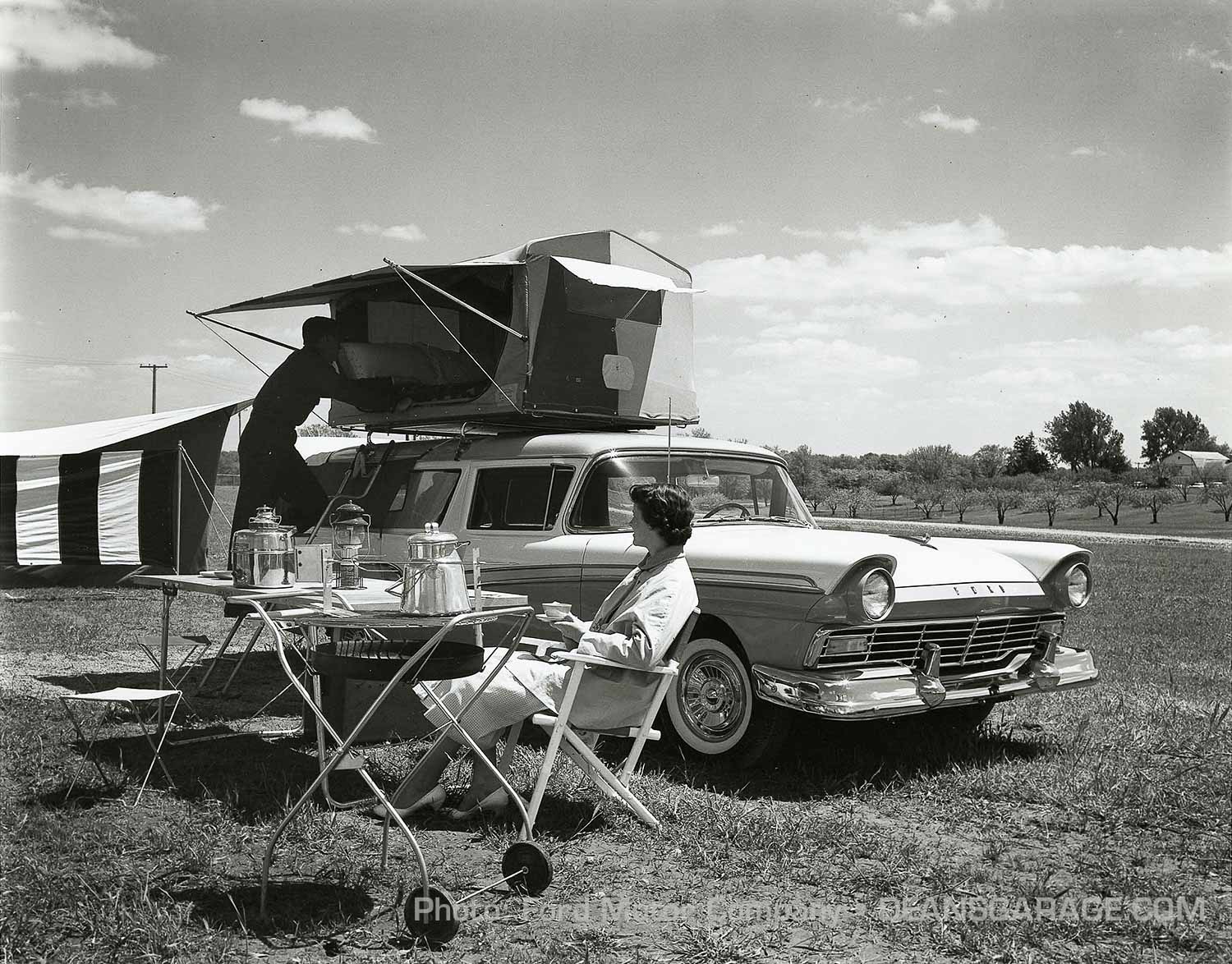
1957 Del Rio Ranch Wagon. Del Rio was a higher trim level over the basic Ranch Wagon. Taken at the Romeo Test Track. I suspect most gals didn’t wear white high heels when camping.
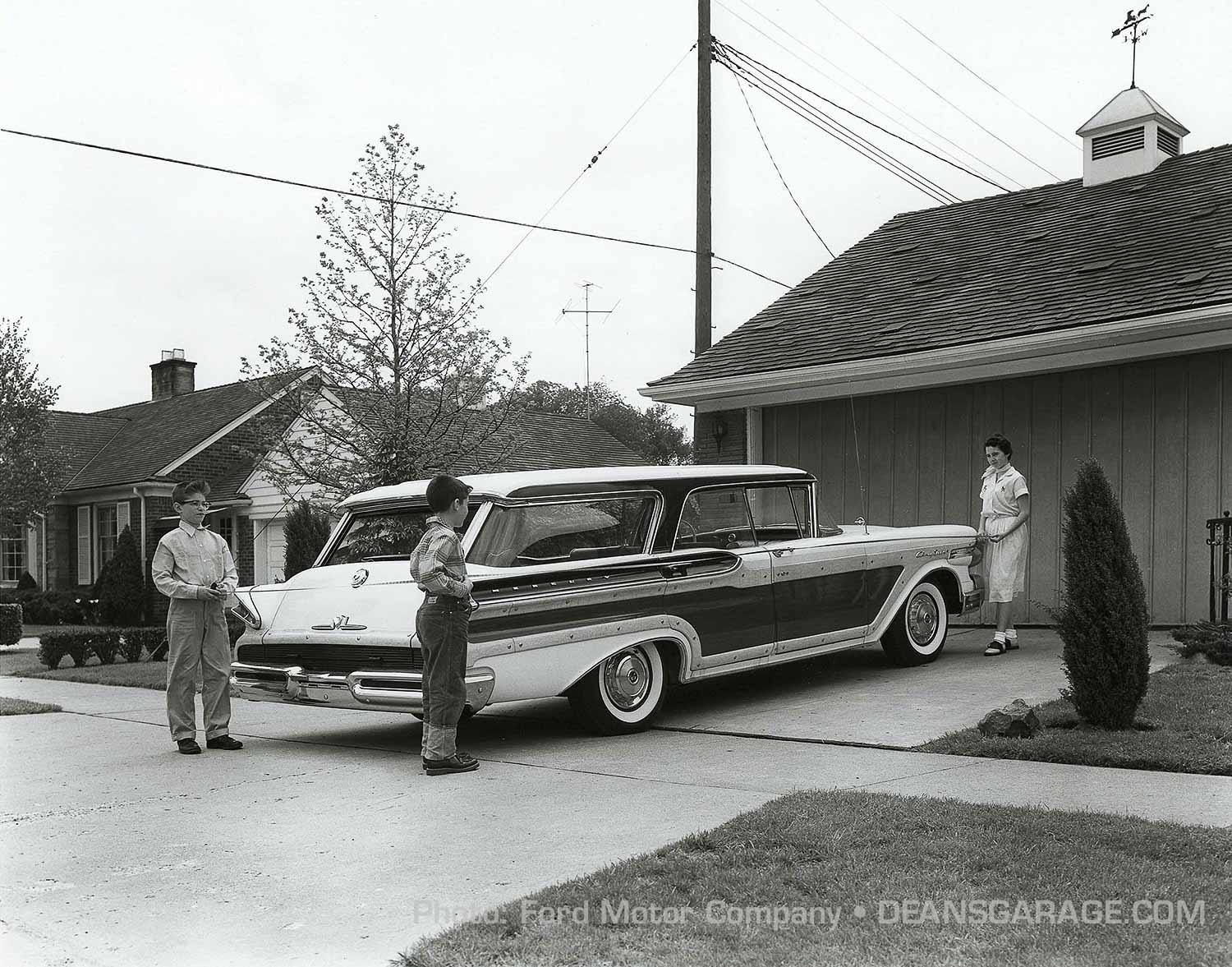
Inspecting Dad’s new ’57 Mercury Colony Park on May 15, 1957 before he takes it hunting. The kids are holding a tape measure, probably to see if “The Big M” will fit in the garage!
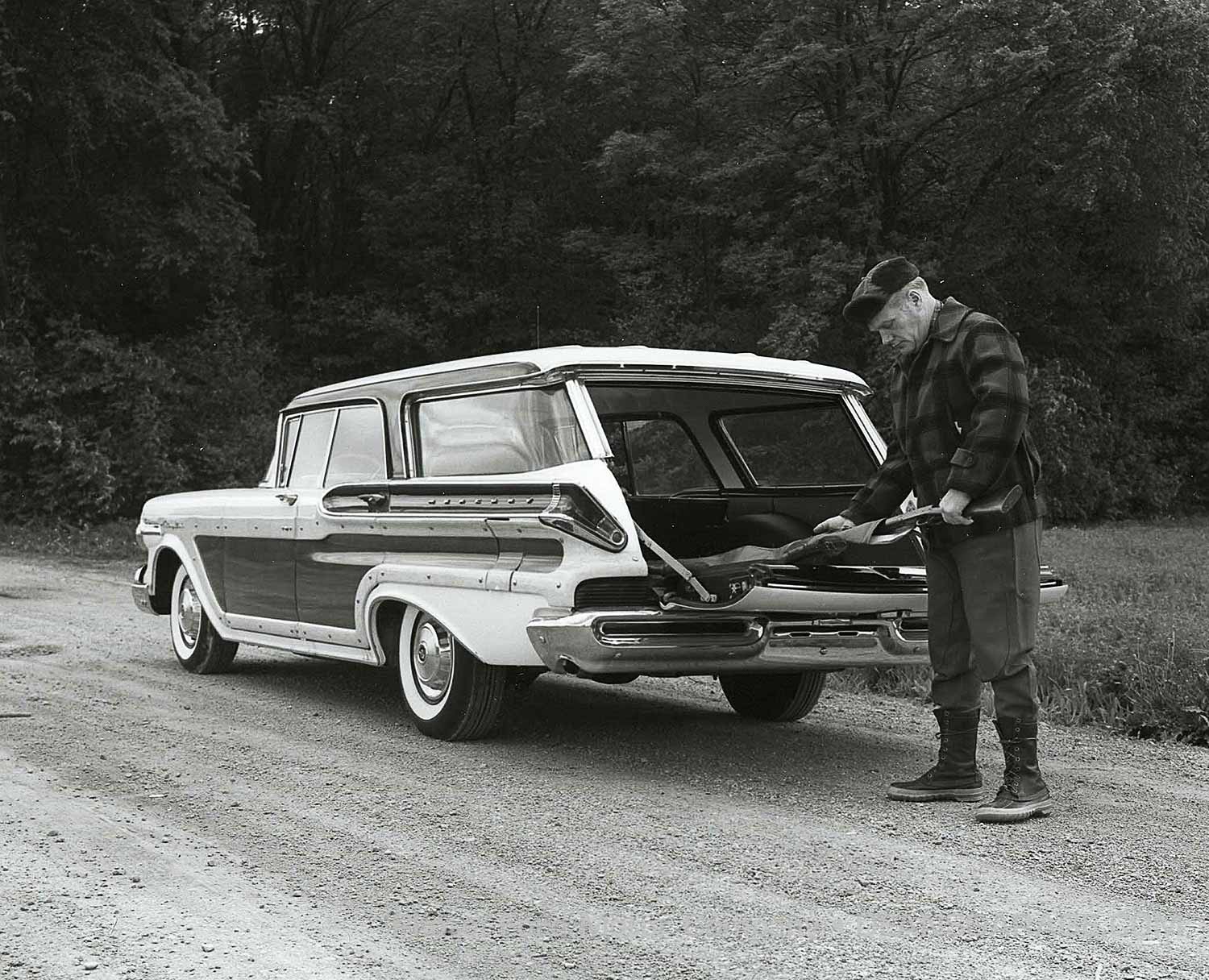
Later that same afternoon Dad unloads the shotgun to go hunting. A license plate on the Merc would be helpful!
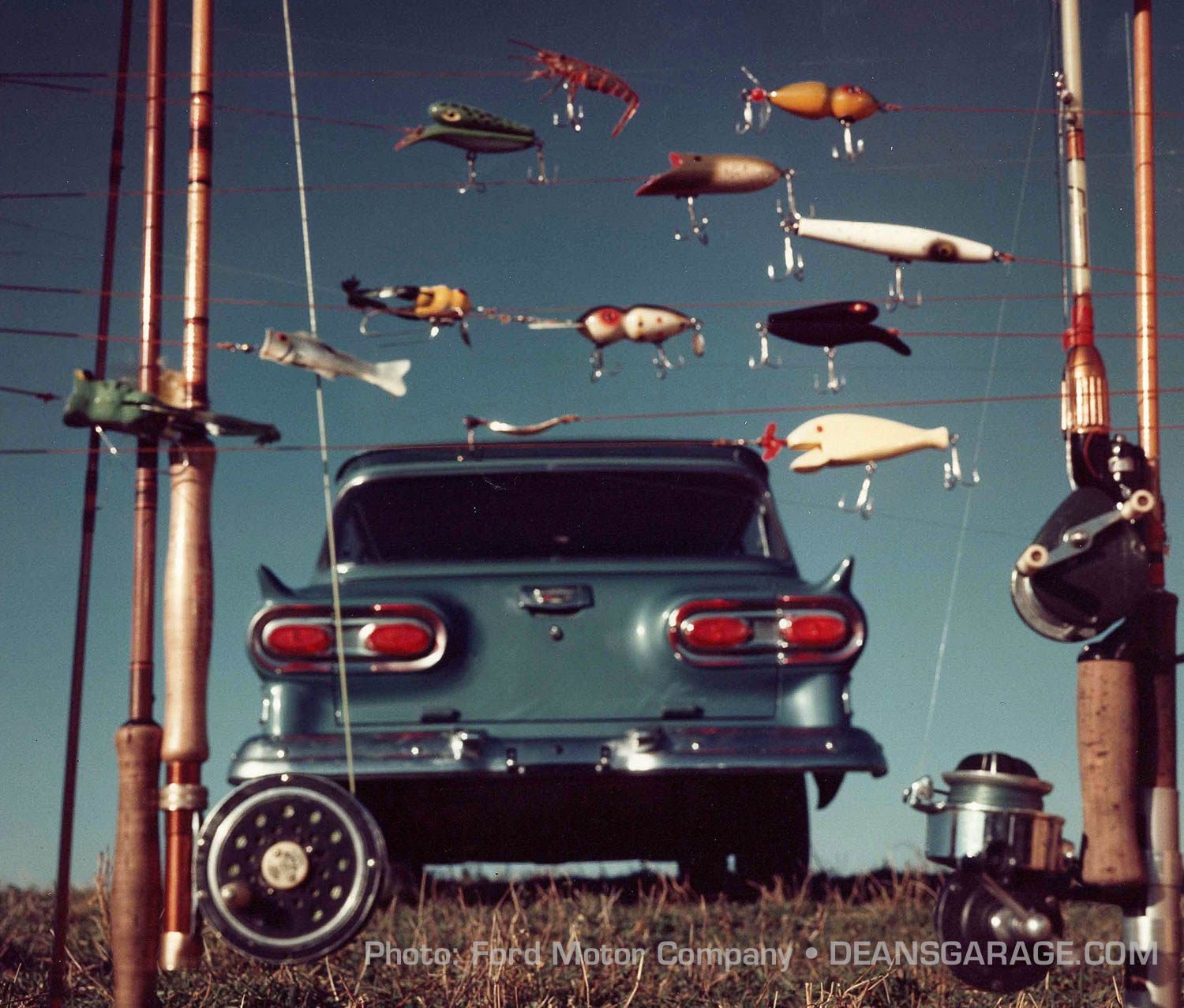
The lure of the great outdoors with a new ’58 Ford. Taken on October 2, 1957 at Brophy Lake near Alexandria, Minnesota.
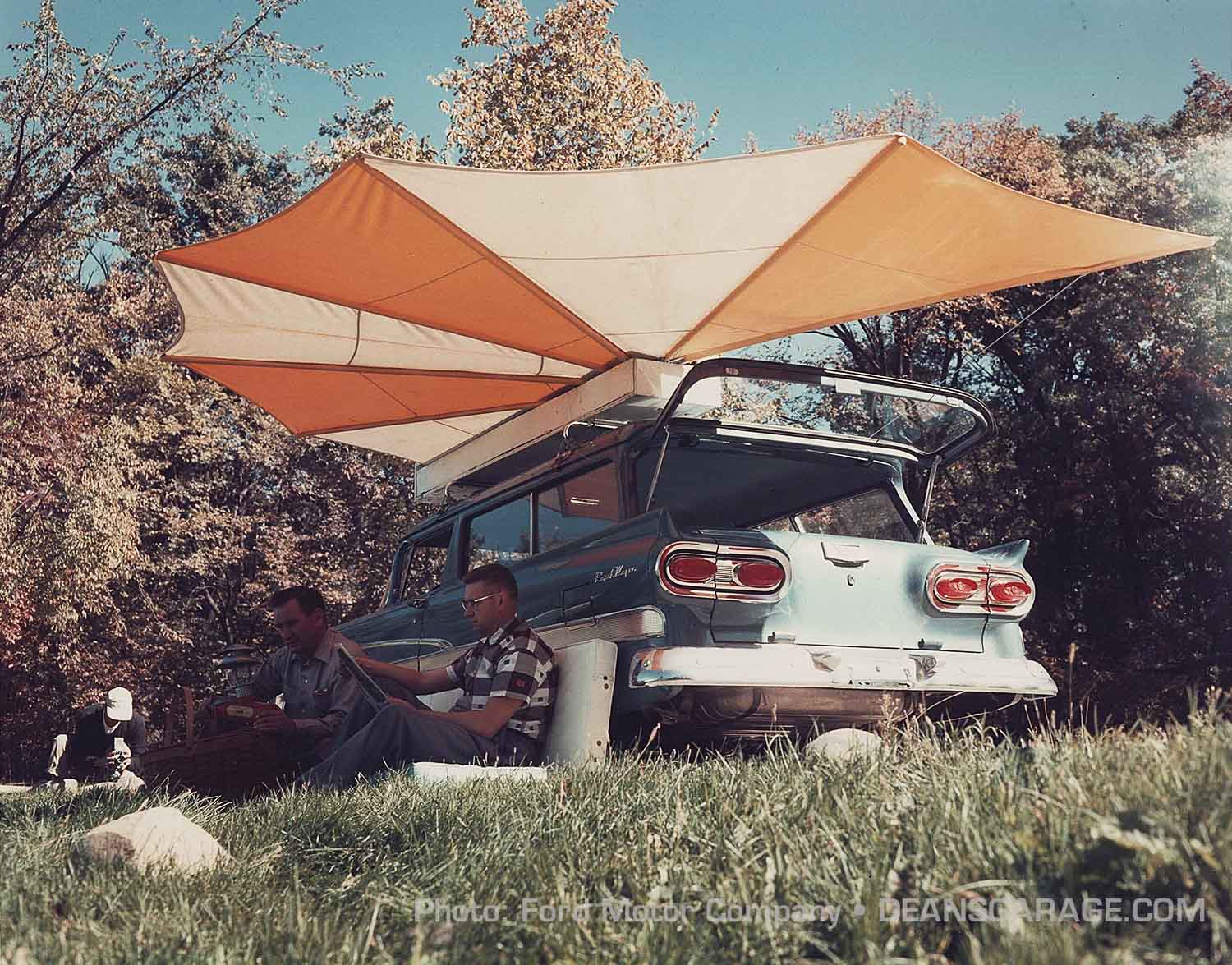
Also taken at Brophy Lake on October 2, 1957. Very interesting and large canopy attached to this same ’58 Del Rio Ranch Wagon. No, that’s not an iPad that he’s holding.
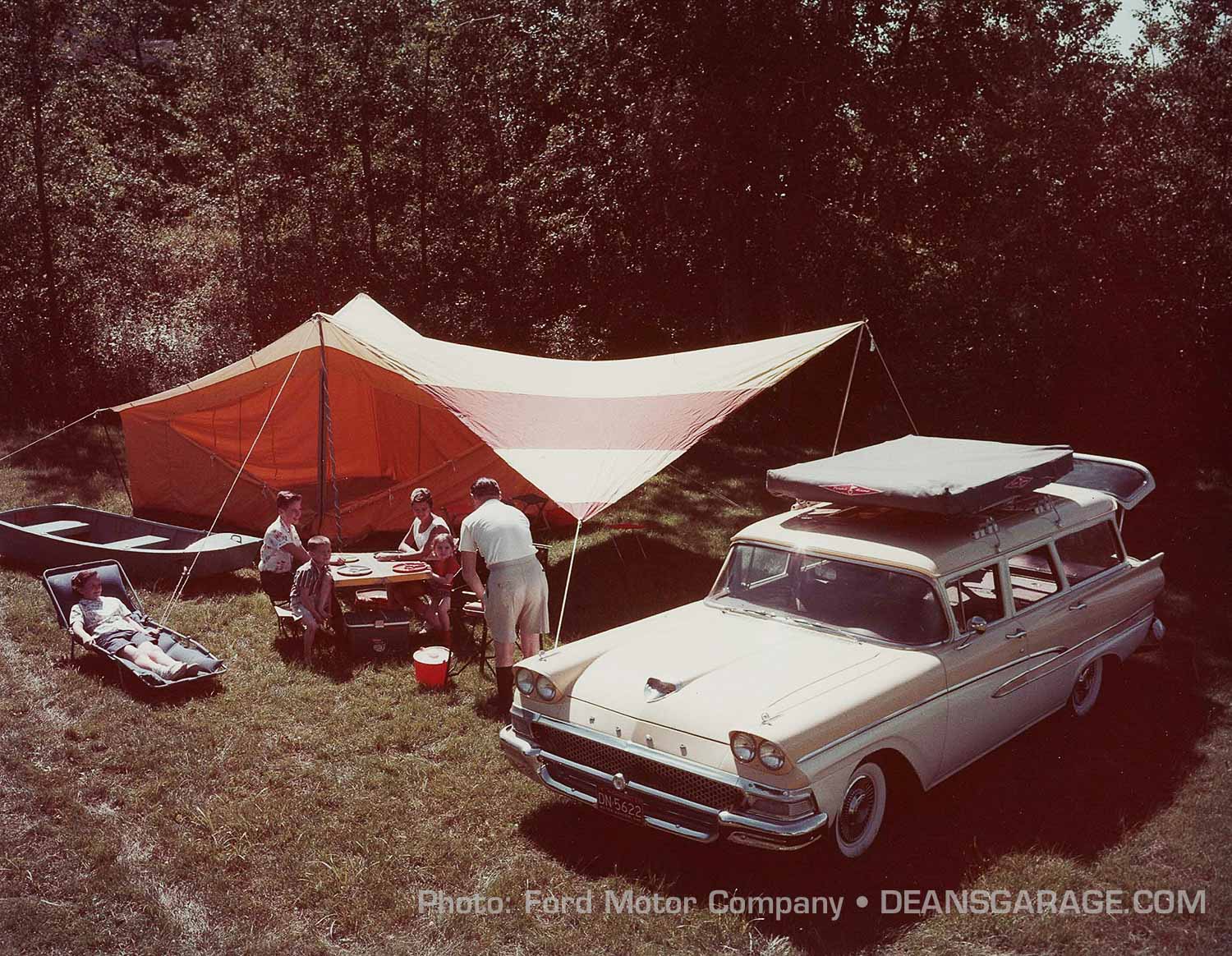
It is apparent that Ford brought several cars up to Brophy Lake for this photo shoot. This group of pictures are all in the 1958 version of the book, Ford Treasure of Station Wagon Living. Again, quite a large canopy besides this 1958 Country Sedan.
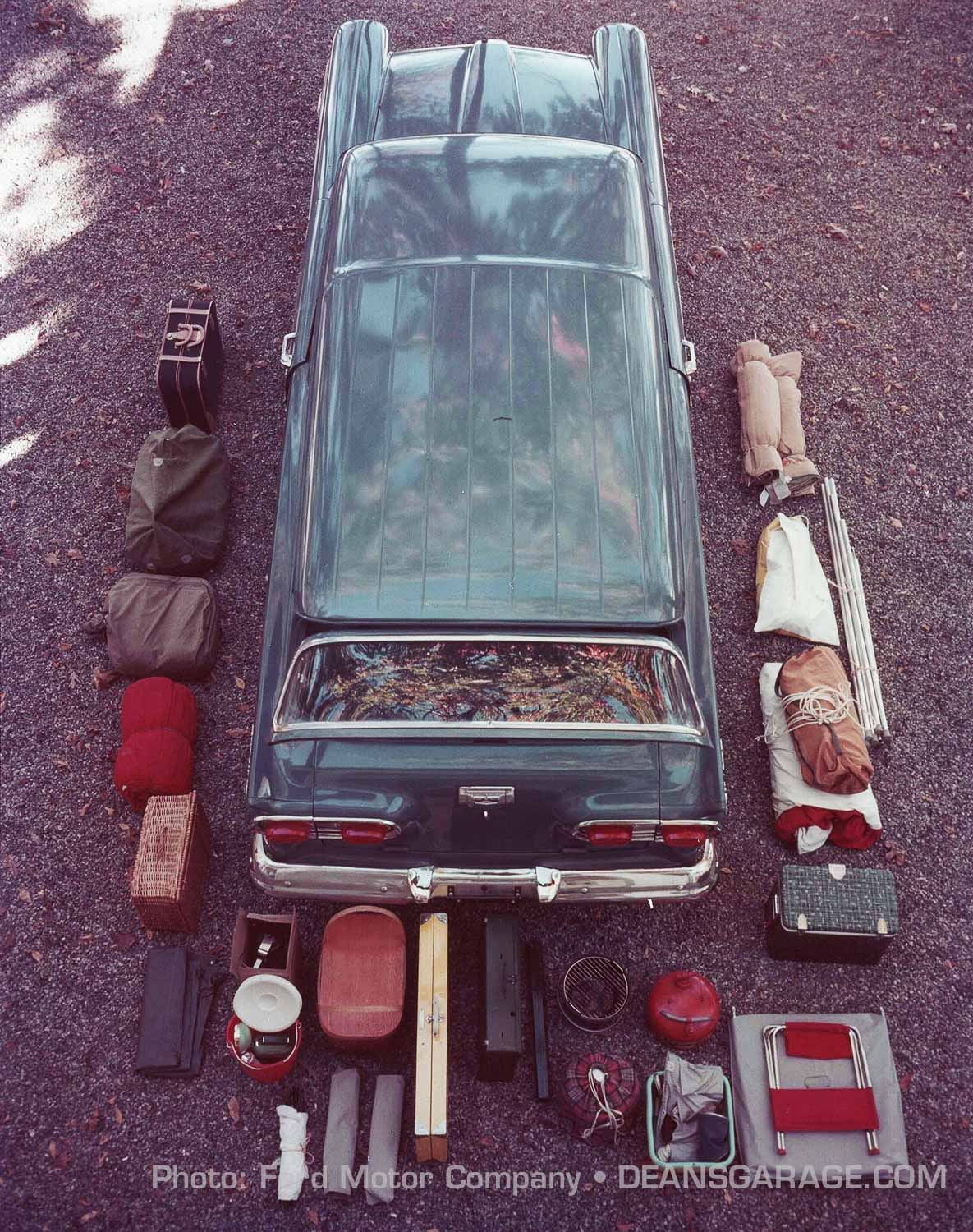
You can pack a lot of gear in your 1958 Del Rio Ranch Wagon. Still up on Brophy Lake on October 2, 1957.
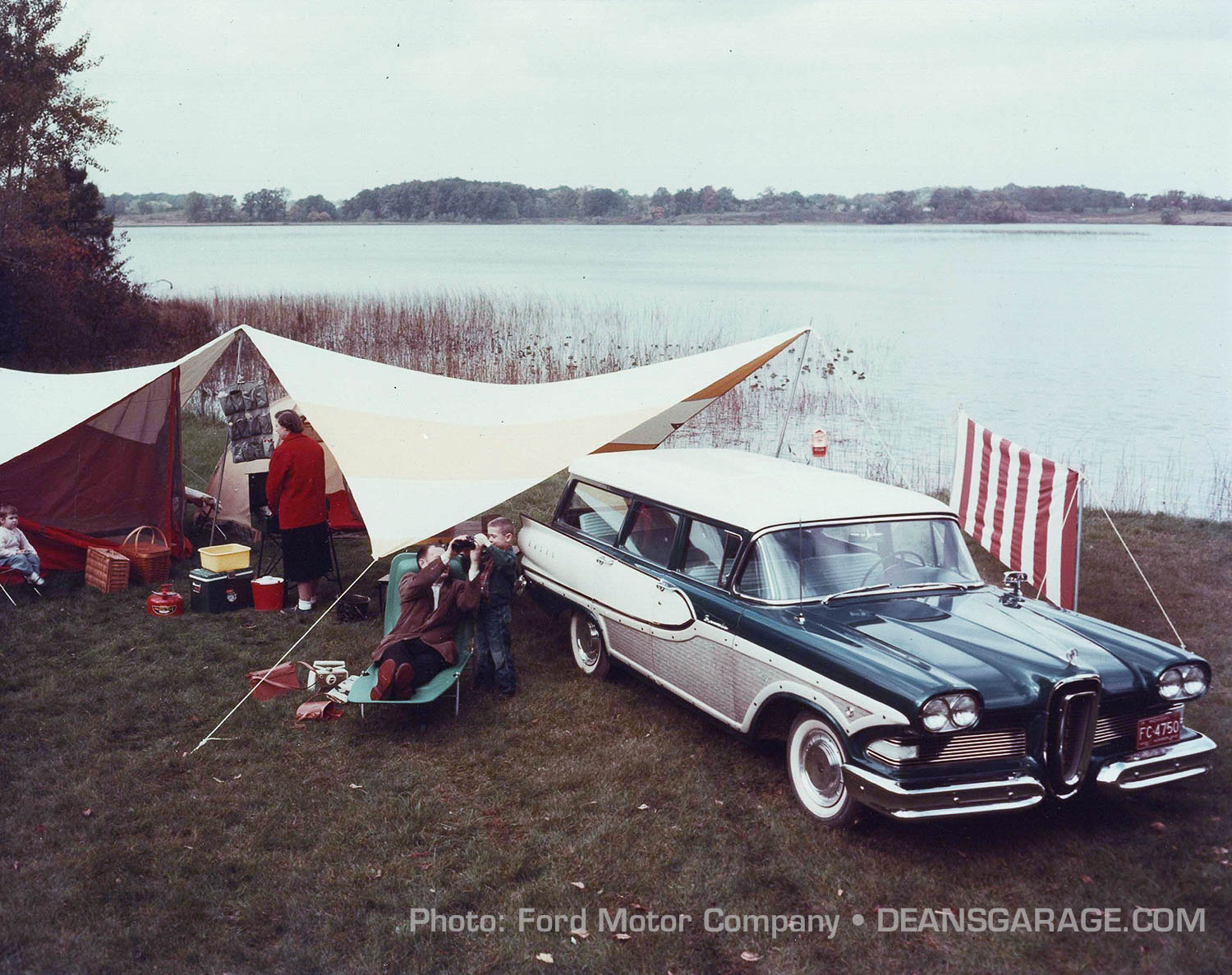
This 1958 Edsel Bermuda wagon didn’t want to miss out on this camping trip up to Alexandria, Minnesota.
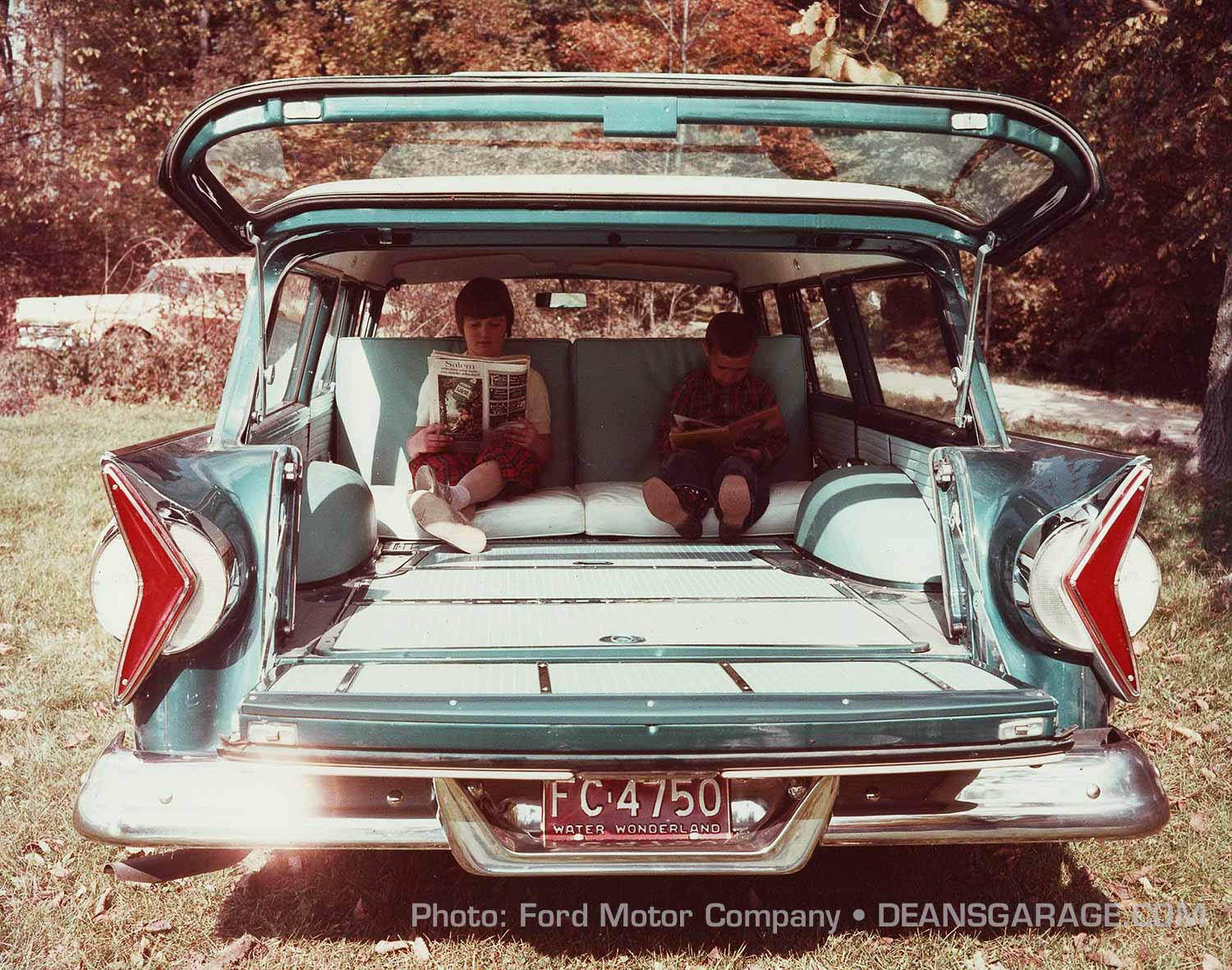
Quite the unusual taillights on the ’58 Edsel Bermuda. The last picture from up on Brophy Lake near Alexandria, Minnesota. Like the earlier ones taken on October 2, 1957.
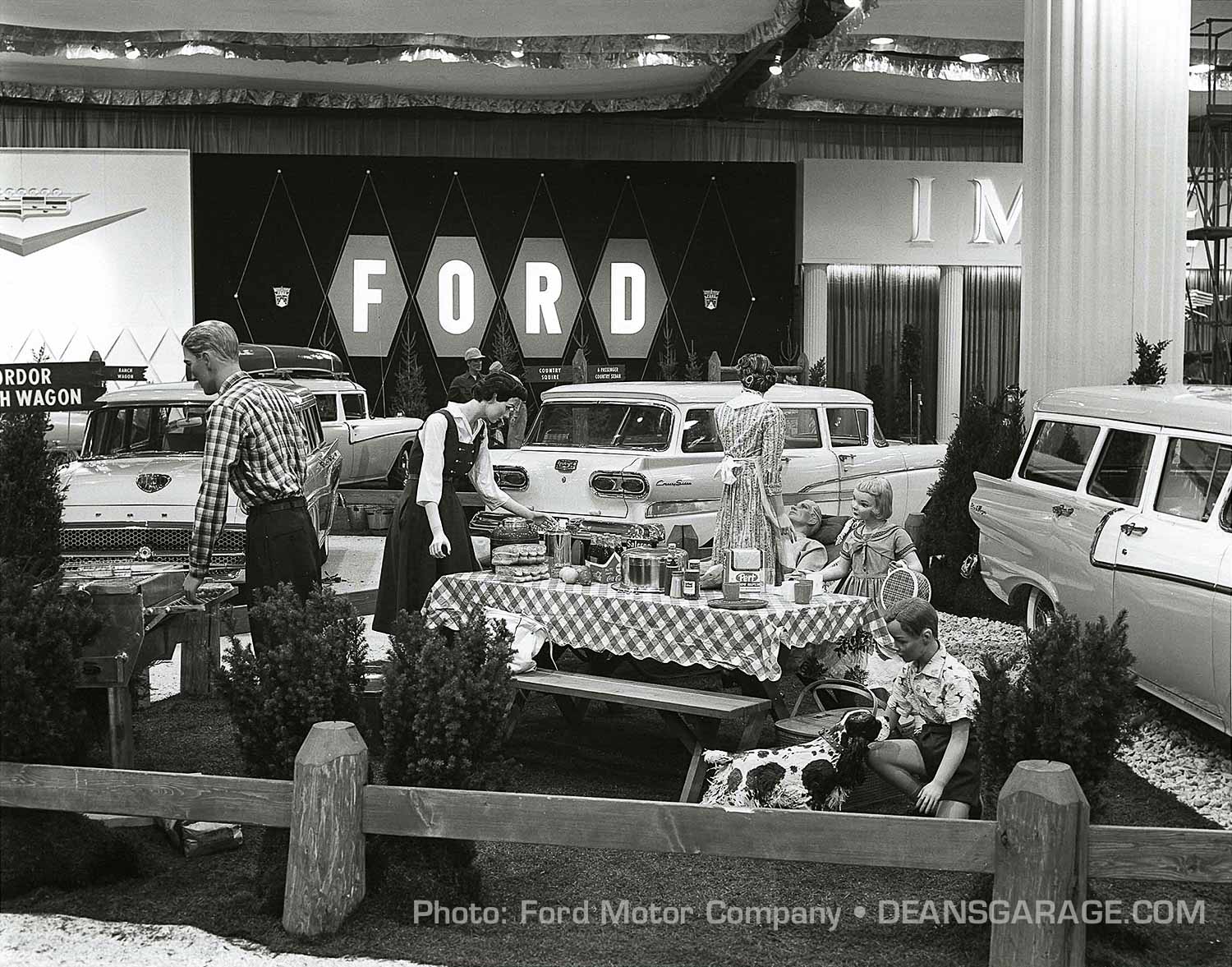
Mannequins depicting Station Wagon Living amongst the full line of ’58 Ford wagons at an unnamed auto show.
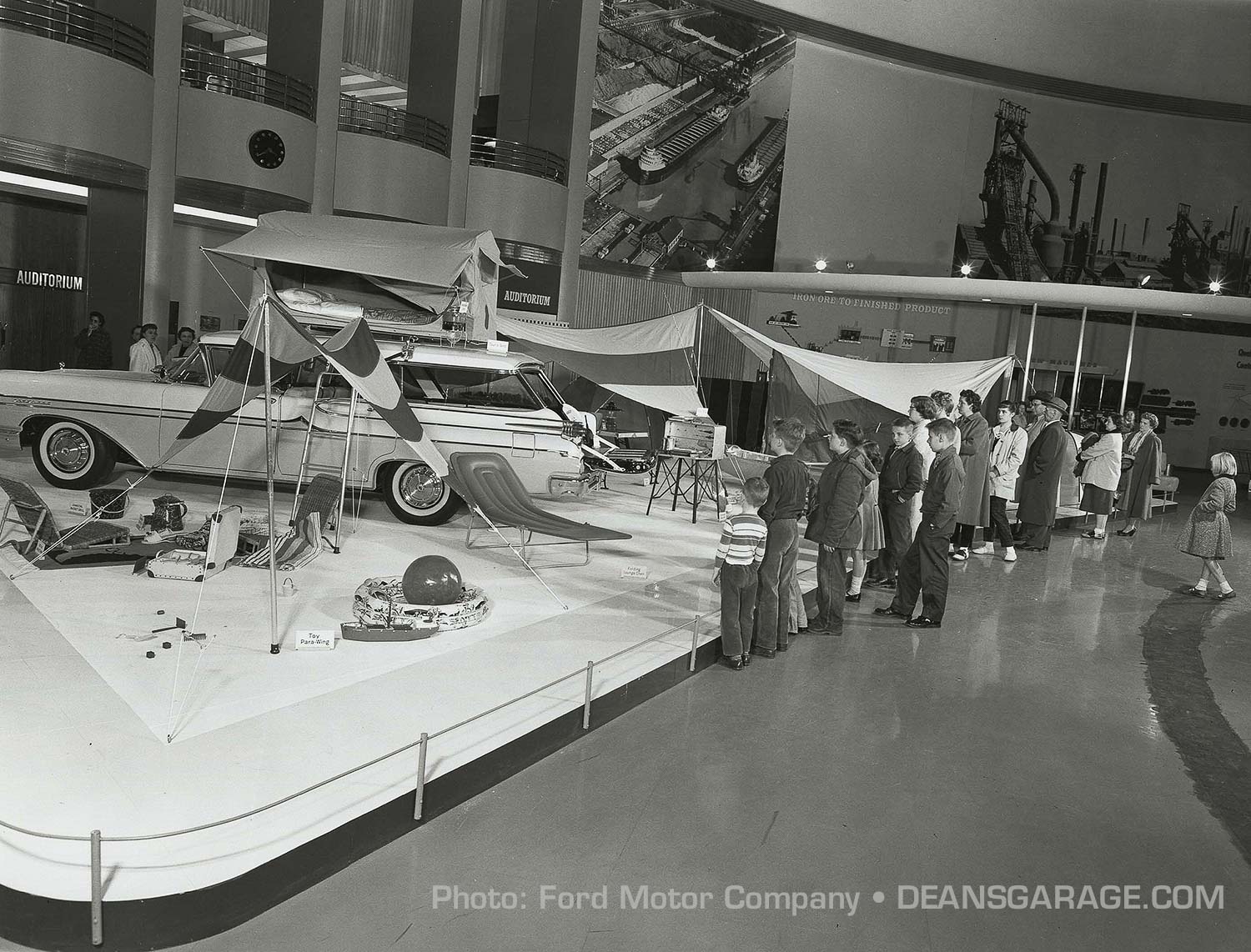
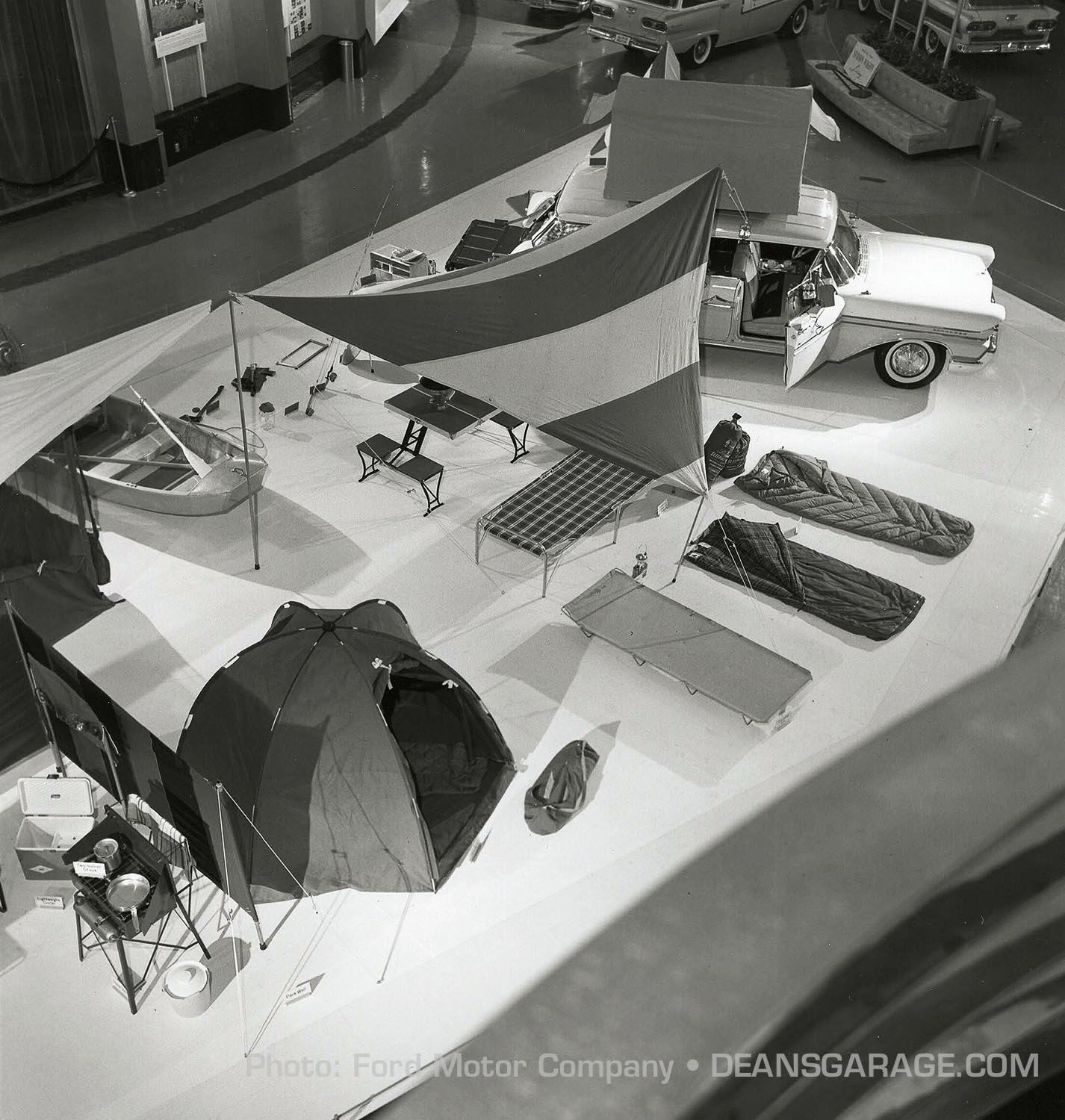
Two pictures of a 1958 Mercury Commuter depicting Station Wagon Living accessories in the famous Ford Rotunda on April 9, 1958.
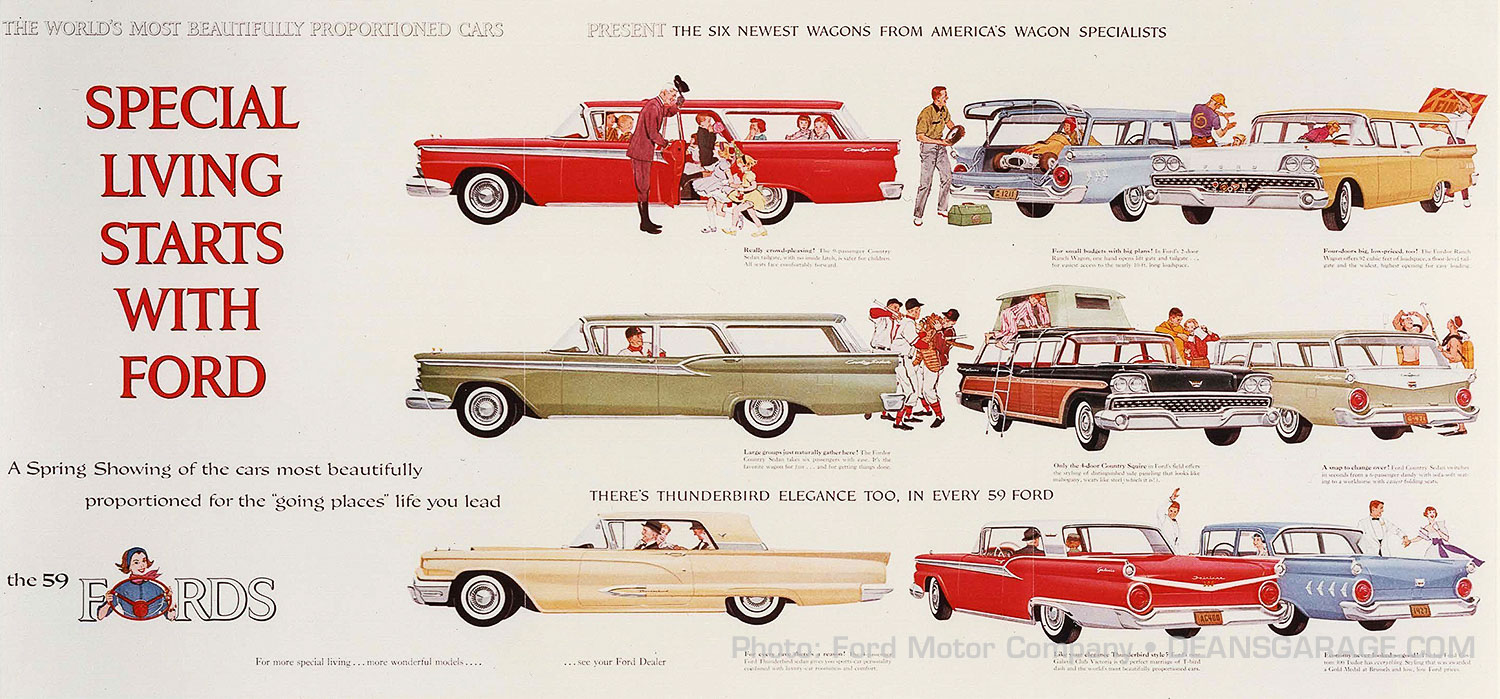
A Ford ad from 1959 which does allude to the Station Wagon Living, though not directly.
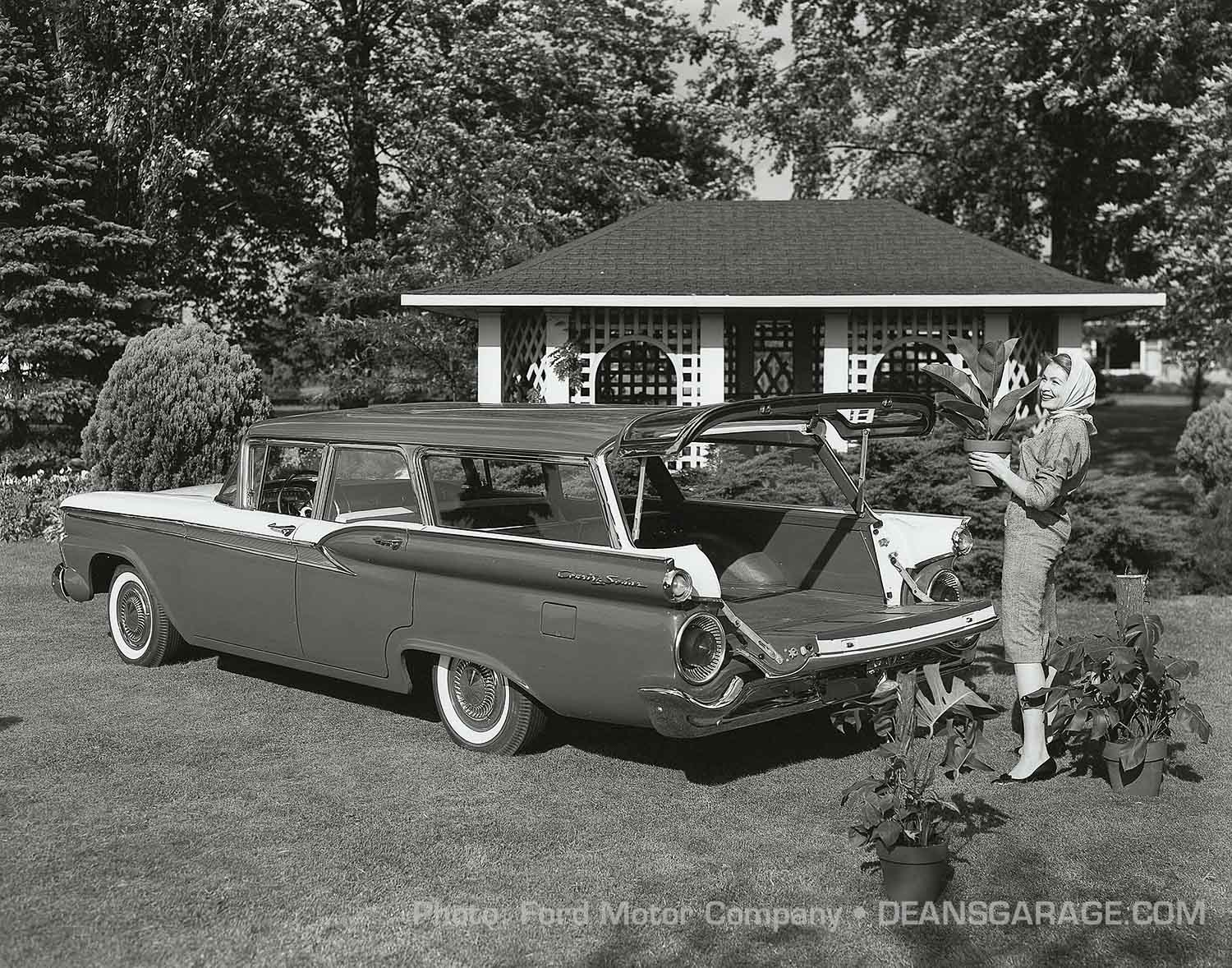
Though not in the same ilk as camping, Ford always depicted other activities that lent themselves well to a Ford Wagon such as gardening. Philodendrons in this case!
I have the ’57 edition of Station Wagon Living. It’s a hoot. My favorite shot is the recommendation to put some pillows/padding around the edges and turn the cargo compartment into a traveling play pen for the kids. Yikes!
Ford had an ongoing relationship with Simon and Schuster – they published their anniversary book, Ford at Fifty, in 1953. And Carly Simon’s father was the Simon of Simon and Schuster!
In the late 1950s Ford spent a lot of extra money on making Mercurys different from Fords, including a completely different station wagon greenhouse. The Mercurys were not only all no-B-pillar hardtop type designs but from 1957 had the rear window winding down into the lower tailgate instead of a wrap around window upper tailgate like on Fords. Fords got a new body in 1960 while Mercurys kept their old one, and the Ford again had the upper tailgate even though the new Falcons did not. Then Ford joined the pack the next year.
I don’t think it was mentioned but Ford called itself the “Wagonmaster” and I think they did sell more of them than the competition.
Great article, Dean! Thanks for sharing this. We had wagons growing up – a 56 Chevy, 62 Catalina, 68 Catalina, 73 LeMans. All nice cars but as a kid I didn’t want another “boring” wagon and wanted Dad to buy a big beautiful 4-door sedan. Finally got my wish in ’74 when he bought a used ’71 Olds Delta 88 4-door hardtop for the newest driver in the family – me. And back in 68, when Mustangs had been all the rage for a few years, Dad brought home a black 66 Mustang with red interior with console but had to return it to the dealer after Mom claimed that the car was “too sexy, not a married man’s car”!! haha. She was probably right.