

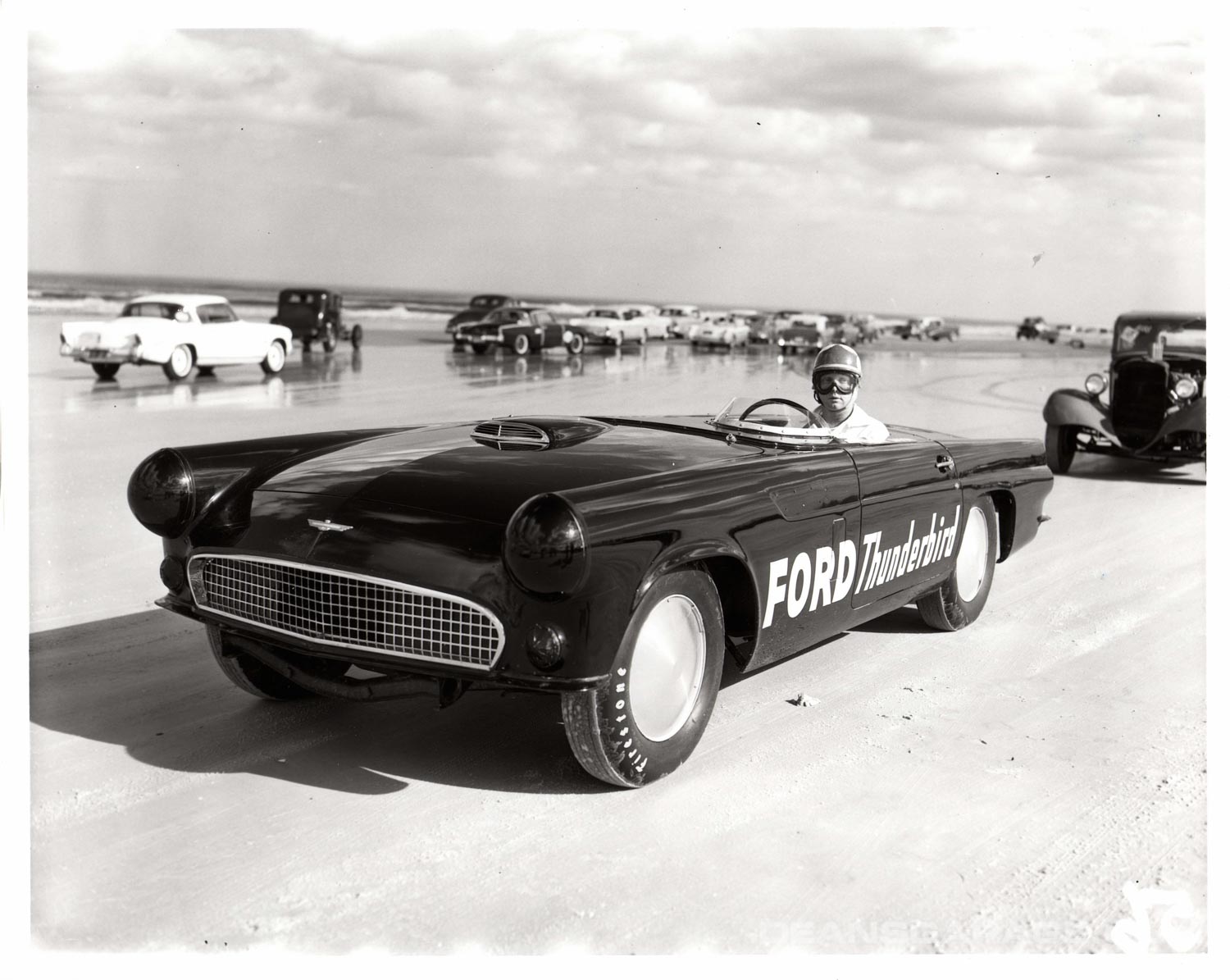
Daytona—70 Years Ago
By Todd Duhnke
Well, it’s February again. Cold, snow, and a groundhog which makes me think of Florida and of course another Daytona Speed Weeks and the 500.
As mentioned in previous postings, I was fortunate enough to acquire from Ford many years ago some 4,000 8X10 prints from the original negatives. Time period of this collection runs from the late 1940s to about 1963. A good 100 or so are from the 1956 and 1957 Daytona Speed Weeks, as well as the Convertible and Grand National races on the old Beach-Road Course.
In both 1956 and 1957 Ford sent one of their company photographers down to Daytona with his trust Speed Graphic camera, which shot a 5×7 negative. That’s why these pictures are so crisp and clear.
By 1956 the principal manufacturers were actively involved in racing, spending millions of dollars doing so. It’s been said that ’56 and ’57 were the pinnacle years of the factory involvement until June 6, 1957, when the Automobile Manufacturers Association, at GM’s behest, voted to suspend all participation in stock car racing. Of course, that ban didn’t last long as both Chevrolet and Pontiac Divisions in particular surreptitiously back-door shipped key parts to their favored race teams. By 1962 Henry Ford II had had enough of the shenanigans and green lighted Iacocca’s Total Performance program. On June 12, 1962, Henry Ford II formally announced that they were withdrawing from the AMA resolution as no one was abiding by it anyway. Detroit was openly back in racing.
So, let’s step back 70 years and look at what stock car racing used to be like. There are really two elements to this. The Speed and Performance Trials for both totally stock and modified cars which took place on 10 miles of beach south of town near Ponce Inlet that the City of Daytona had allowed NASCAR to use. These trials were extended to two weeks on February 12, 1956.
The other element was head-to-head racing in three classes. A Modified—Sportsman Race which featured a lot of souped up ’30s Fords and a few Chevrolets. The 159-mile Convertible race and lastly, the main event, the 159-mile Grand National race which both occurred on the Beach-Road Course. That being two miles south on Florida highway A1A, a turn to the beach at the south inlet followed by two miles north on the beach to the north turn. A slightly bent paper clip shape.
Photos courtesy of Ford Motor Company.
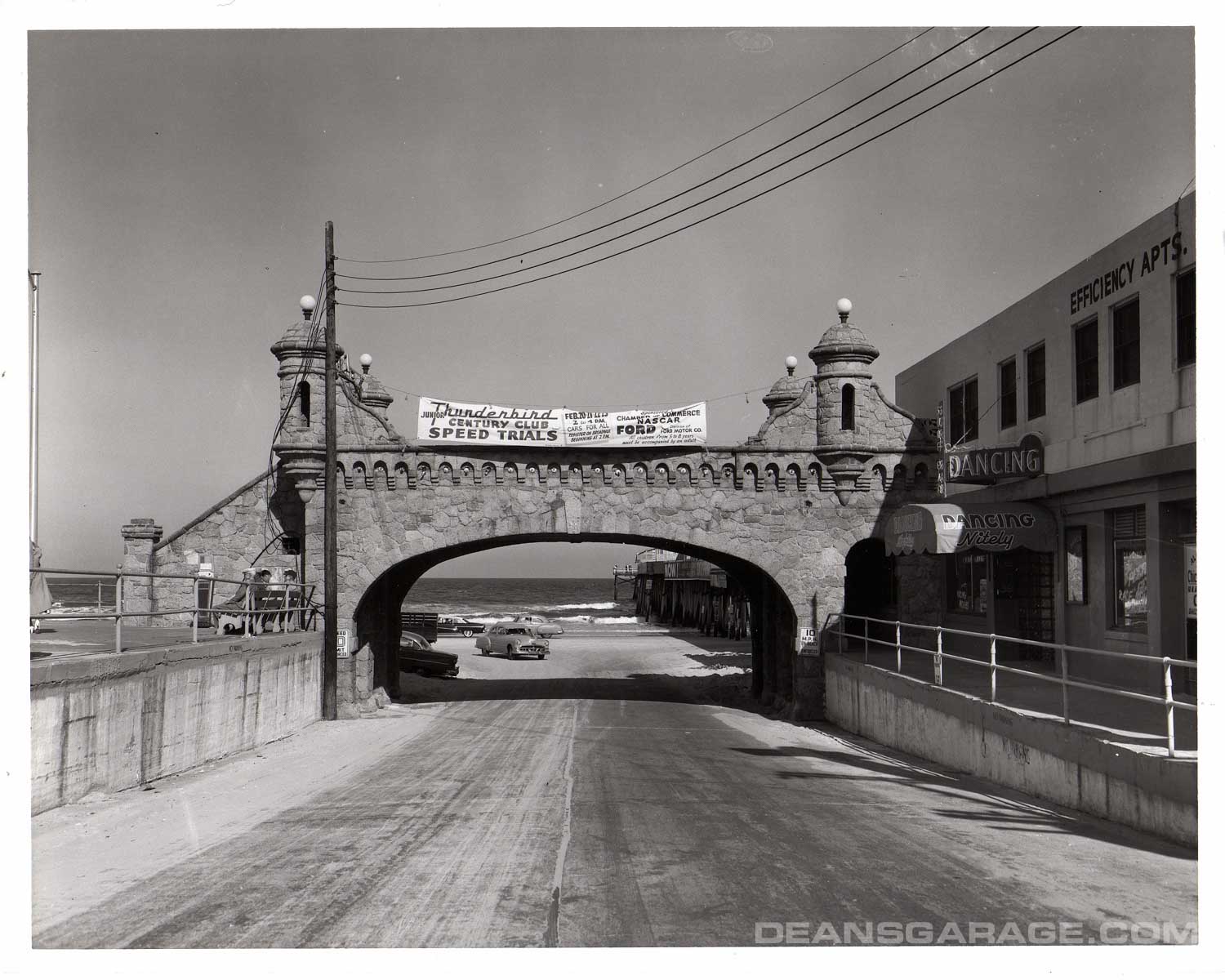
Back in the day when these photos were taken there were very few structures or homes south of Daytona Beach along A1A. Access to the beach was easy and there were numerous entrances and cuts in the dunes. This is one of the fancier entrances in the city at the end of Main Street. Note the Ford banner announcing the “junior” Thunderbird speed trials for 5- to 8-year-olds. This structure still stands at the end of Main Street.
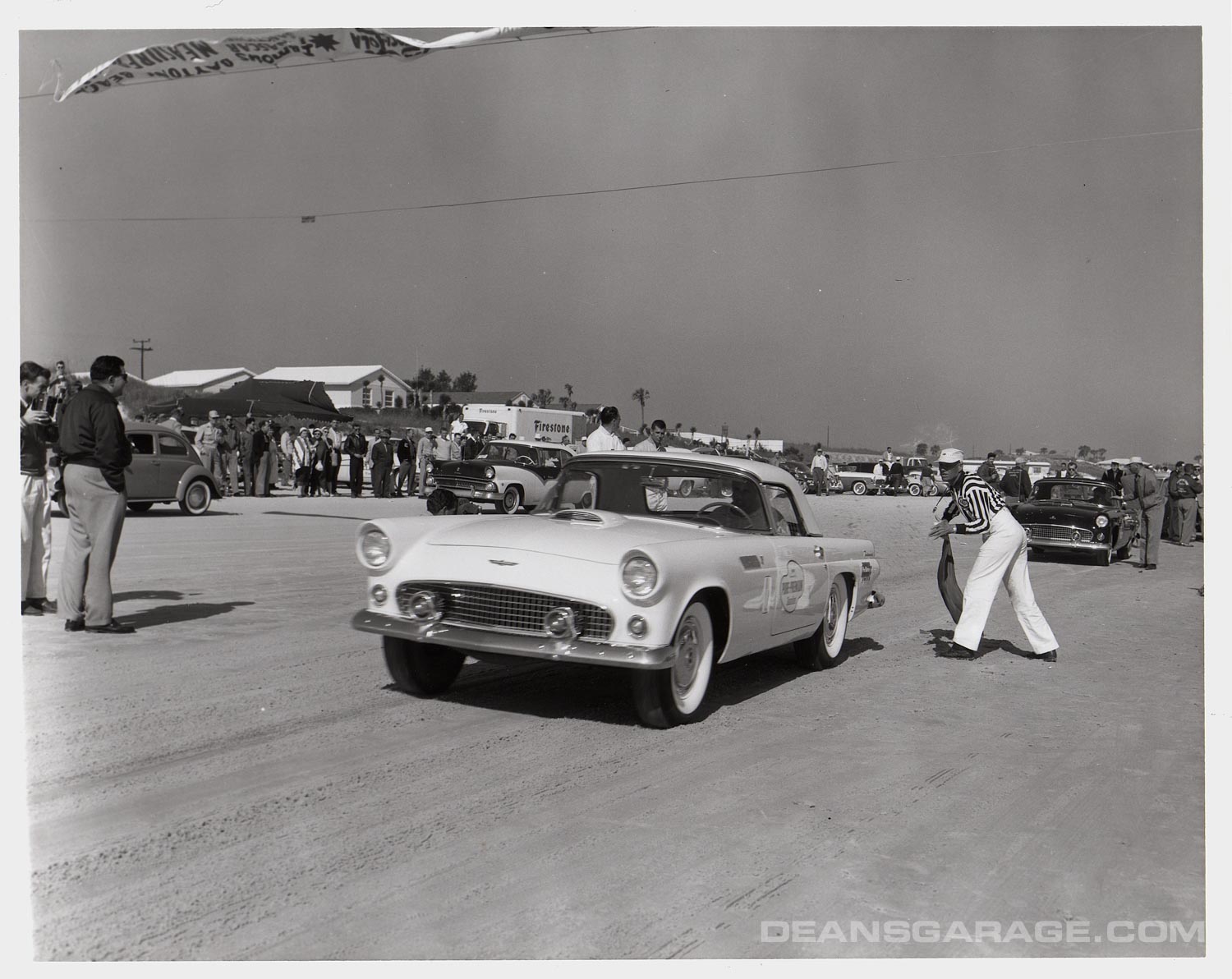
As one might expect, the Ford photographer was naturally sent to photograph company products primarily. So, we don’t see much in the way of competitive cars.
Here we see at the starting line a totally stock Colonial White ’56 Thunderbird with its stock wheel covers still in place. Note in the background how sparsely populated the housing was. Today the scene is saturated with very high-rise condominiums. Note also the Firestone truck in the background as even tier one suppliers were interested in the proceedings.
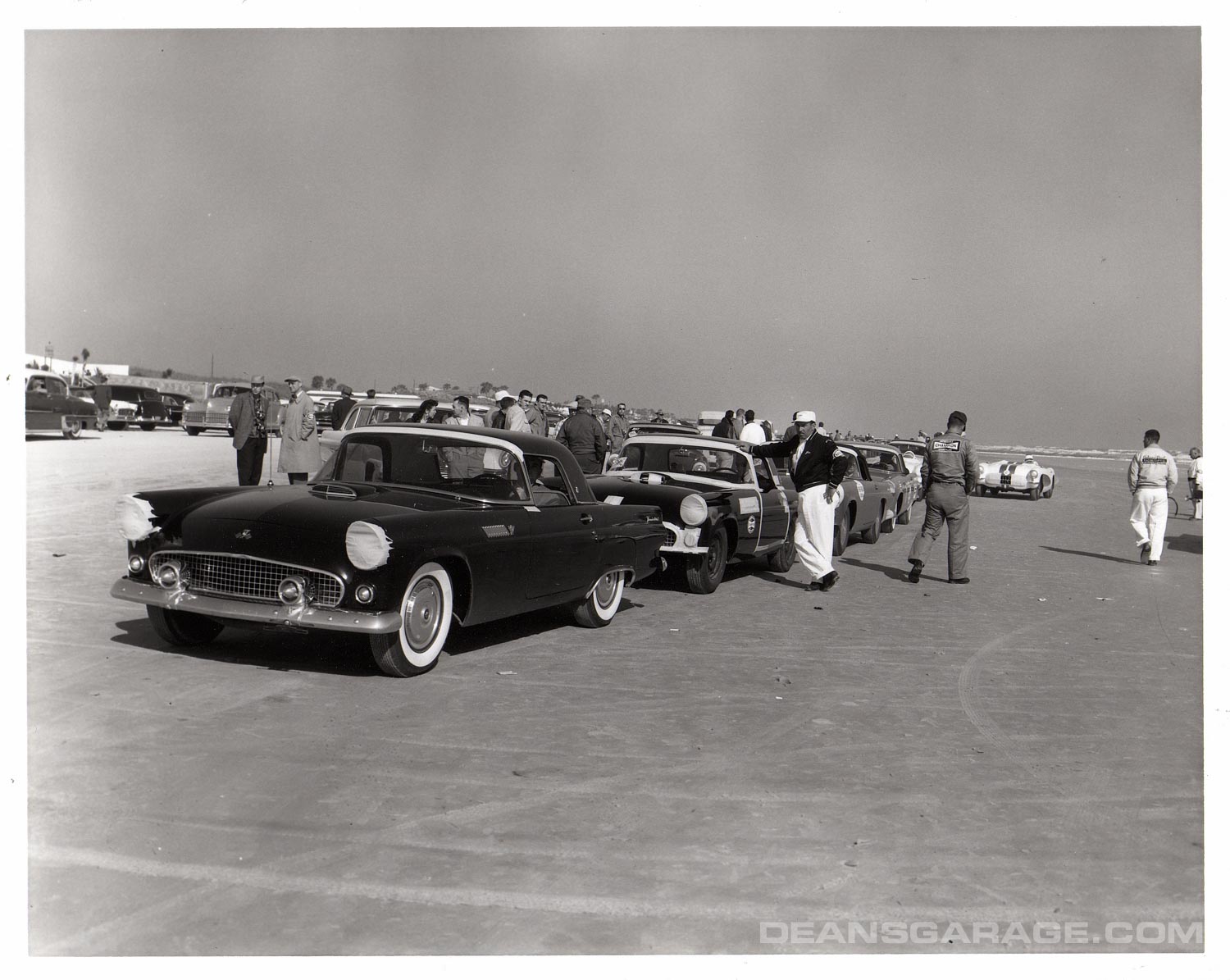
A Raven Black ’55 Thunderbird followed by several ’56s. Note at the back of the line a modified ’56 Corvette. There were several classes allowing varying degrees of modifications. Such as the “200 mph racing tape” on these Thunderbirds in an effort to cut drag.
Tests were for both acceleration and top speed in both directions through the Flying Mile. The goal was to achieve membership in “The Century Club” which was a speed greater than 100mph through the Flying Mile.
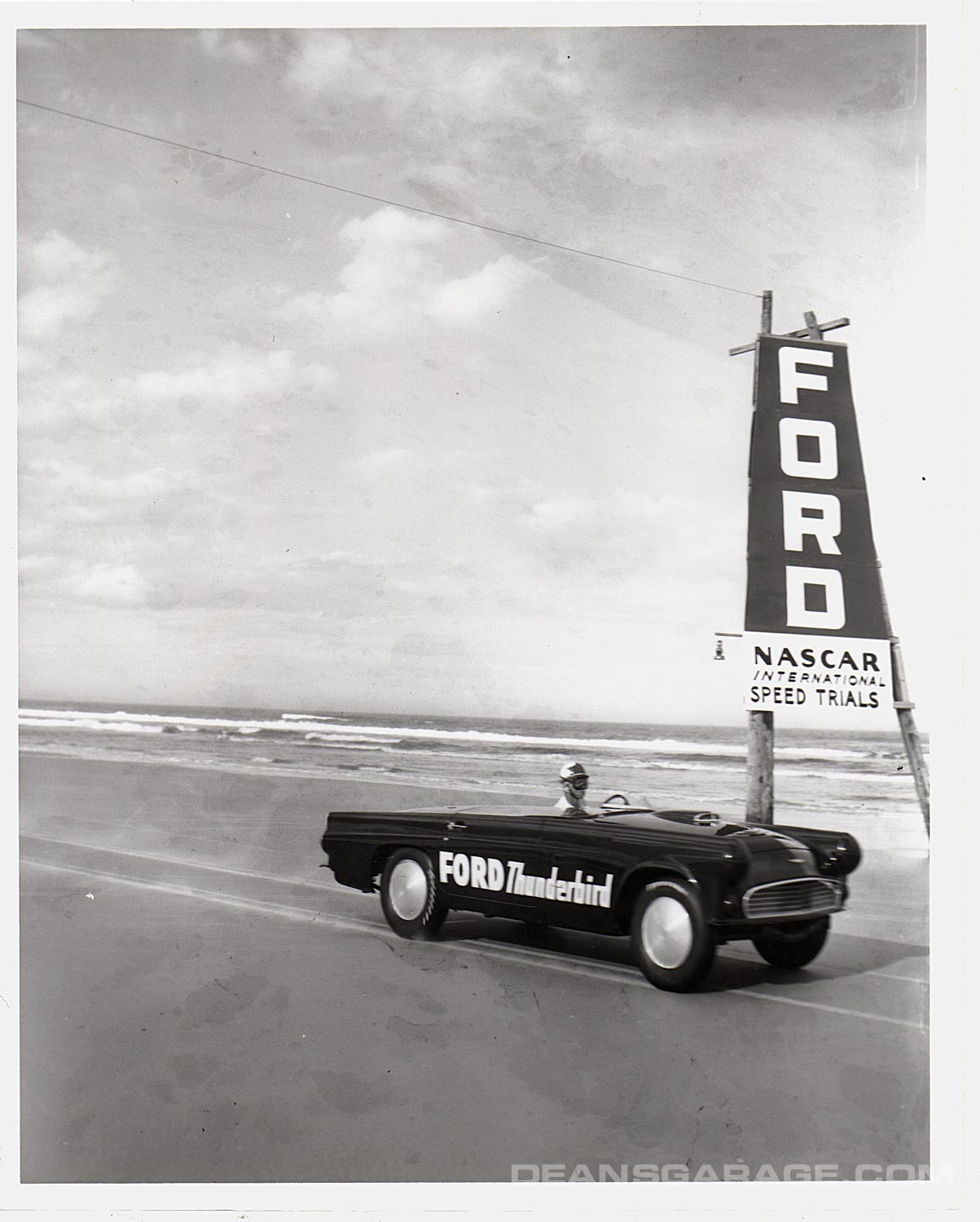
Above we have a much more modified ’56 with just a small Perspex racing windshield and spun aluminum Moon style wheel covers. From the big signpost we can tell that Ford was an active sponsor. The tide must be going out as there is still a sheen of water on the sand and wheel tracks in it as well. A north to northeast wind and receding tide were the essential elements to a smooth glass racing surface.
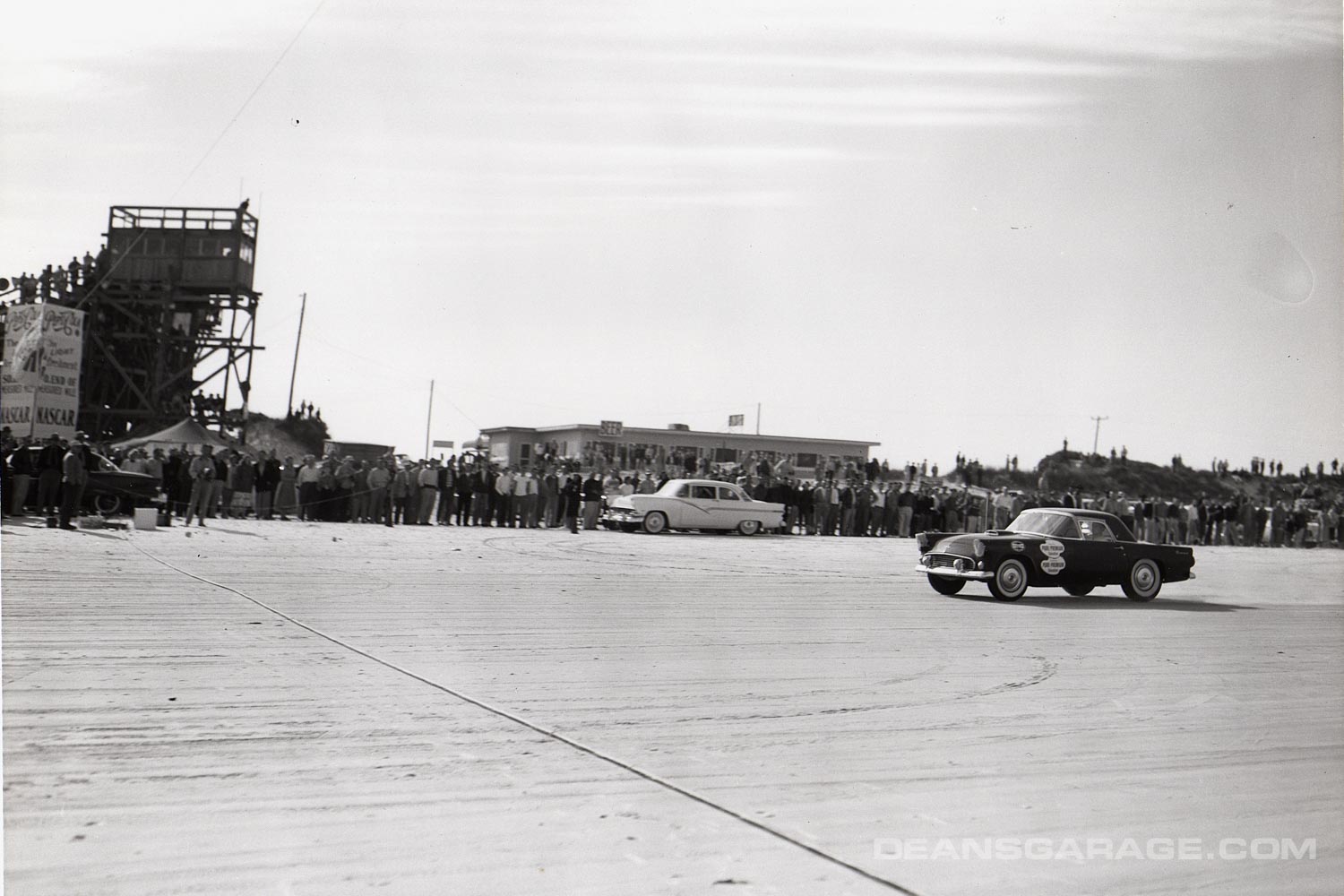
This taped up ’55 at speed is in front of the North Turn Bar. Note the “Beer” sign above the ’56 Fairlane Club Sedan. And just to the left (due south) of the bar are the north turn grandstands of the Beach-Road Course. To the north of the North Turn Bar there is nothing more than sand dunes and a few houses off in the distance.
The North Turn Bar still exists today in a much-expanded building. It is full of old beach racing photos and other memorabilia. Definitely worth a stop for a burger and beer if in the area. A lot of history there!
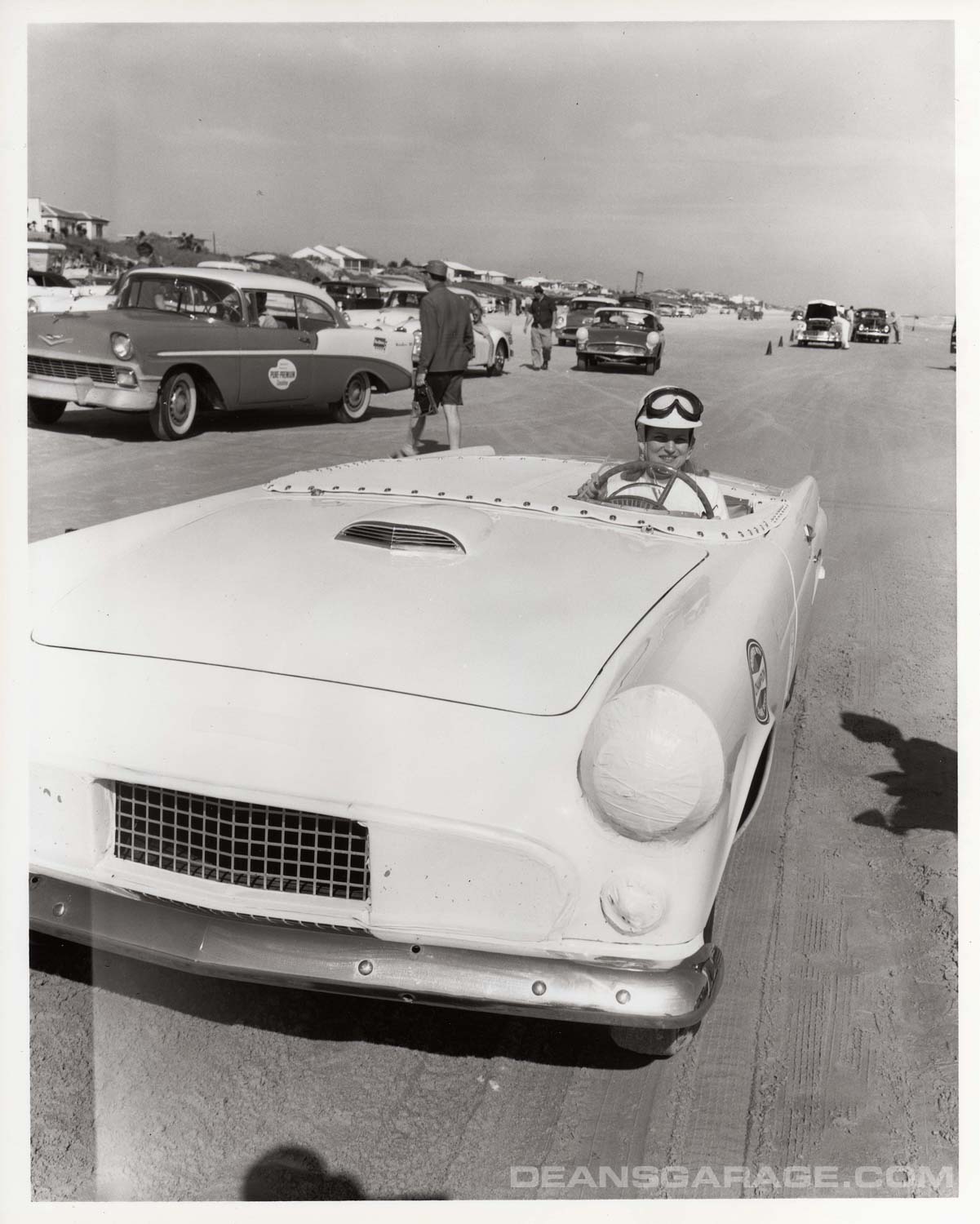
There were more than several female drivers. A bone stock ’56 Bel Air behind this highly modified ’56 Thunderbird driven by Freda Herrman.
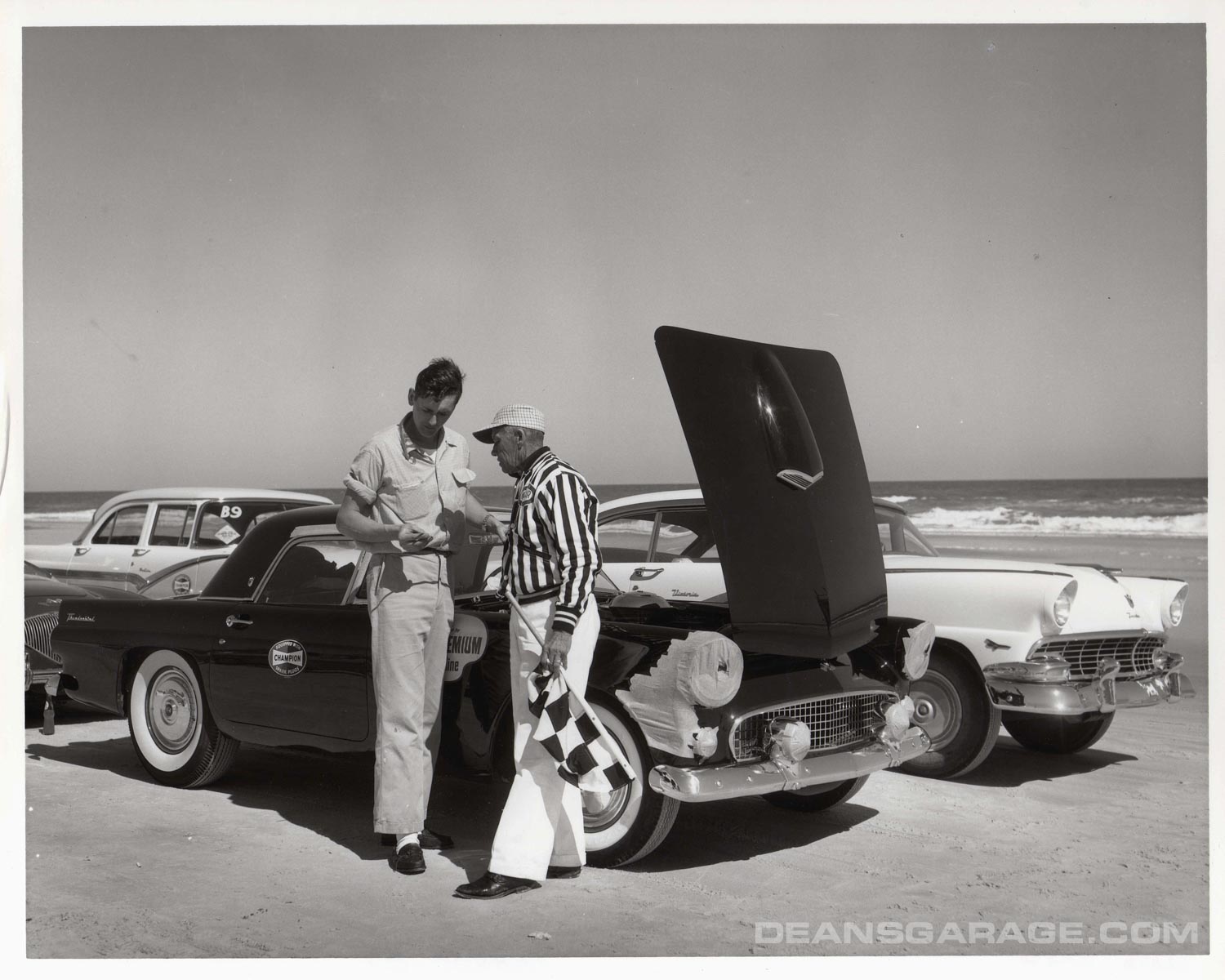
A dipstick inspection with a NASCAR official. To the right a stock ’56 Fairlane Victoria. An Austin Healey and ’56 Town Sedan behind.
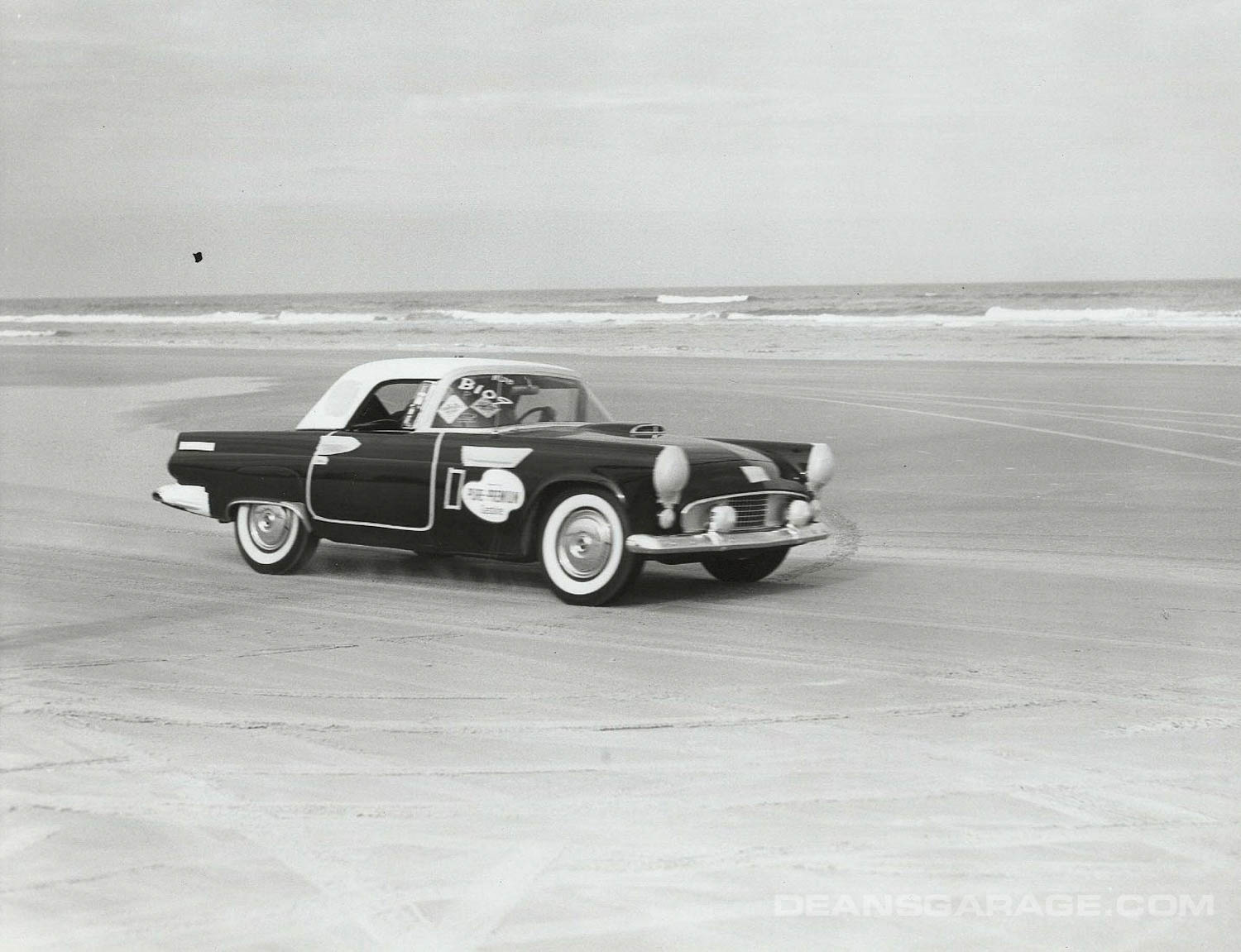
A taped up ’56 Thunderbird at speed.
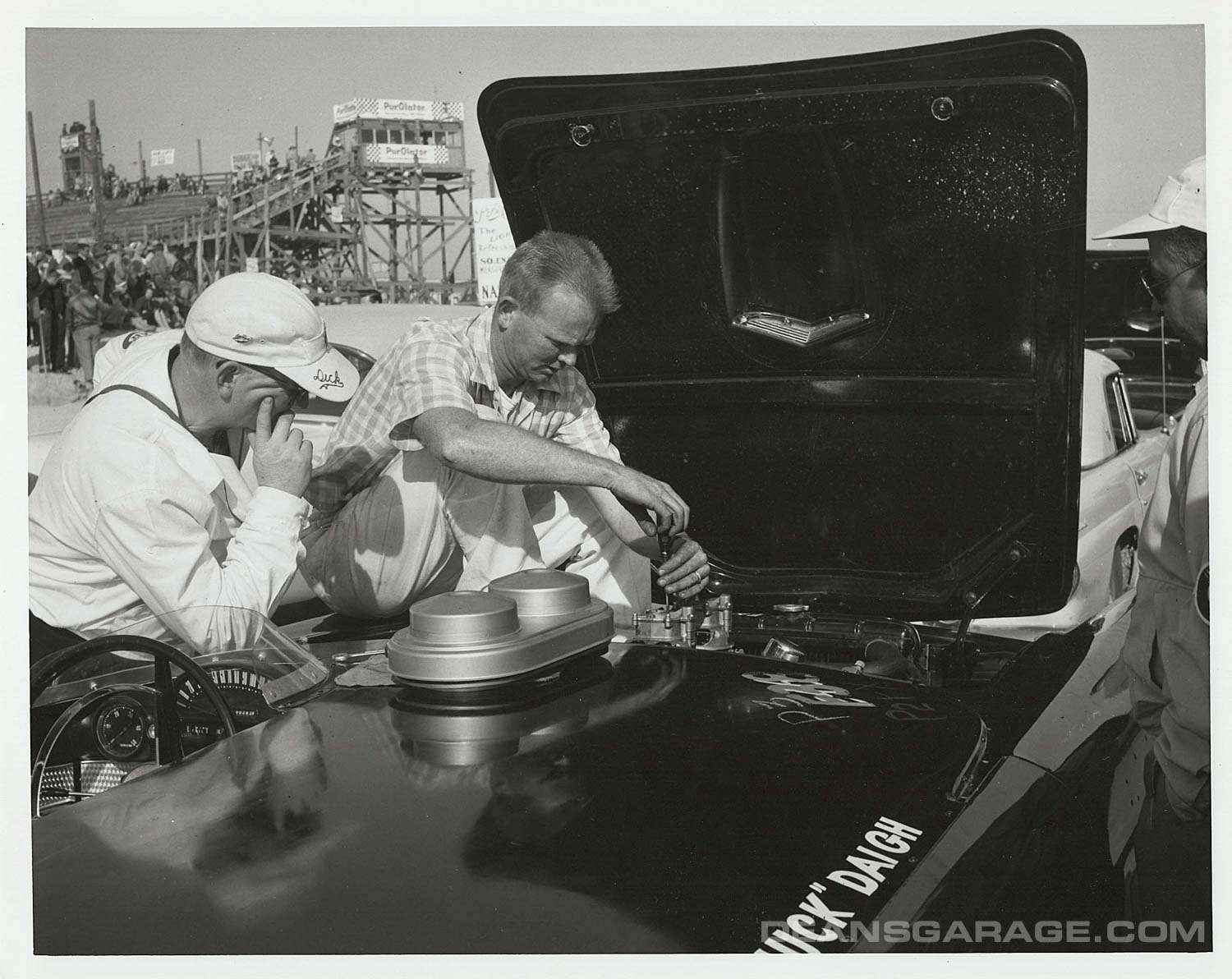
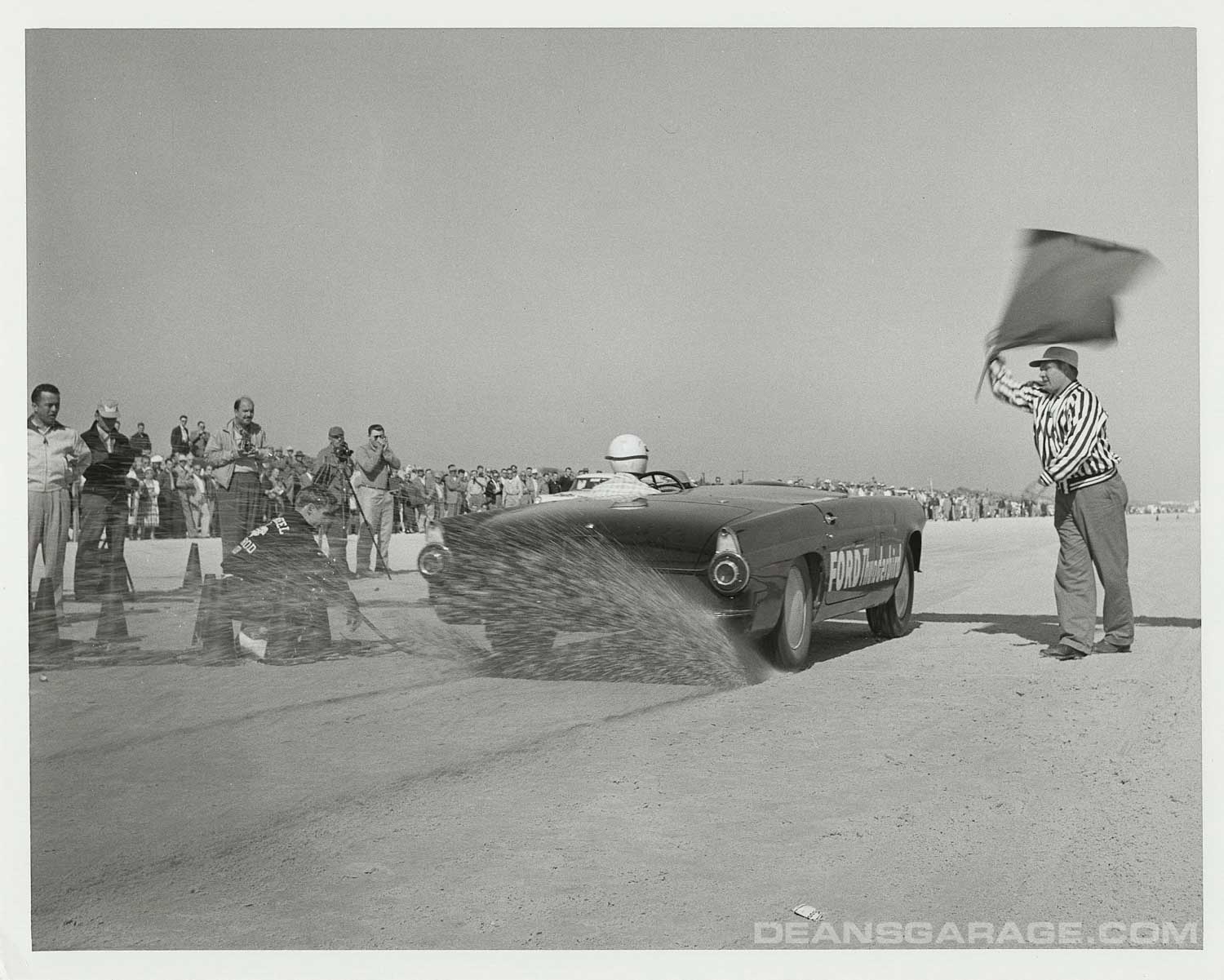
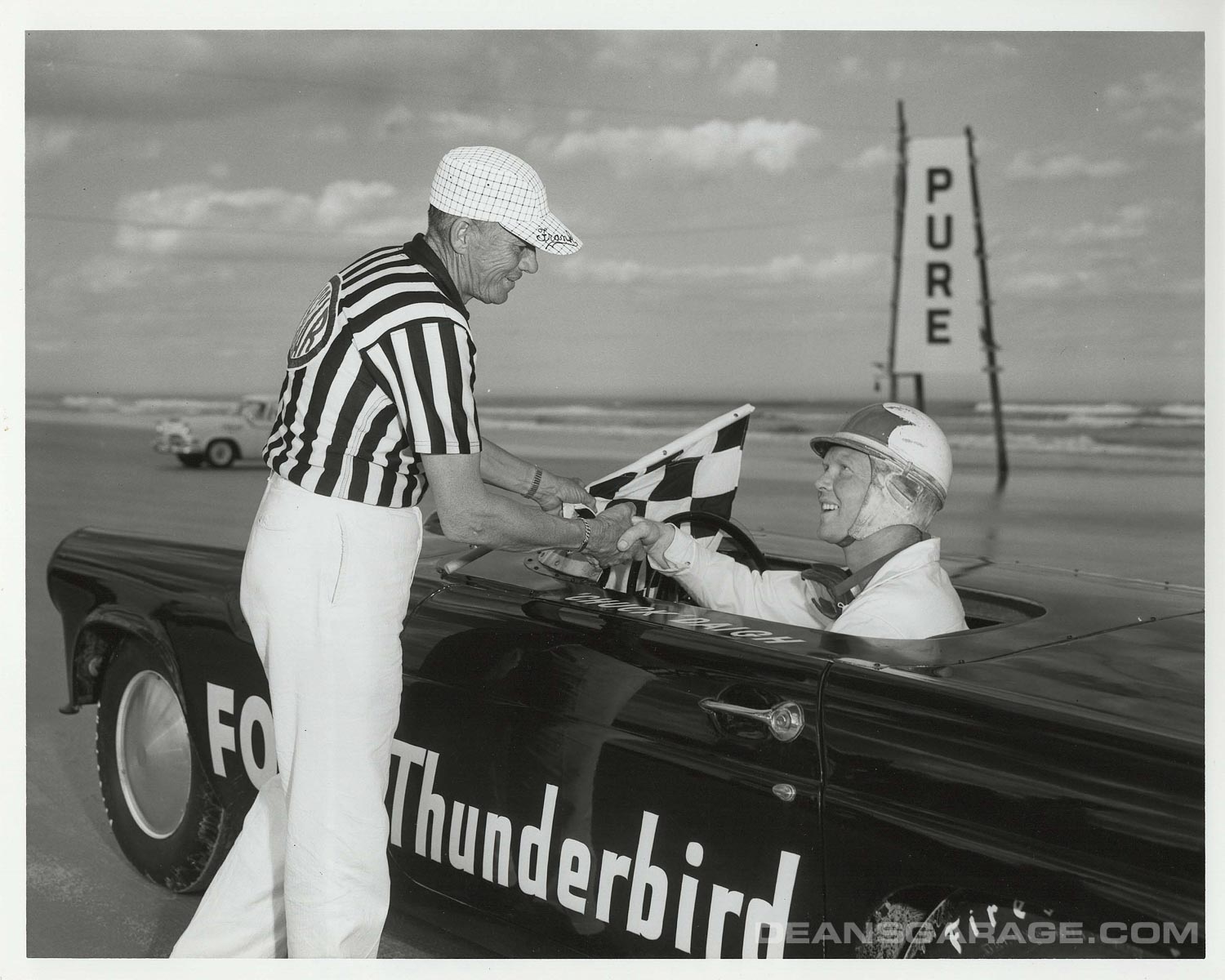
These photos are of Californian Grand Prix and sports car driver Chuck Daigh adjusting and driving a heavily modified 2×4 bbl 312 cu. in. Y-Block. Chuck started out driving Scarabs for Lance Reventlow. Chuck is in the checked shirt sitting on the fender. North turn grandstands in the background.
In the last photo Chuck is lined up for the start, launch and take the checkered flag from a NASCAR official. He won the standing start acceleration run competition at 88.779 mph. Note the Studebaker contingency in the background of the first picture.
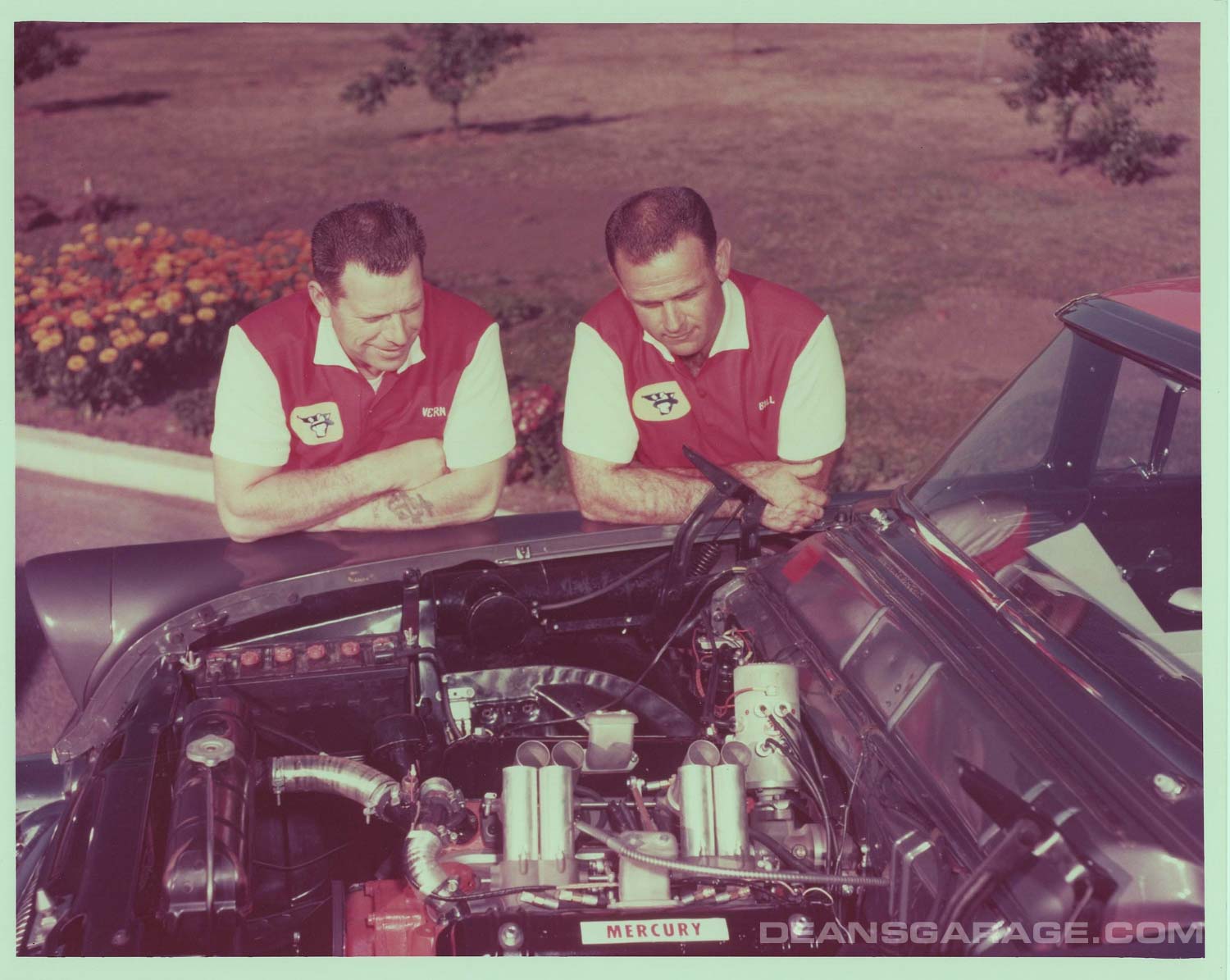
After the Mexican Road Races were canceled Bill Stroppe (right) furthered his career with Mercury. Stroppe was close friends with Benson Ford who at that time headed up the Mercury Division. Stroppe was from Long Beach, California and participated in many West Coast USAC and Baja events. In 1960 he teamed up with Holman-Moody.
Vern Houle on the left drove this car to 152 mph in the Flying Mile competition.
Note the Hilborn style fuel injection and a magneto instead of a distributor on this ’56 Mercury Montclair.
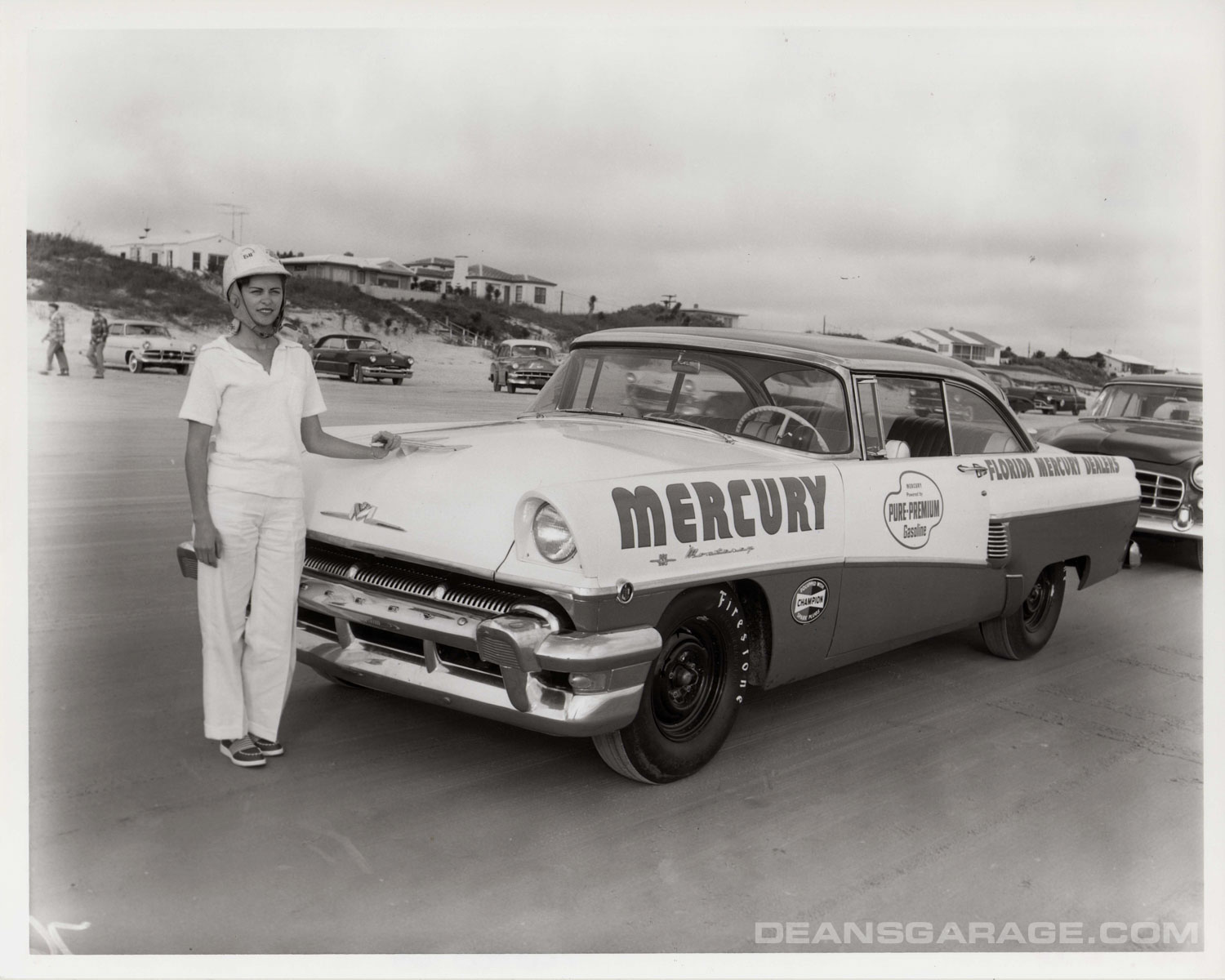
One of the Stroppe built ’56 Mercurys and driven by this lass.
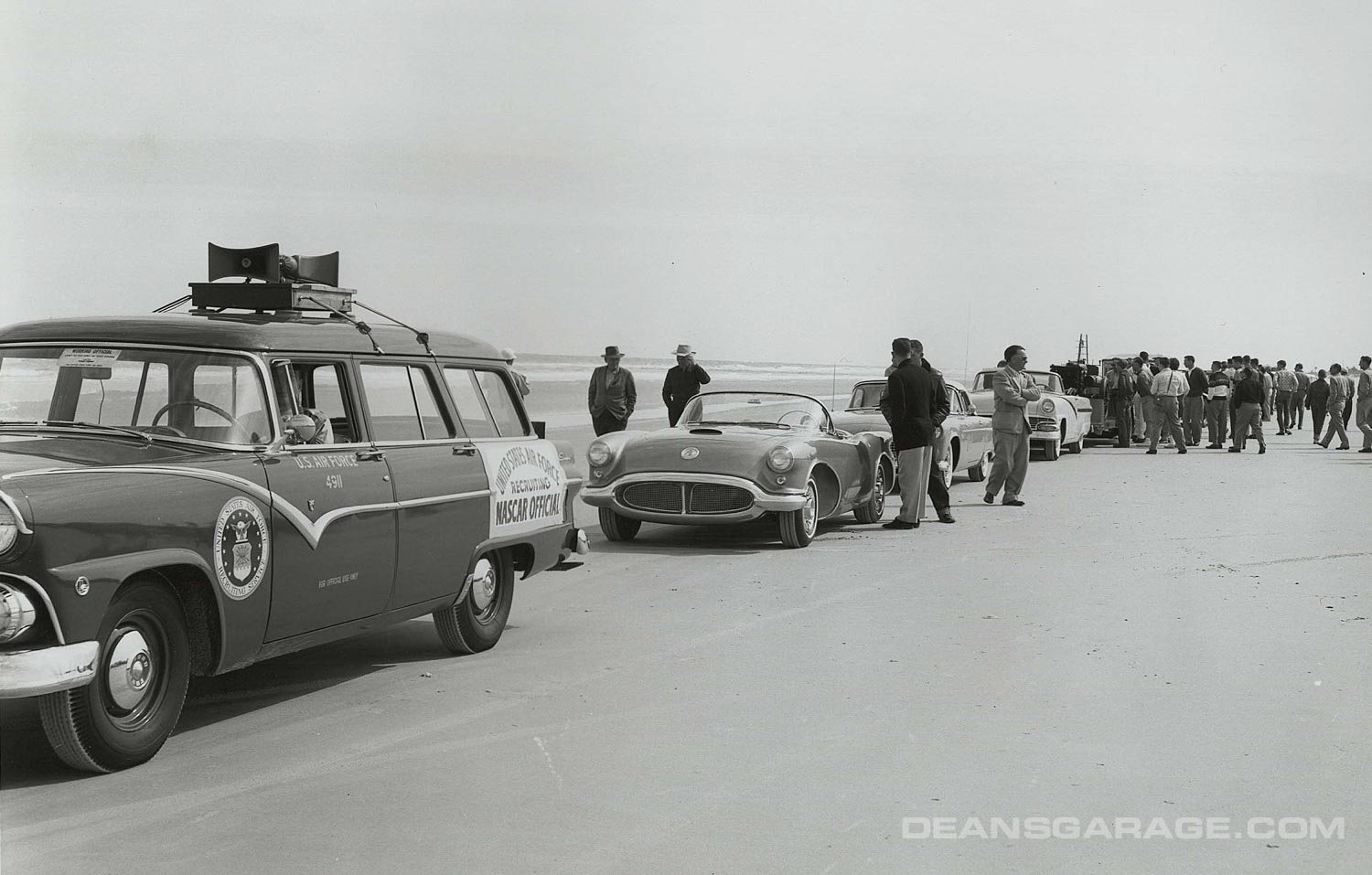
A U.S. Air Force ’55 Country Sedan leads what may be one of the more unique cars on the beach. One of four Oldsmobile F-88s built in 1954 for the GM Motorama. Penned by Bill Lange under Harley Earl’s direction. It had a 250 horsepower, 324 cu. in. Olds Rocket 88 V-8. Only one of the four exist today, which is on display at the Gateway Museum in Colorado. It was sold to them at Barrett-Jackson in 2005 for $3.3M. I was on the stage when it sold. To call that a spectacle would be a huge understatement!
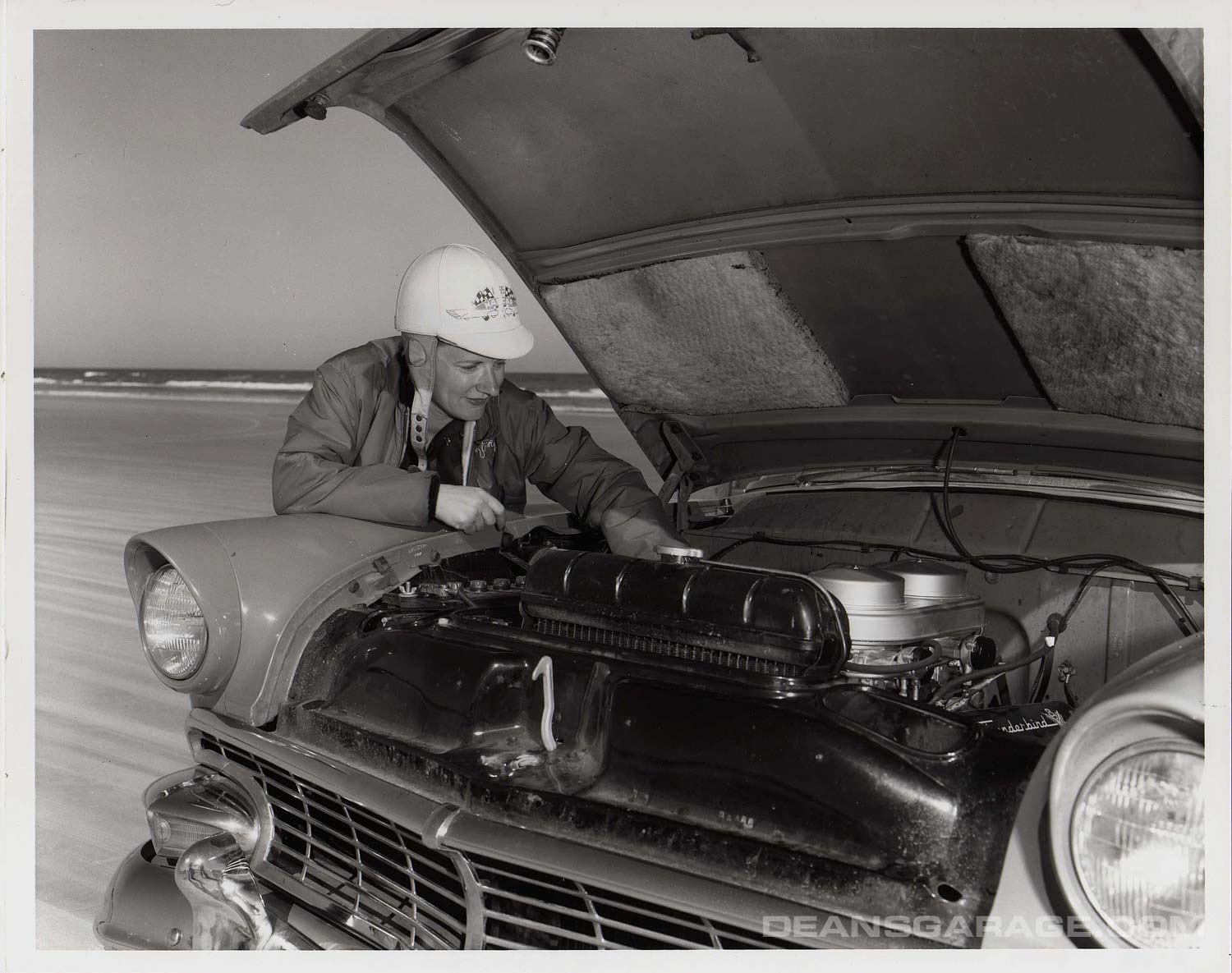
Mrs. Vicki Wood from Belleville, Michigan raced in the Women’s Division. She raced this “E Code” 2×4 bbl ’56 Ford Customline Club Sedan and a Chrysler 300B. Got the Chrysler up to 130 mph in the Flying Mile.
During the time trials Vicki would often race on the beach wearing a dress and heels. She wanted to let the boys know they were beaten by a girl! She had raced from 1953 to 1963 when she retired. But she kept driving till age 99. She paved the way for a lot of younger female drivers and achieved a record 150 mph on the beach in a ’60 Pontiac. She was an idol of Danica Patrick.
Vicki passed away June 5, 2020 at age 101.
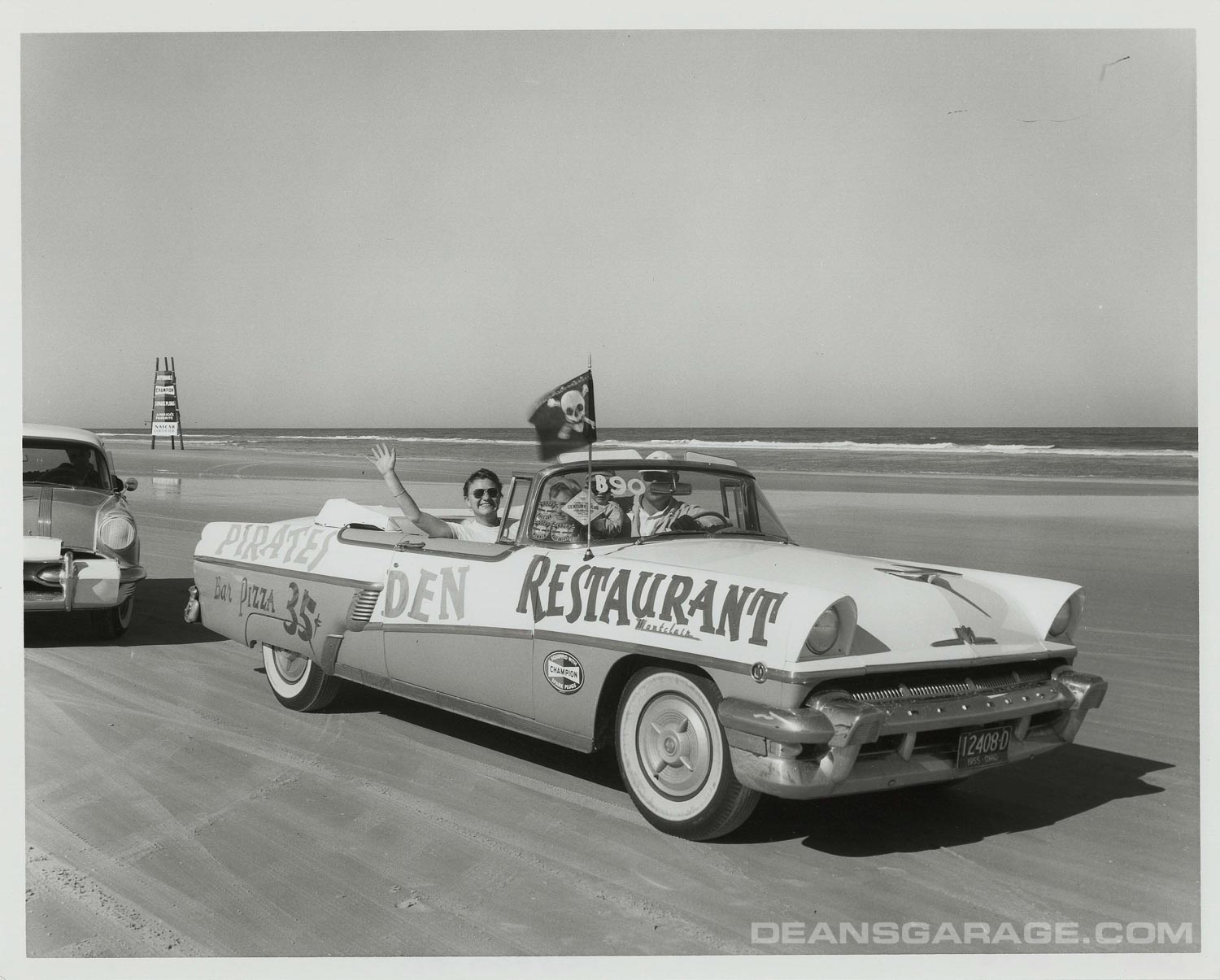
A fun shot of some spectators adverting their restaurant with the ’56 Mercury Montclair convertible. A pizza for .35 cents seems like a good deal!
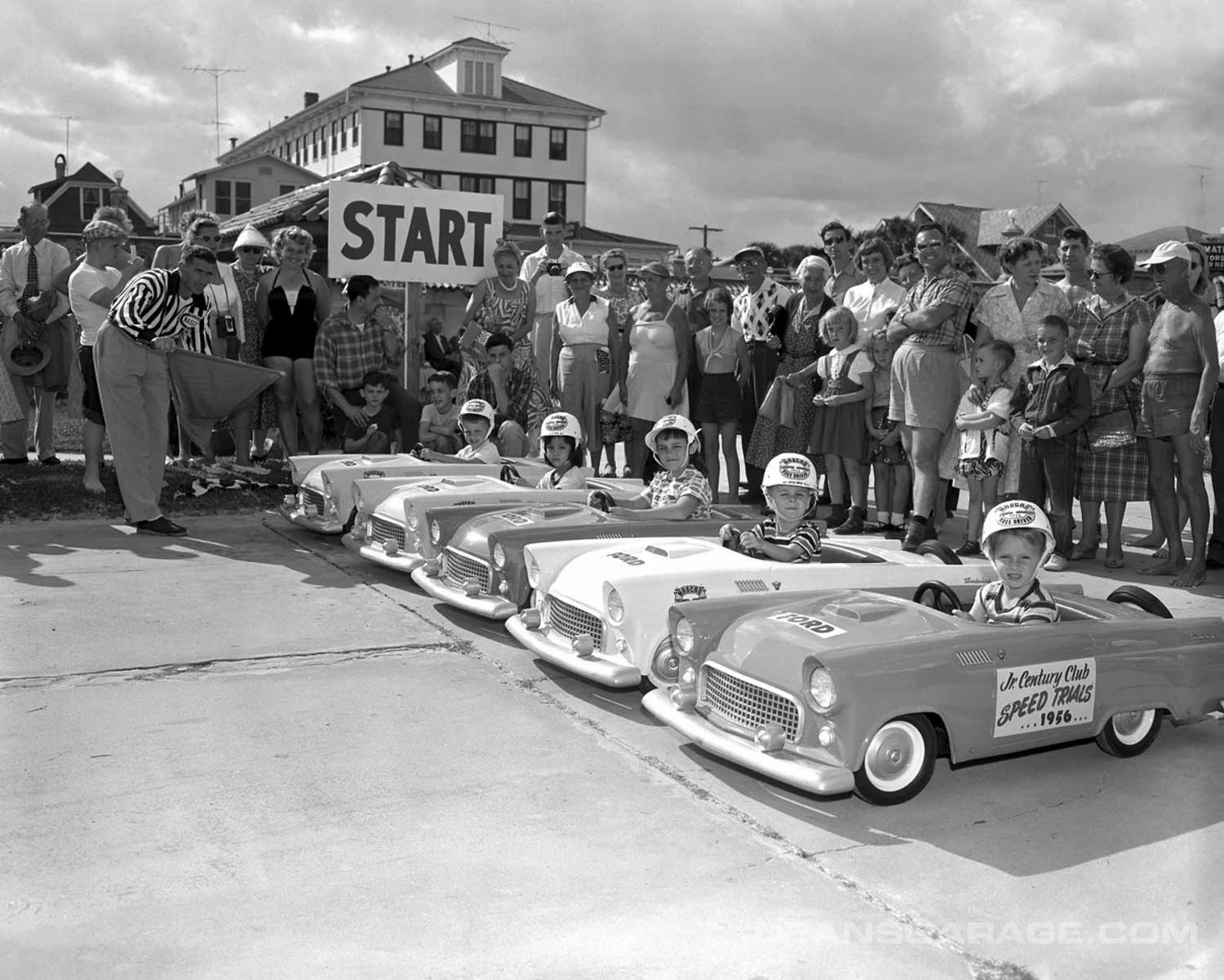
The 5–8 year olds had their own Junior Century Club Speed Trials in their Junior ’56 Thunderbirds. Get ’em started early!
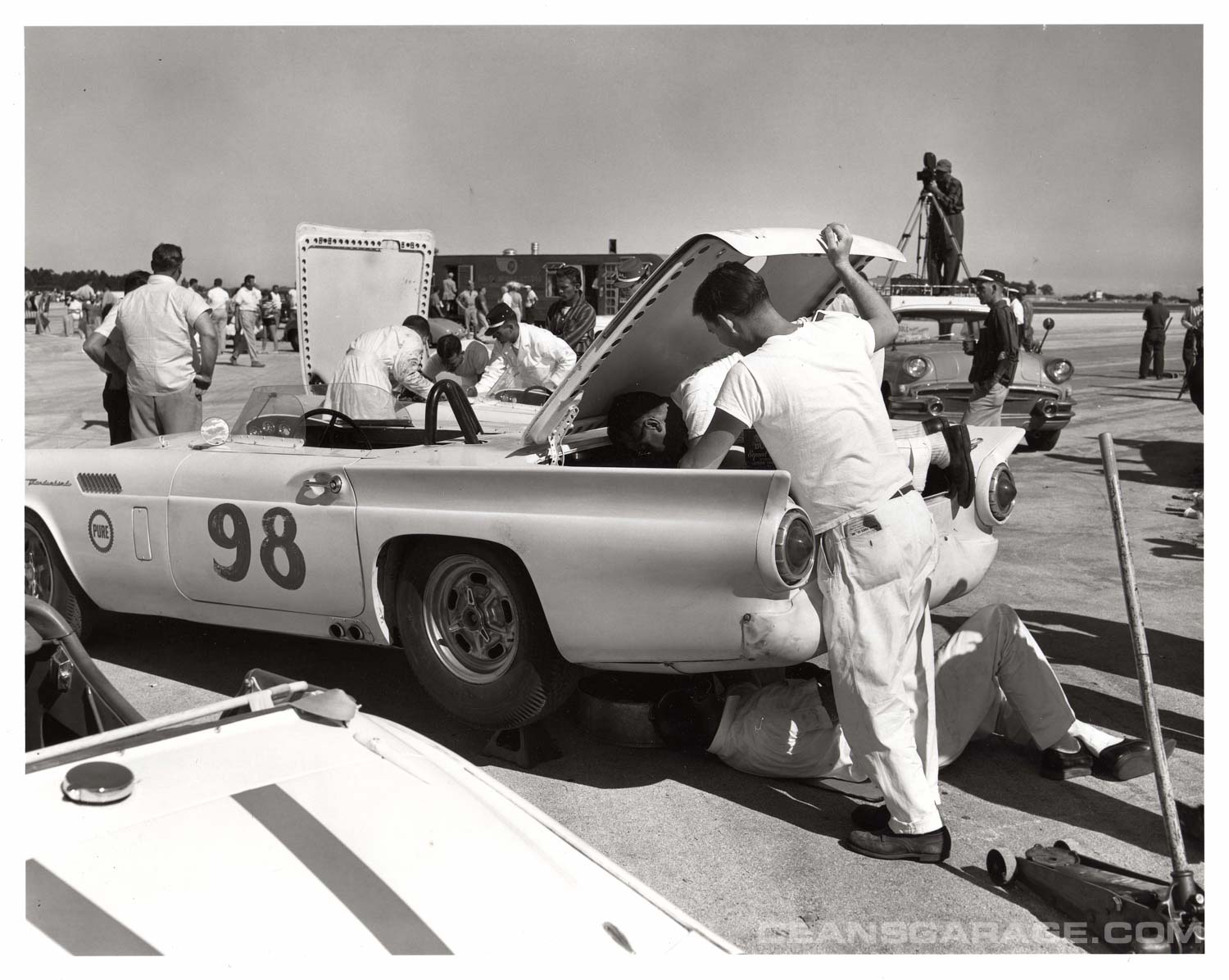
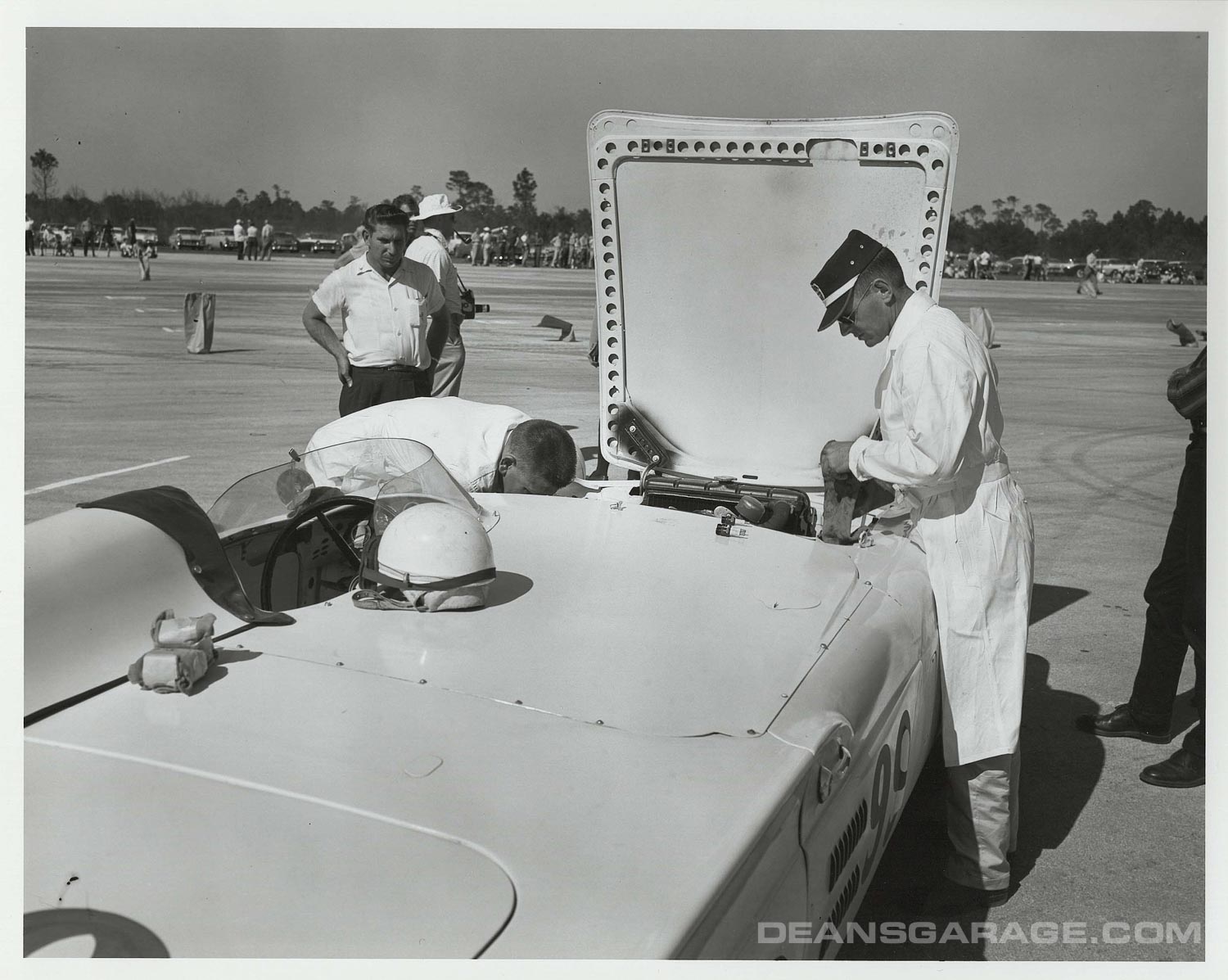
Moving to the 1957 Speed Weeks we see a highly modified ’57 Thunderbird. One of two famed “Battlebirds” that also raced on the track at New Symna Beach and Sebring. One had a 430 cu. in. Lincoln motor. The other a 312 stroked to 348 cu. in. with a Hilborn injection set up. Both were built by Pete DePaulo of DePaulo Engineering in his California shop.
Note the exhaust peeking out from the left rocker panel, lightweight Halibrand wheels and the holes drilled and bracing removed in the hood and trunk to save weight. Doors, hood, deck lid, tonneau cover and firewall were fabricated with aluminum. Engine was moved back four inches and utilized a Jaguar 4-speed transmission.
One of the “Battlebirds” achieved 204 mph in the Flying Mile, but since they couldn’t make the return run for some reason it could not be a record. Their two-way record of 160.356 with Chuck Daigh at the wheel did stand.
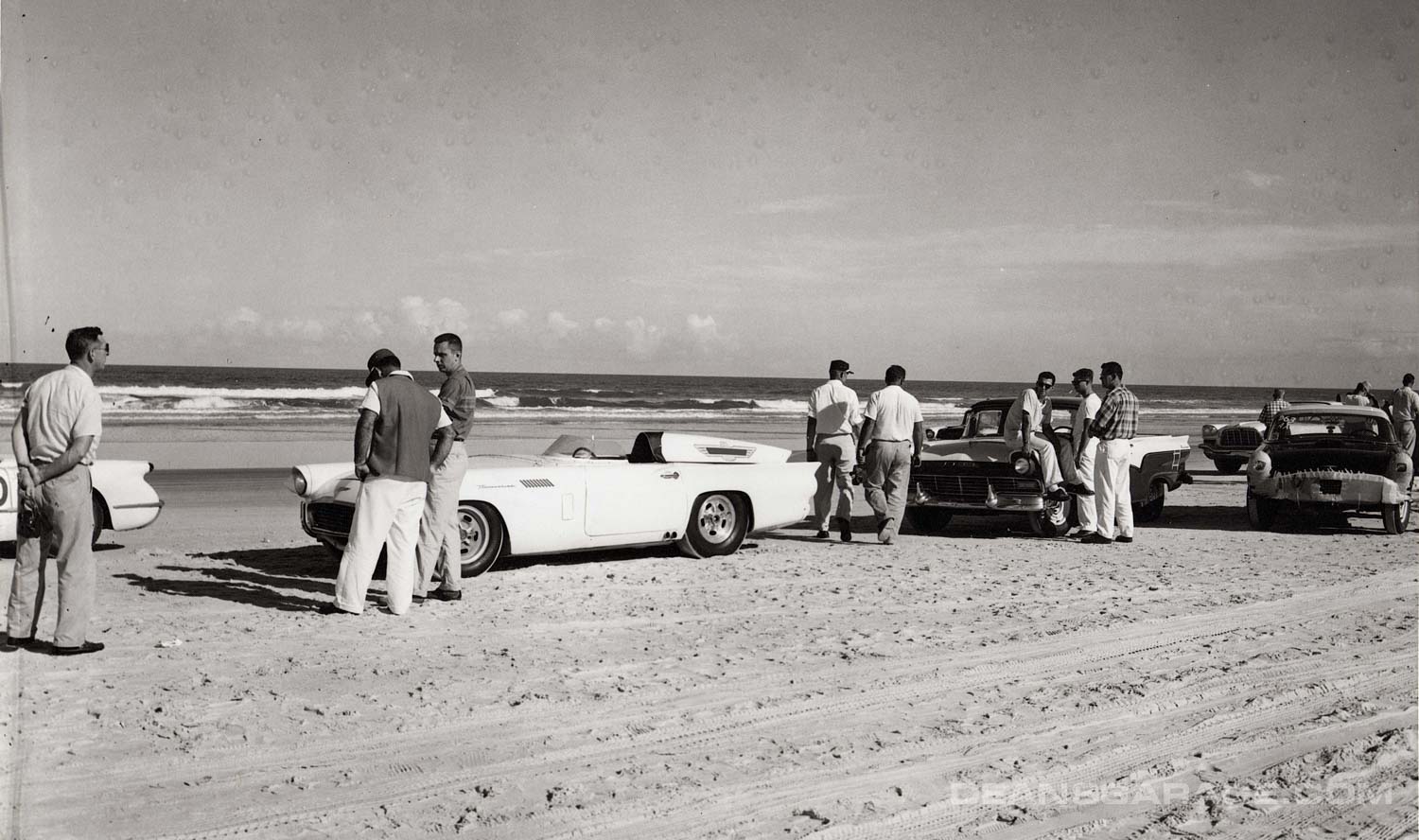
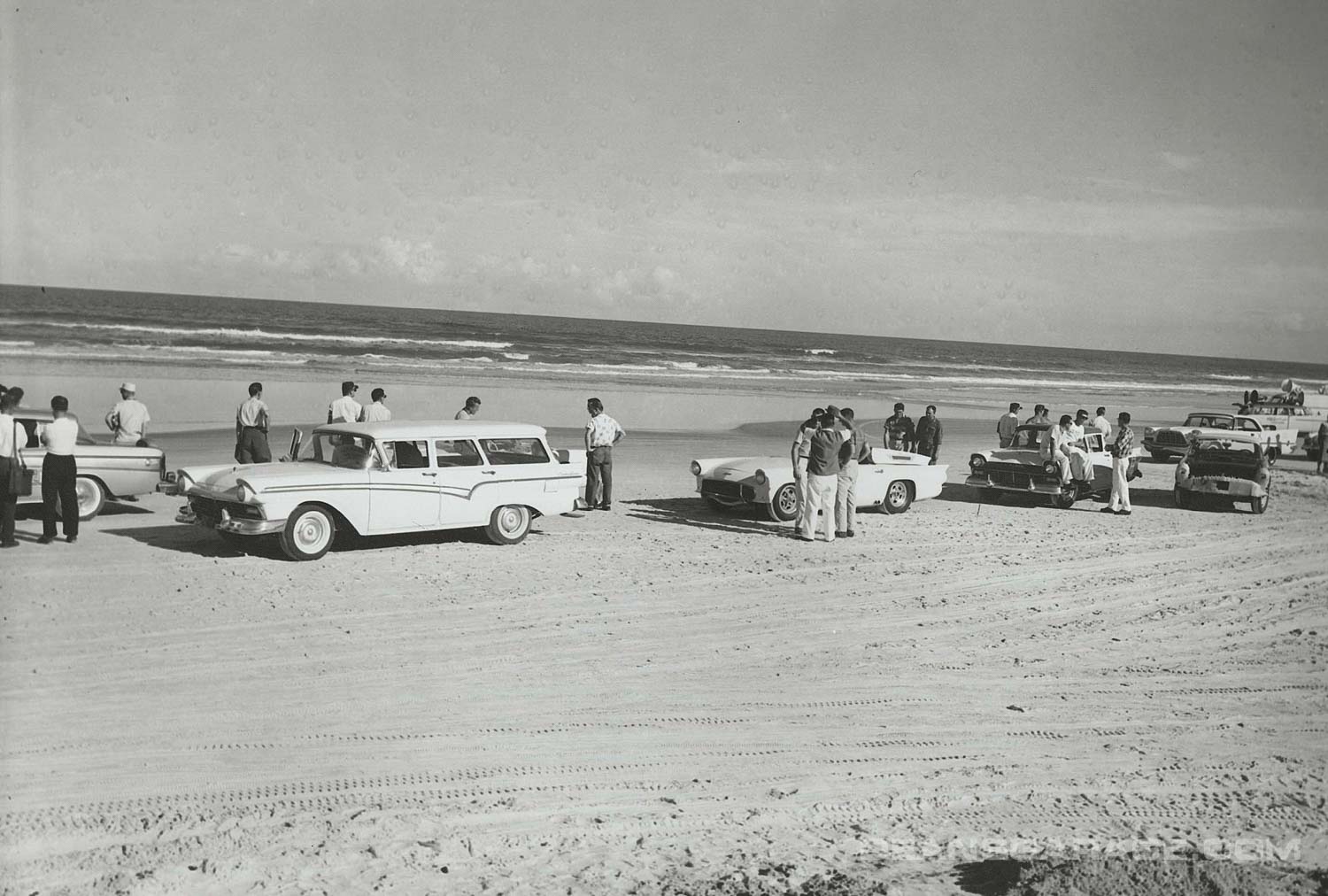
A “Battlebird” on the beach getting ready for the Flying Mile competition. Danny Eames not only drove the car, he was heavily involved in its development along with DePaulo Engineering. Eames was from Southern California and started by driving “Gow Jobs” or “Lakes” cars in the high desert. After a stint in the Marines in WWII he joined Chrysler and has involved with the Dodge and DeSoto D-500 engine program. Ford hired him away in 1955 to work on performance issues.
The Ranchero behind might look like an ordinary service vehicle, but it was anything but. One of 230 “F Code” Fords and Thunderbirds the factory built with a Paxton-McCullough centrifugal Supercharger and 4 bbl carburetor.
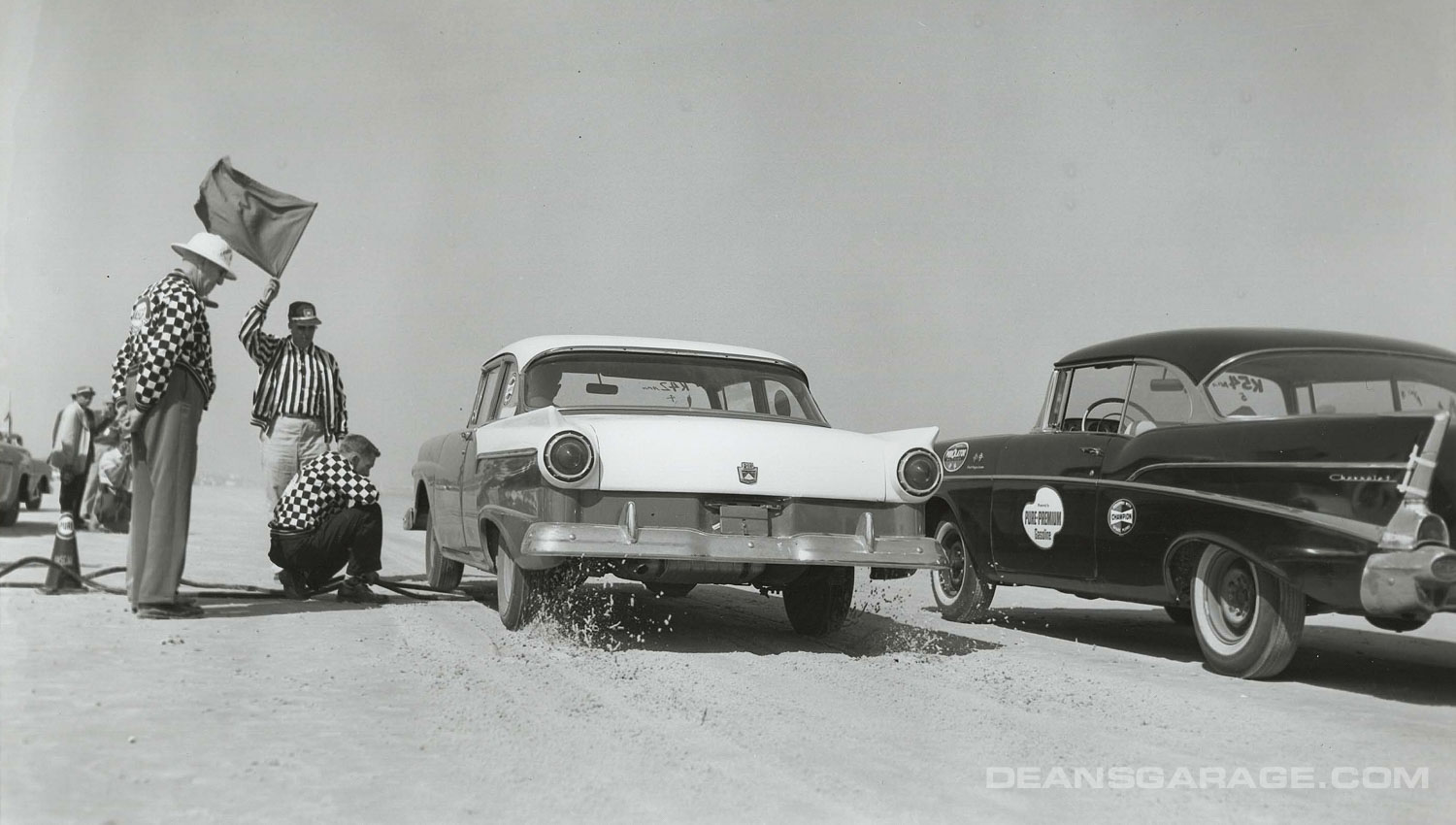
Got to have at least one ’57 Chevrolet in the story! This one being a fuel injected 210 hardtop. Note the gas filler door is taped shut.
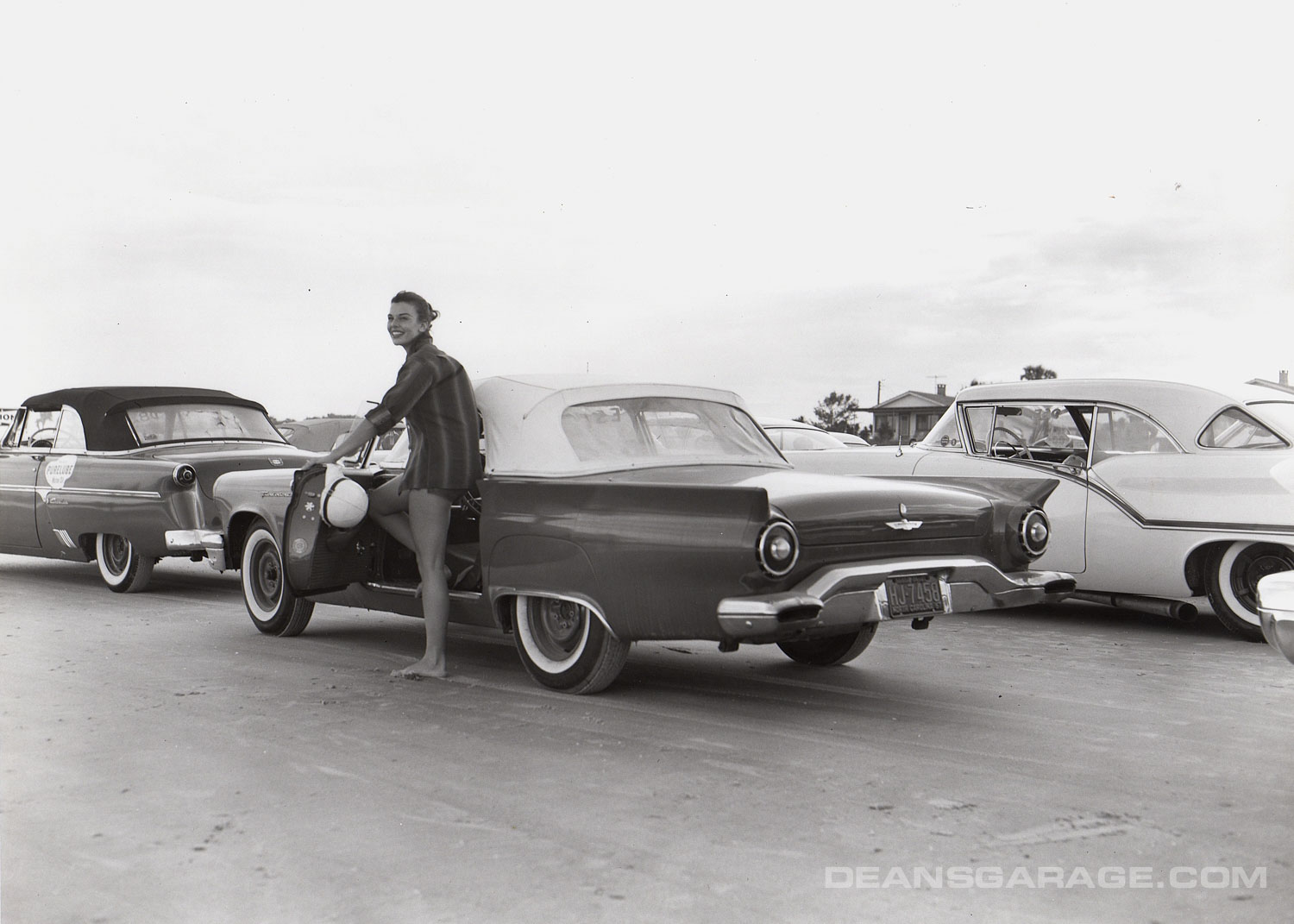
This young lady drove her ’57 Thunderbird down from North Carolina to compete. Note the rather primitive racing helmet in her left hand. But racing barefoot?
Note also the large exhaust exit under that ’57 Olds Super 88.
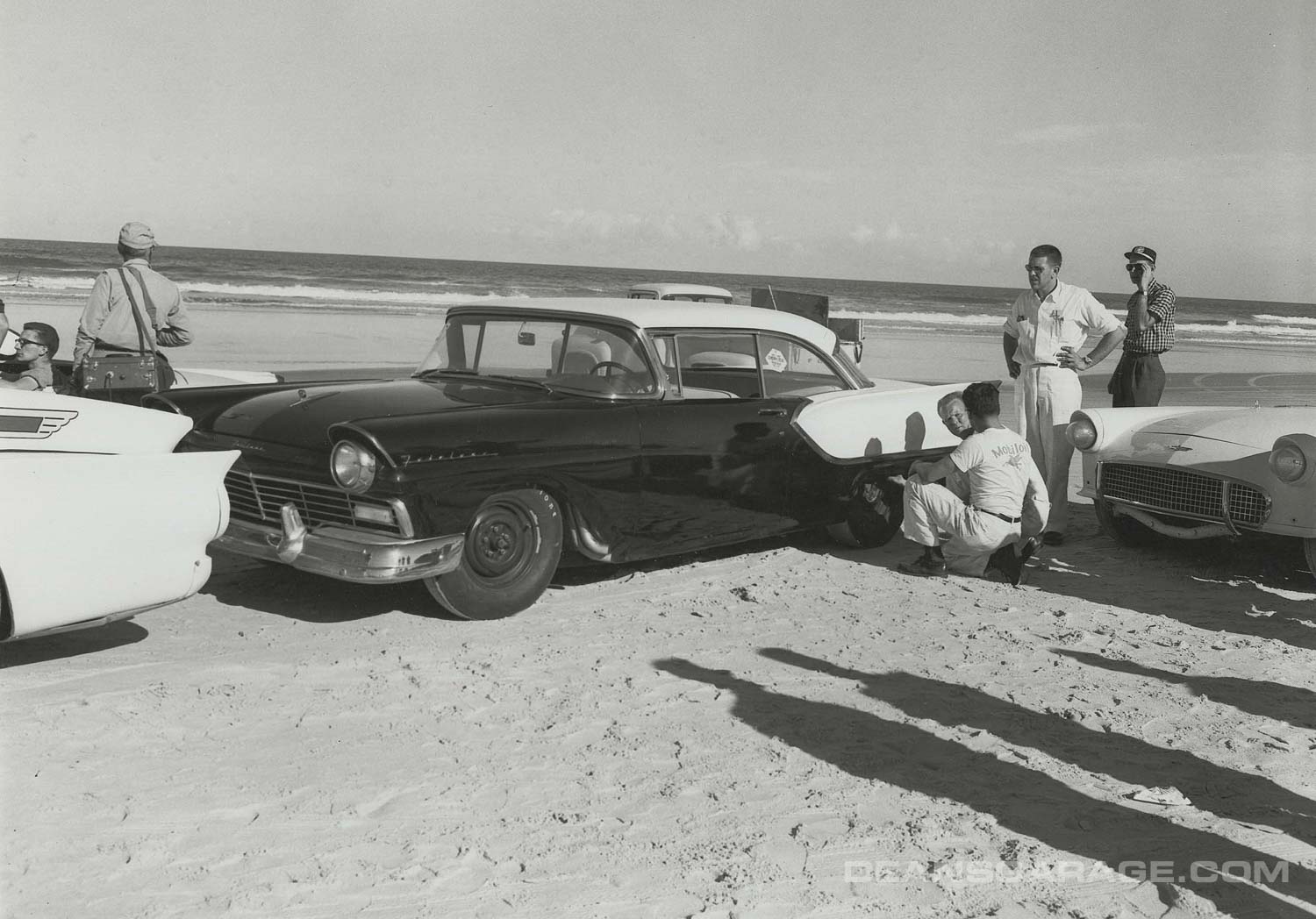
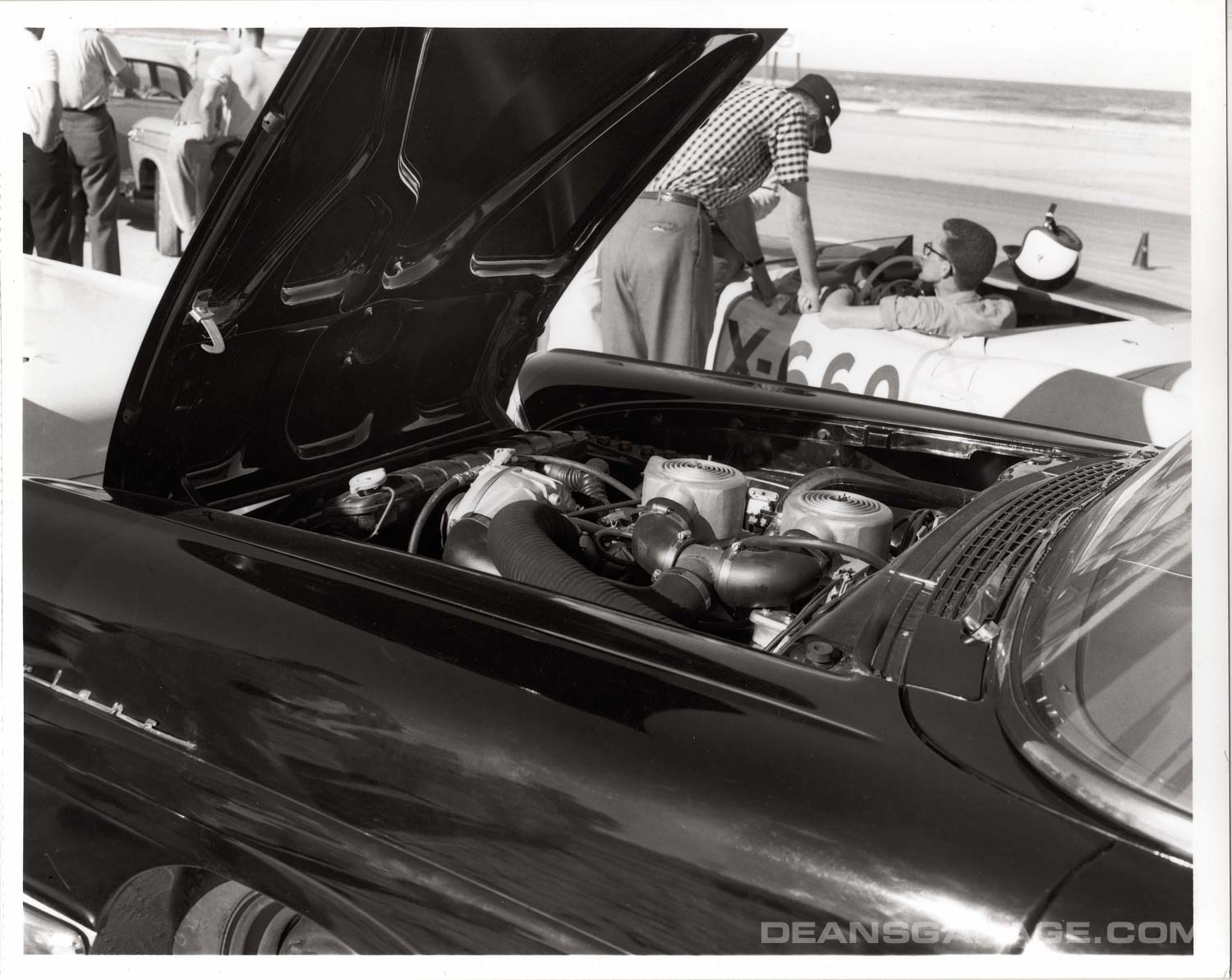
A very interesting, lowered ’57 Fairlane Victoria with 2×4 bbl carbs behind that Paxton-McCullough supercharger. Quite an engineering feat to get that all in a rather cramped engine compartment. Note above the exhaust peeking out of the front wheelhouse.
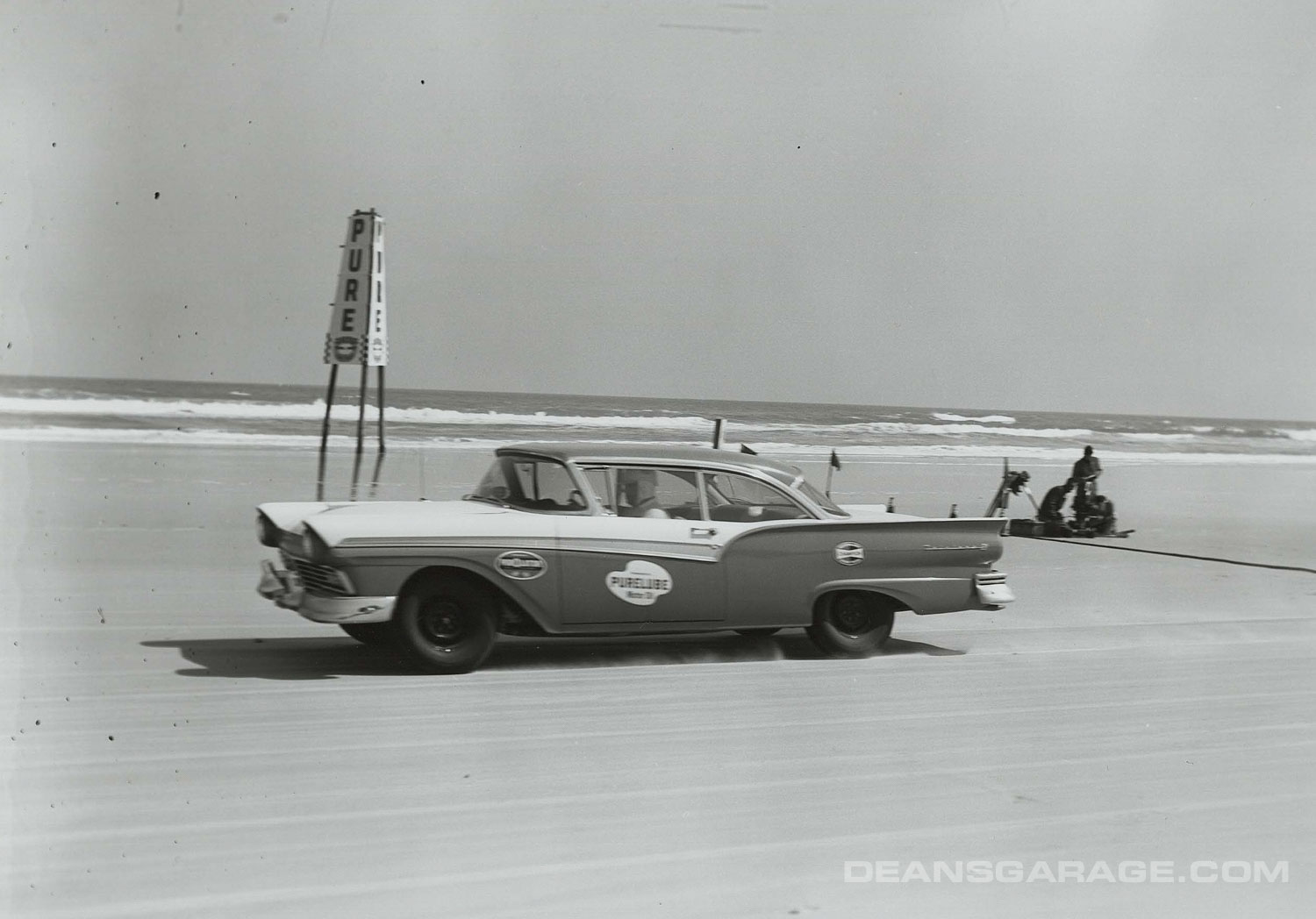
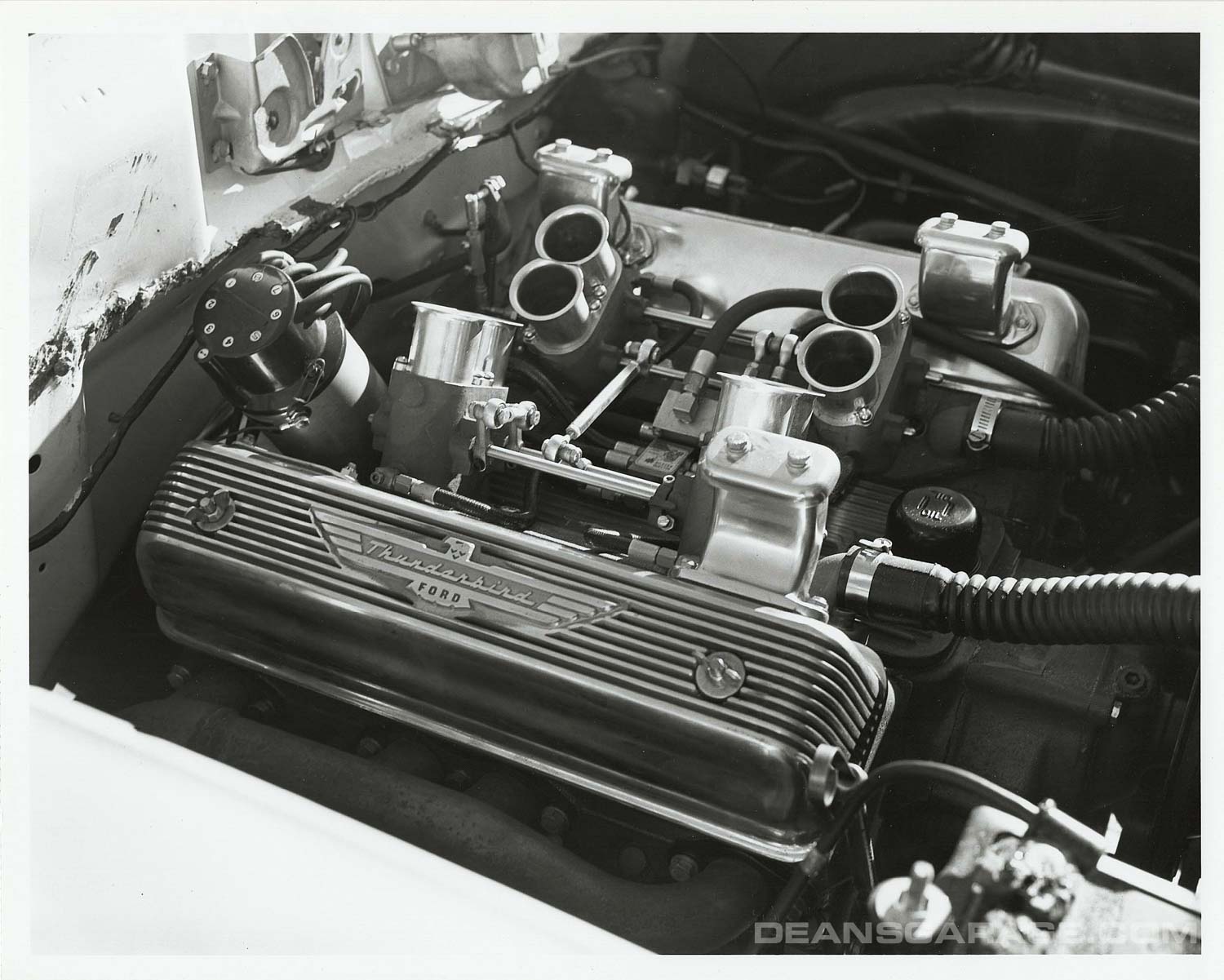
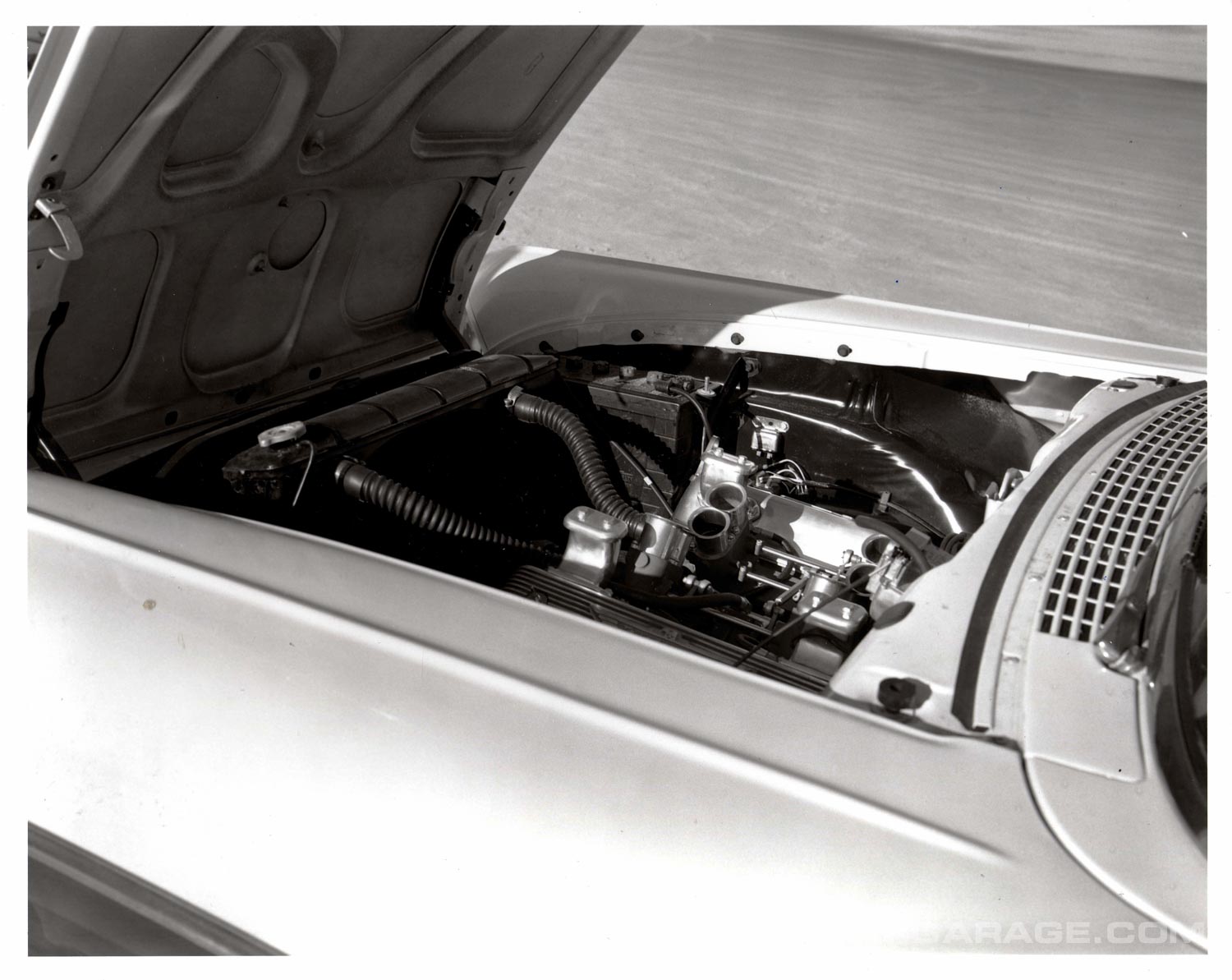
Another interesting and highly modified ’57 Fairlane 500 Victoria. This also with a Hilborn fuel injection system and Sintilla magneto instead of a distributor. Dual upper radiator hoses as well.
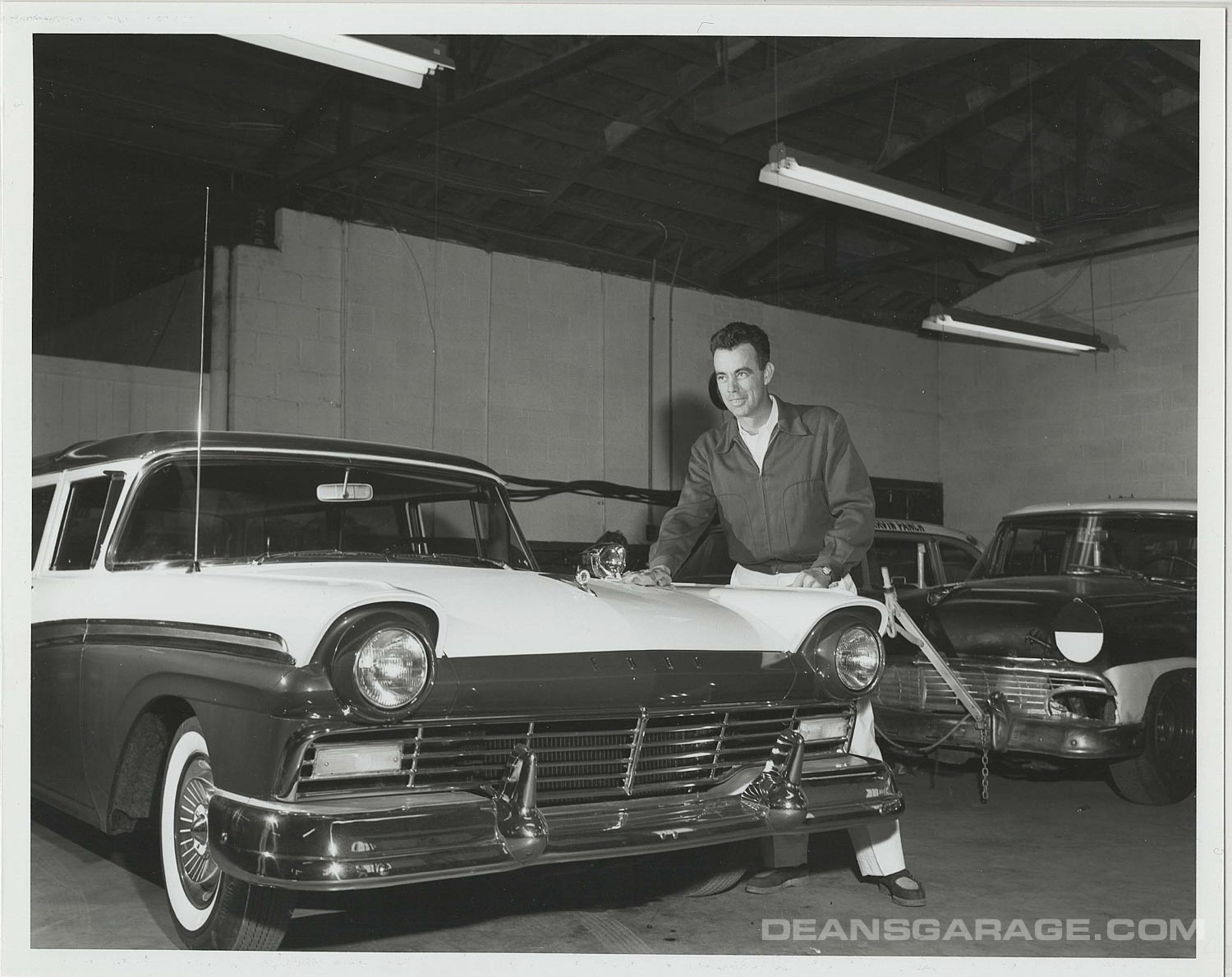
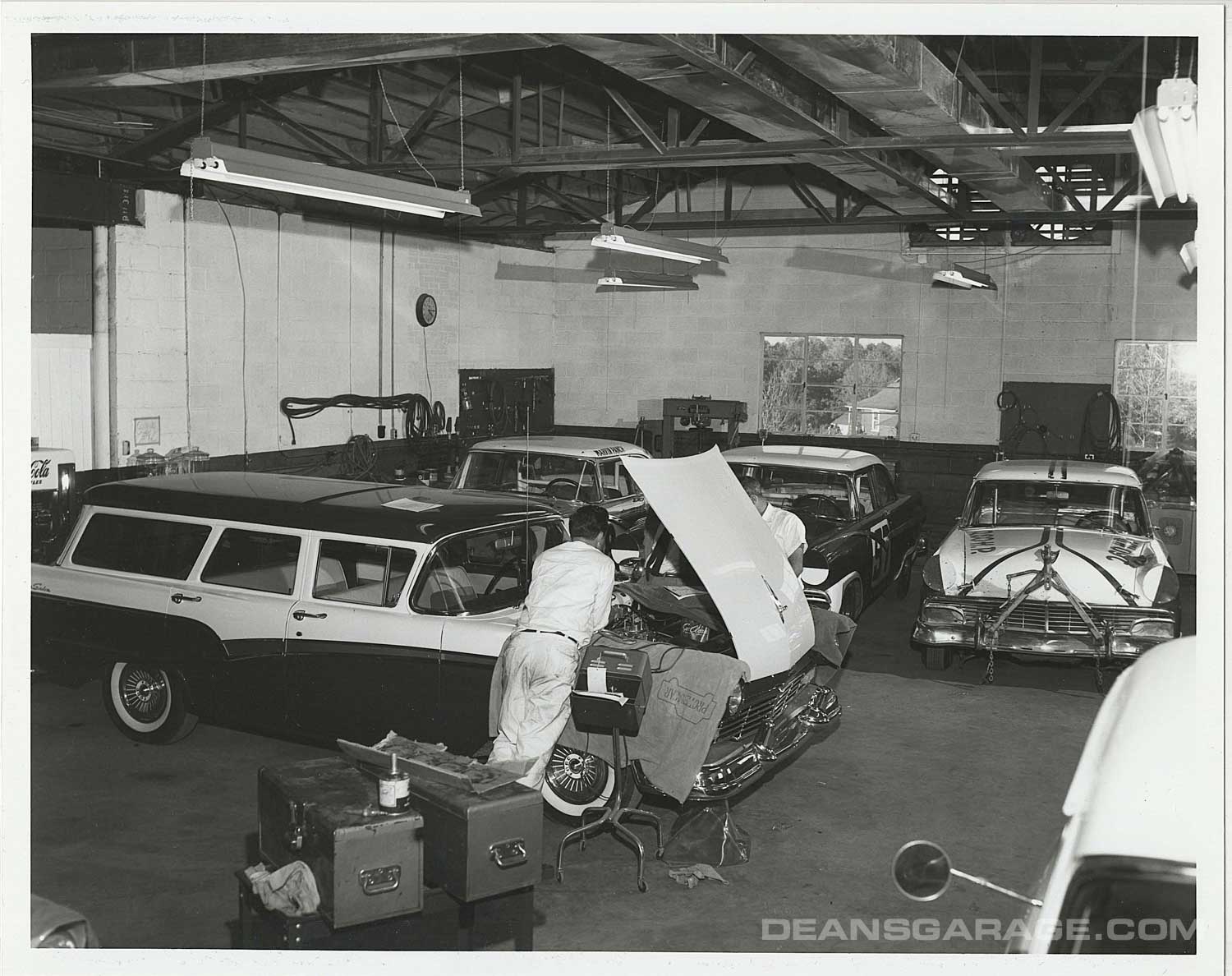
Ralph Moody of Holman-Moody fame in his shop. Compared to today’s huge NASCAR team shops, this is extremely small and primitive. You can bet that Country Sedan wagon has more than the standard 292 cu. in. Y-Block V-8! In this case a 386 Cu In ’57 Lincoln motor that was bored to over 400 cu. in.
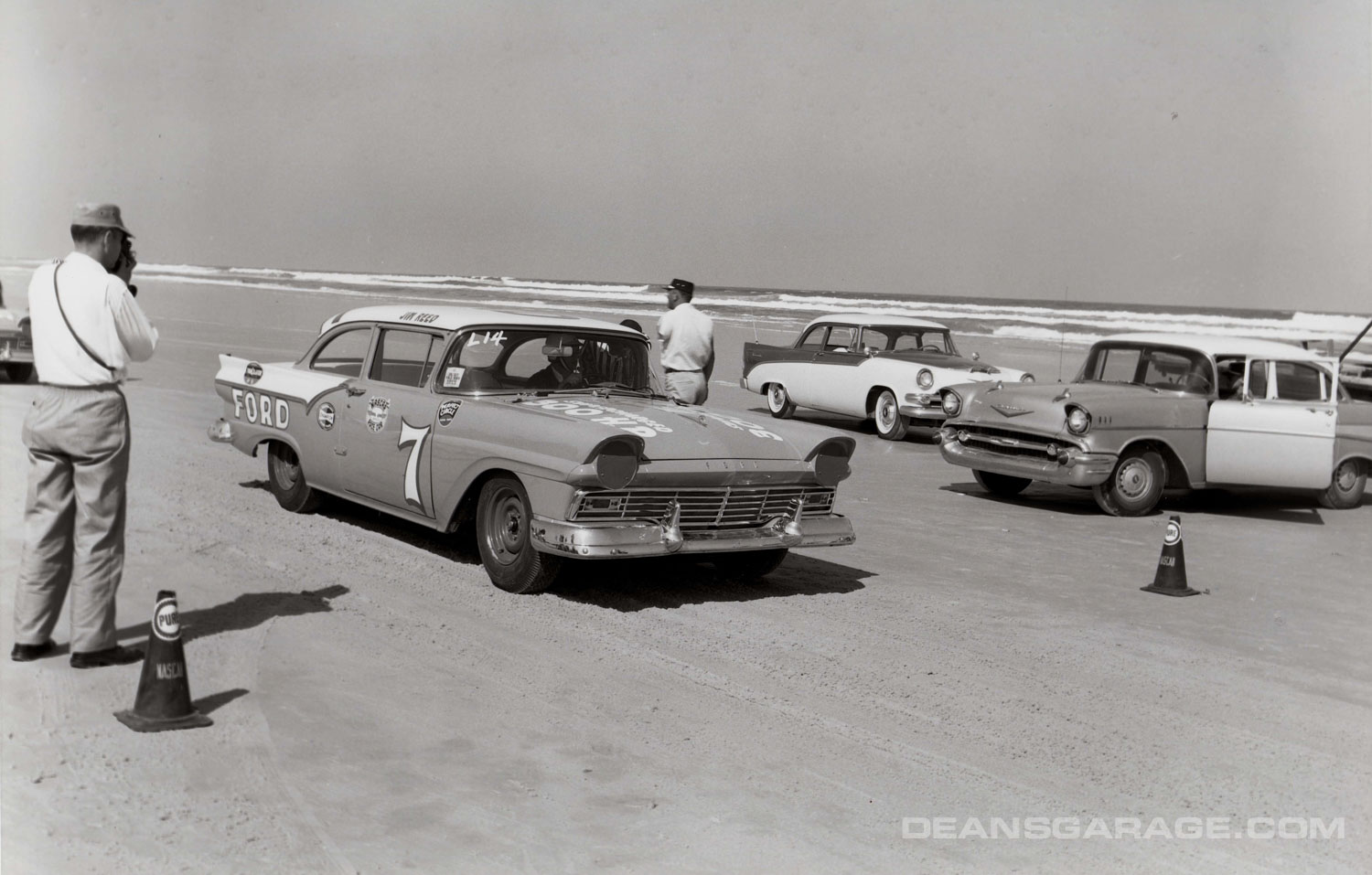
Jim Reed is about to launch his basically stock ’57 Custom two-door sedan. And, of course, another ’57 Chevy.
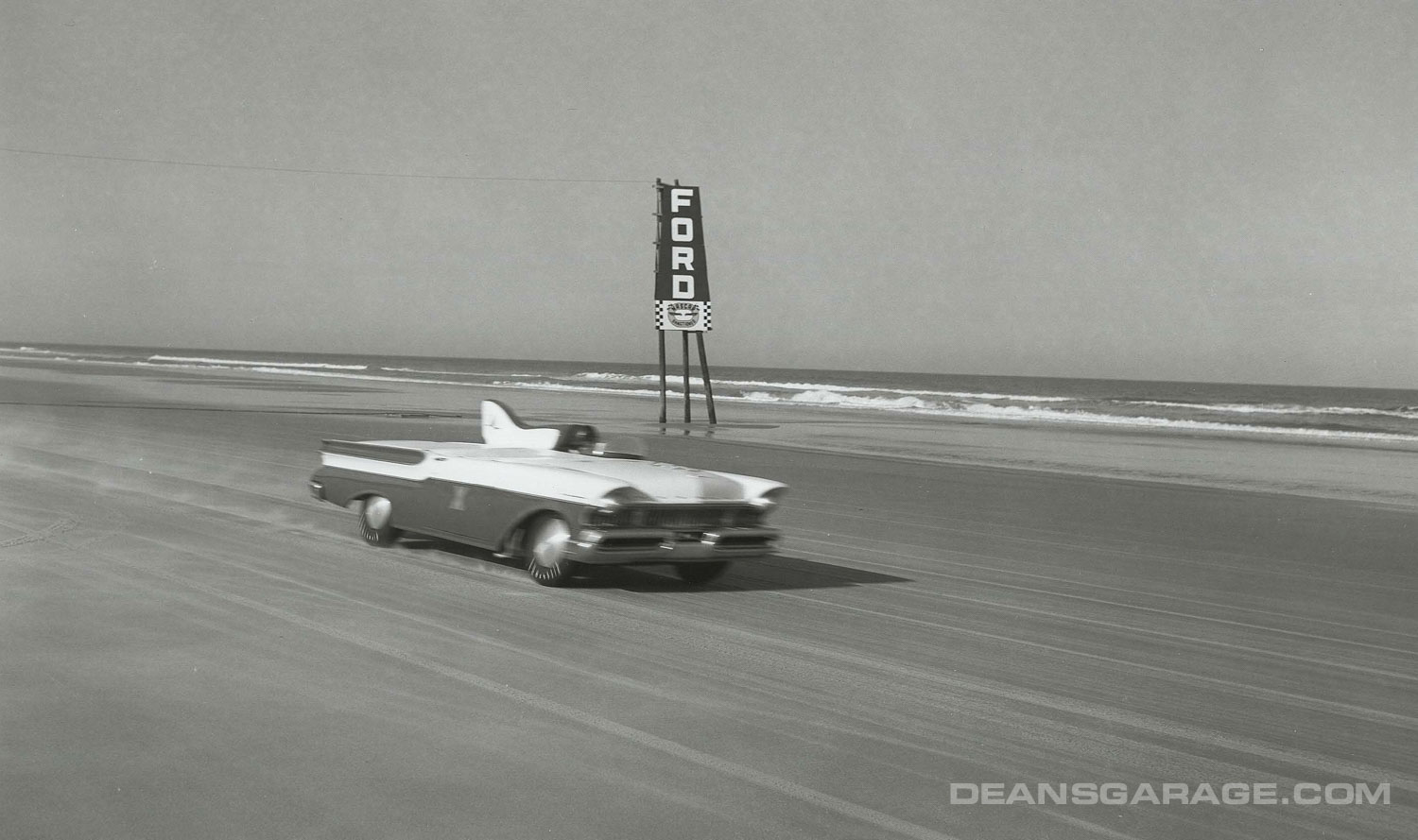
Bill Stroppe and the Chrisman Brothers (of belly tank, hot rod and dry lakes racing fame) took a ’57 Mercury Monterey convertible and stripped it of its windshield and top mechanism, fabricated an aluminum cover for the passenger compartment and added the fin behind the driver. This was all done in Stroppe’s Long Beach shop. With that “vertical stabilizer” they decided to name the car “Mermaid.”
Powered by a 1957 Lincoln 368 cu. in. V-8 which was bored out to 387 cu. in. Again, Hilborn constant-flow fuel injection was utilized as well as a Scintilla magneto. Hedman fabricated the headers and Harmon and Collins the roller cam. On the dyno it produced over 400 horsepower.
Art Chrisman, and experienced Bonneville and dry lakes driver, piloted the big Merc to a two-way average of 154.174 MPH, which gave him second place in the Experimental category. He was bested by Wally Parks’ 57 hemi-powered Plymouth Savoy hardtop. That Plymouth is on display at the NHRA museum in Pomona, California.
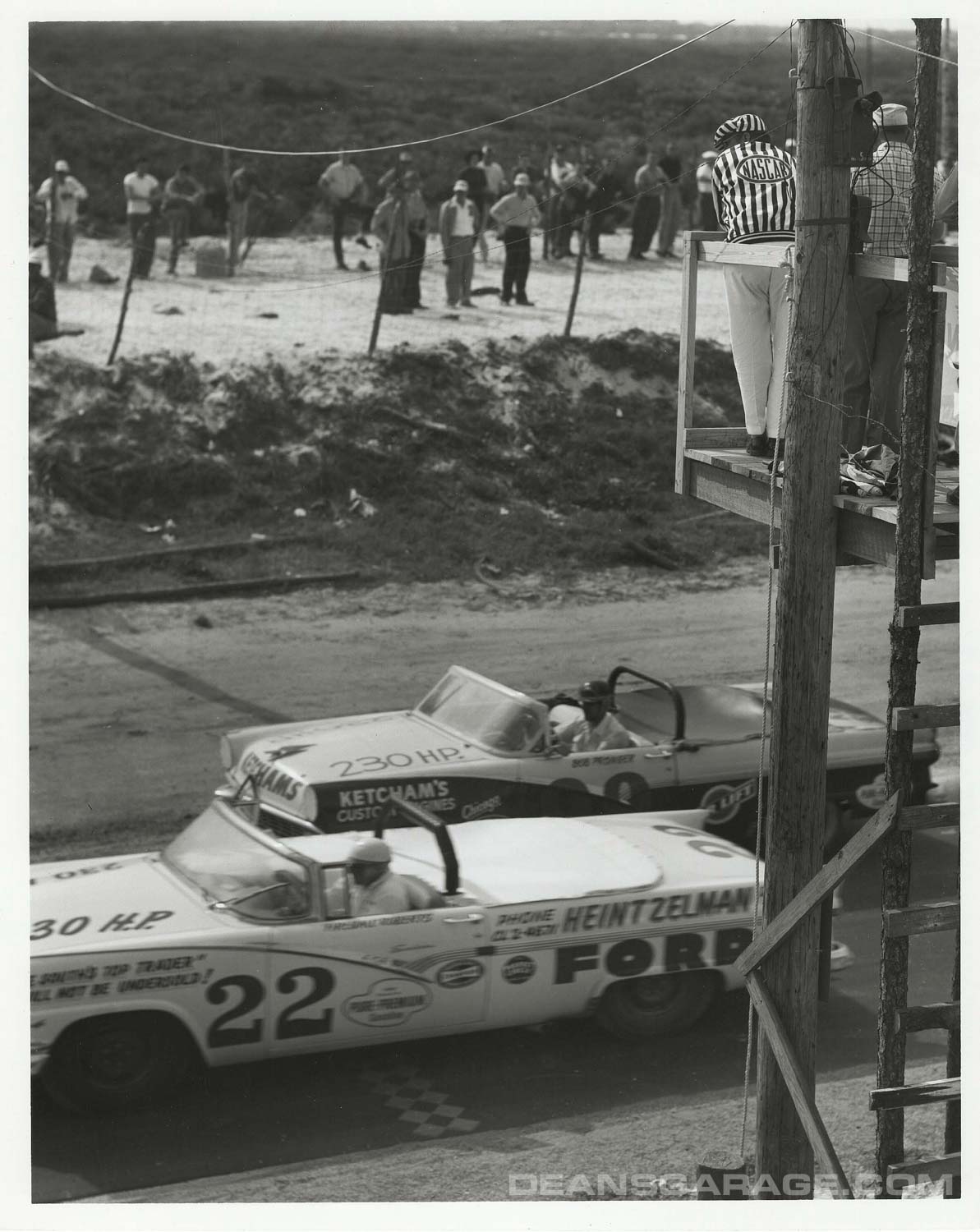
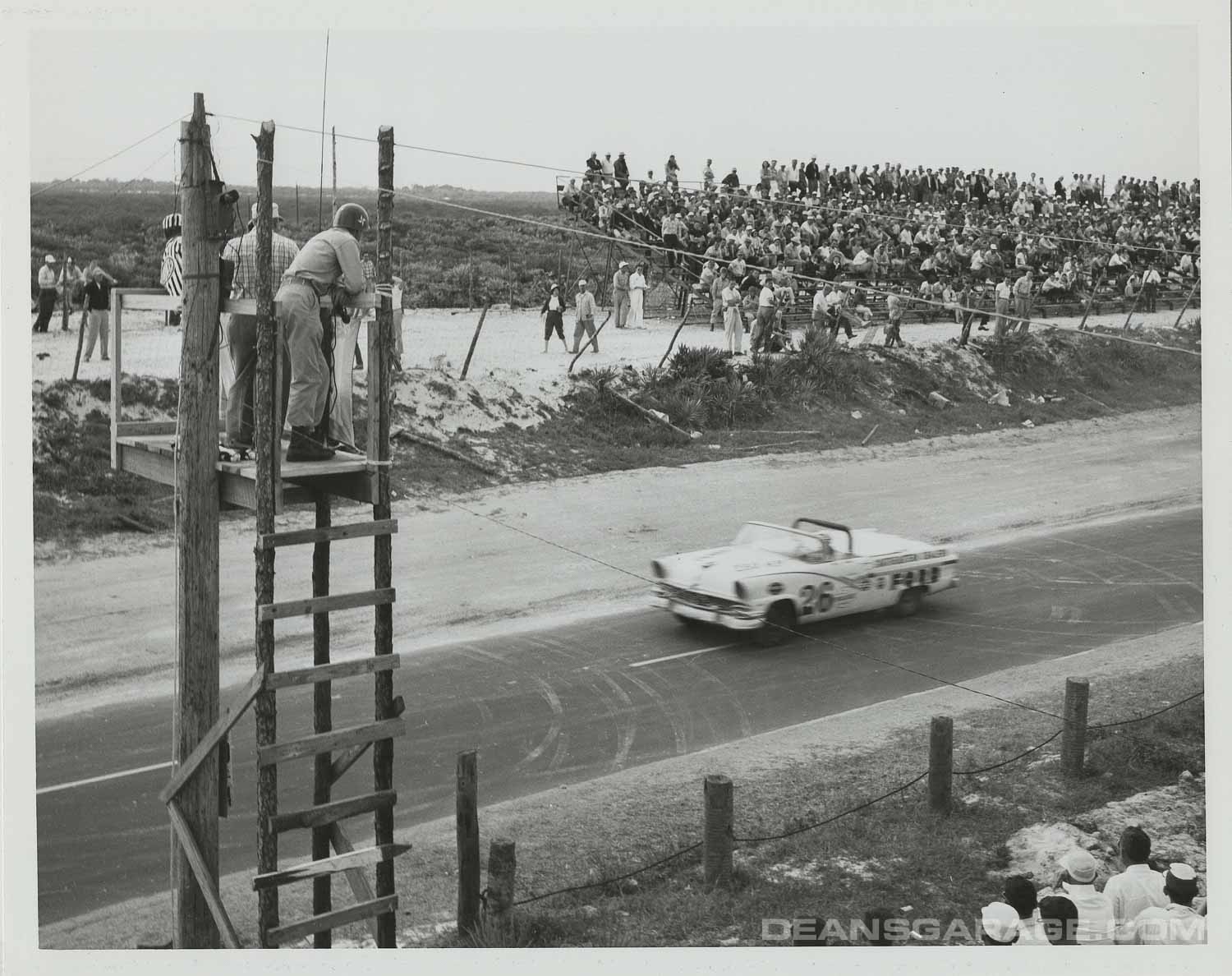
We’ll wrap this story up with a few photos from Convertible and Grand National races.
In the first shot Fireball Roberts leads Bob Pronger, both in ’56 Fairlane Sunliners. Fireball finished second in this February 25, 1956, race.
The next photo shows the winning Sunliner of Curtis Turner.
Note how remote A1A looks in these pictures. No houses or structures of any kind visible. No rest rooms either! Note also the total lack of protection for the crowd should a car lose control or be in a crash. Not much protection for the driver either. Very limited, small roll bar and no shoulder harnesses visible. How things have changed!!
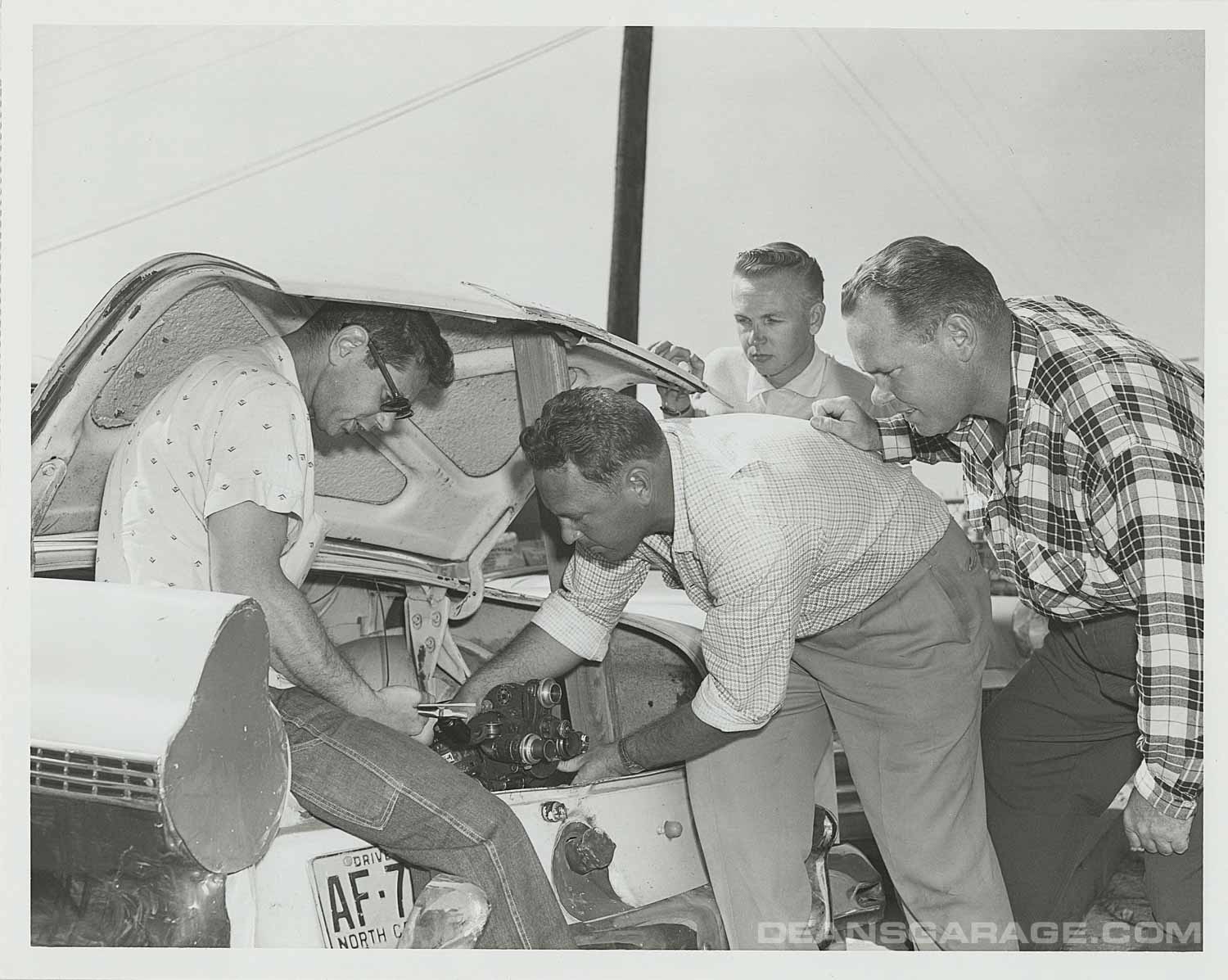
In today’s races there are in-the-car cameras everywhere. This may be one of the first attempts to capture racing action from the car’s perspective. This looks to be a 16mm motion picture camera. They also mounted one behind the right-side windshield in this ’56 Ford.
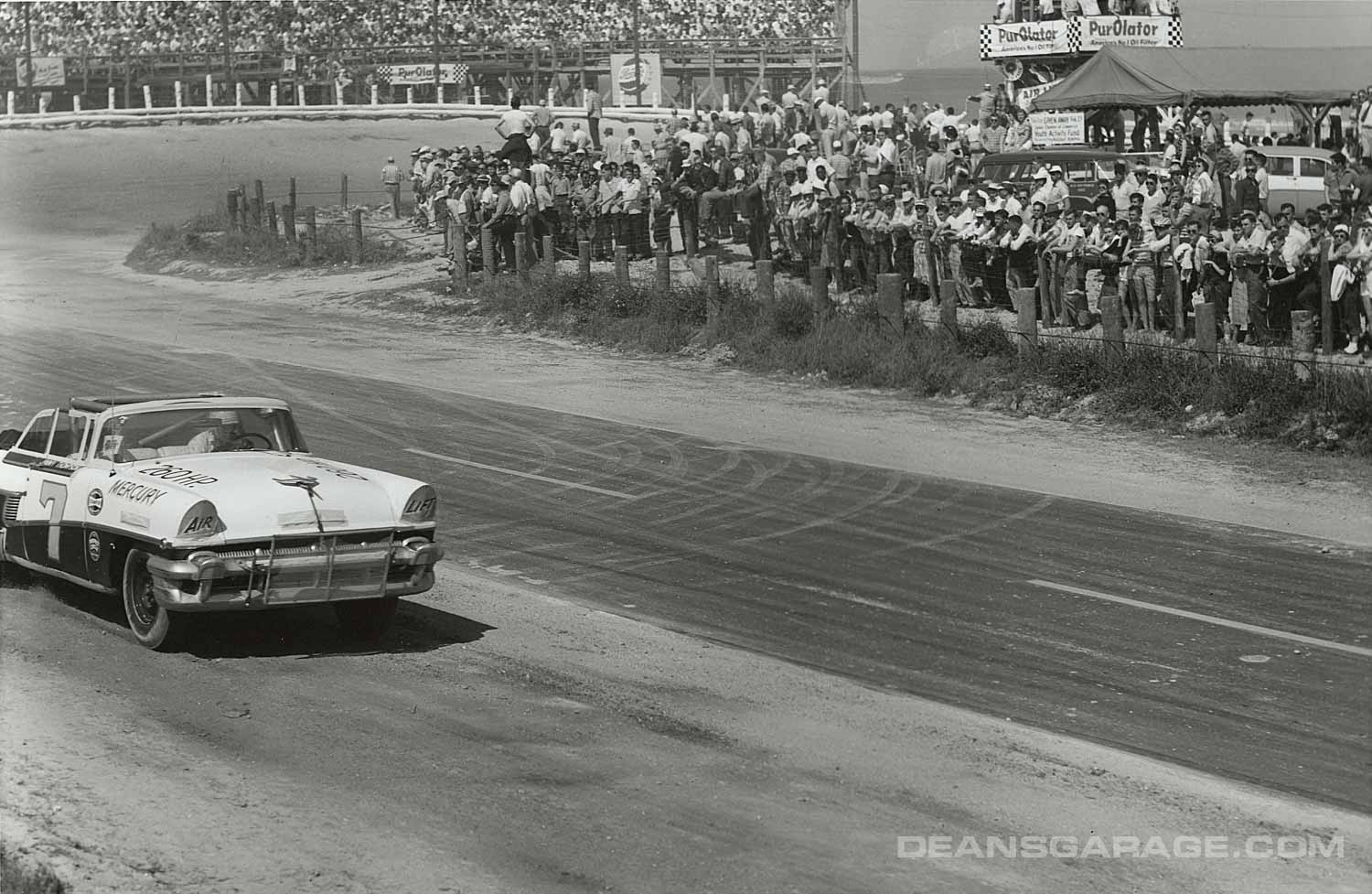
Jimmy Thompson’s ’56 Mercury exiting the north turn and heading south on A1A. One can see how tight the turn was at the north turn. And how little protection there was for the spectators. Standing room only, it appears!
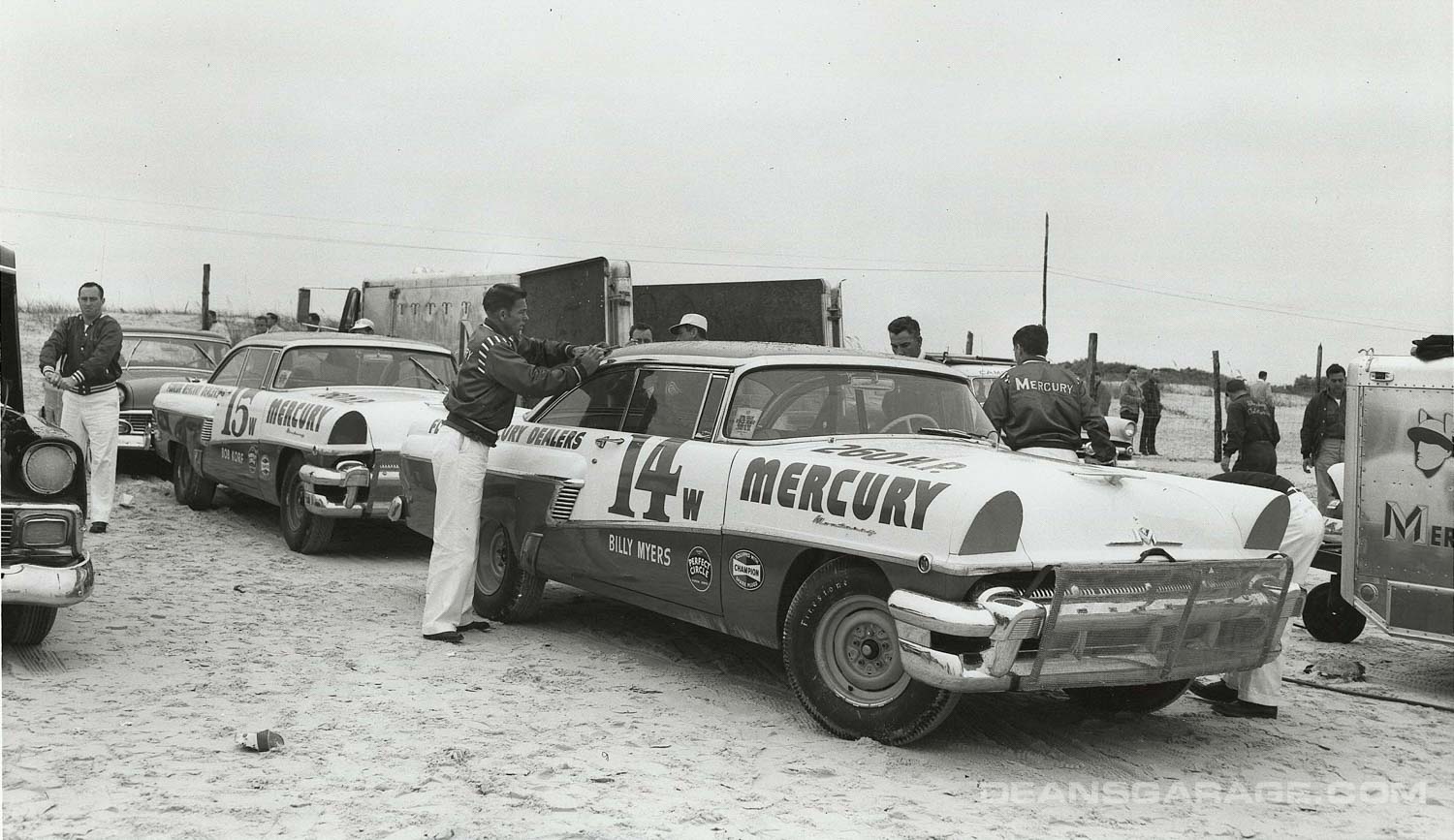
Stroppe-prepared Mercurys for the Grand National race. Billy Myers’ Mercury in front finished second in the 76-car field behind Tim Flock’s ’56 Chrysler 300B. Bob Korf in the second Mercury finished eighth. One windshield wiper with a washer to eliminate the salt spray and a bug net to protect the radiator.
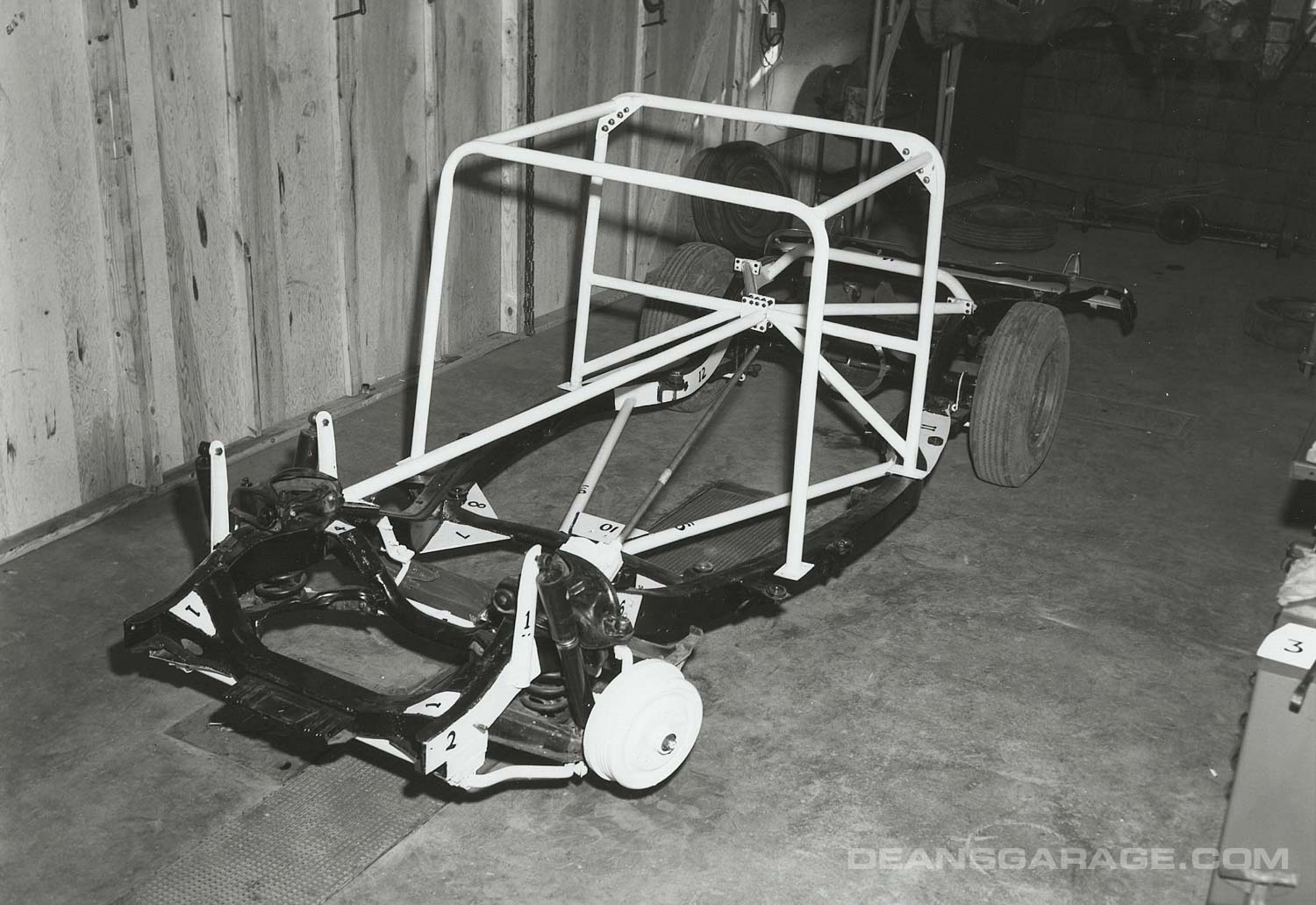
Here’s the frame of a ’57 Ford Custom 300. By today’s standards the roll cage is minimal, though a lot more than in the Convertible races. The numbered areas on the frame show where they stiffened up the frame with extra plates and gusseting. Note also that the front suspension has two very large shock absorbers on each wheel. So, the cars were no longer totally stock.
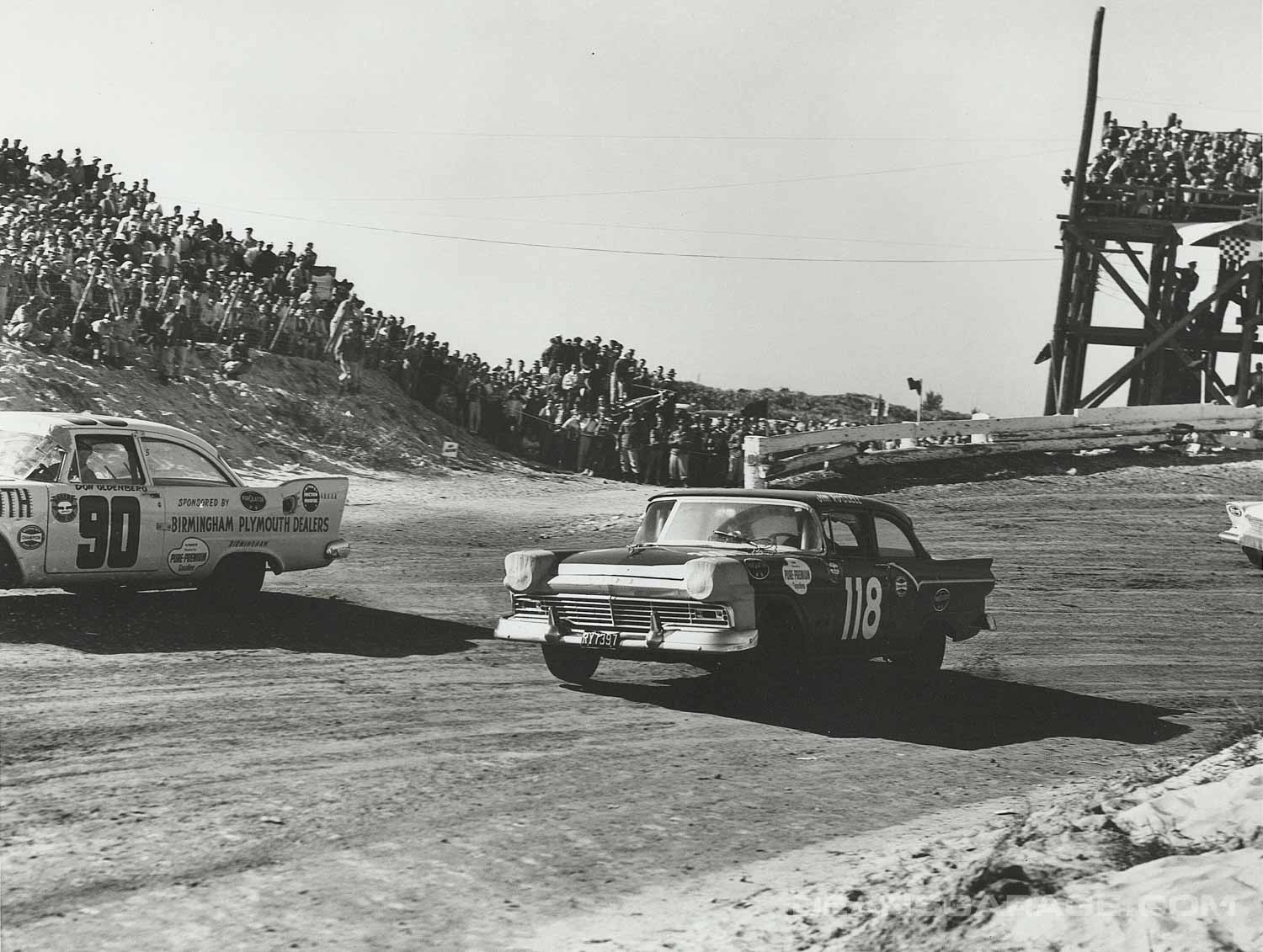
Tail end Charlie. Jim Russell in the number 118 Ford Custom finished second to last. Here he is on the inside coming out of the north turn and heading south on A1A.
Today A1A is mostly known as South Atlantic Boulevard. It’s a wide, four lane divided street with grass medians lined wall to wall by high rise condos. The grandstands are naturally gone. The two turns are barely discernible. In the late 1980s I went looking for evidence of the old Beach-Road Course in a Hertz Lincoln Town Car. Back then you could easily find the North Turn as the North Turn Bar was still standing and selling burgers and beer. I drove exactly two miles south and found the South Turn and took it. Back then you could still drive on the beach at Ponce Inlet. I made two full circuits of the old Beach-Road Course that day and got the Lincoln up to about 70mph on the beach imagining what it was like in the fifties. It was a pretty rough ride, and the Lincoln was heaving mightily in the wavy sand. But it was darn good fun! Sorry Hertz.
I got my drivers license in 1957. fun to look at the pictures.
Thanks for a fun look backward. Those old Speed Graphics produced very sharp images, but Graflex never made a 5×7 version, just 4×5 and smaller.
Frank, great comment. Thanks. So I must be mistaken on the type of camera used as all the older Ford black and white negs were 5×7. I pulled them myself. Makes me wonder what kind of camera was used? Any idea?
BTW most all the older color negs were a full 8×10. Pretty amazing.
Thanks,
Todd